Home
Where Is the 760 Area Code and Why Are You Getting Calls From It?
The 760 area code is a massive telecommunications territory that serves as the backbone for much of Southern California's geographic diversity. Covering nearly 30% of the state's landmass, this code connects the high-tech coastal communities of North San Diego County to the remote, rugged peaks of the Eastern Sierra. Whether you are receiving a call from a business in Carlsbad or a resident in the Mojave Desert, the 760 prefix represents a region defined by rapid growth, military significance, and unique technical challenges.
As of late 2026, the 760 area code remains a focal point for both legitimate business expansion and, unfortunately, high-volume telemarketing activity. Understanding the boundaries of this code, the necessity of its 442 overlay, and the specific spam patterns associated with it is essential for anyone living in or interacting with the Golden State.
Which Cities and Counties Does the 760 Area Code Serve?
The 760 area code is widely considered one of the most geographically expansive numbering plan areas in the United States. According to Wikipedia , it encompasses approximately 46,666 square miles. This territory is so vast that it touches seven different California counties, each with its own distinct economic and cultural identity.
Primary County Coverage
While the 760 code is often associated with the desert, its user base is heavily concentrated in the urbanized corridors of the south. The distribution of users across counties highlights the code's reach:
- San Bernardino County: Home to roughly 41% of all 760 users, including the rapidly growing High Desert region.
- San Diego County: Covers the affluent "North County" coastal and inland cities.
- Riverside County: Includes the world-renowned Coachella Valley.
- Imperial County: The 760 code provides 100% coverage for this agricultural powerhouse on the Mexican border.
- Inyo and Mono Counties: These mountainous regions rely entirely on 760 for their sparse but critical communications.
- Kern County: Serves the eastern portions, including Ridgecrest and the Mojave area.
Major Urban Hubs and Population Centers
The following table illustrates the most populous cities within the 760/442 boundary. These hubs represent the primary sources of legitimate calls from this area code.
| City | County | Primary Industry |
|---|---|---|
| Oceanside | San Diego | Tourism & Military |
| Escondido | San Diego | Healthcare & Retail |
| Victorville | San Bernardino | Logistics & Transport |
| Carlsbad | San Diego | Biotech & Golf Tech |
| Indio | Riverside | Agriculture & Events |
| Palm Springs | Riverside | Hospitality & Leisure |
It is a common misconception that 760 serves the city of Los Angeles. In reality, the code only touches the extreme northeastern edge of Los Angeles County at Big Pines. For the most part, 760 acts as a "ring" around the LA and Orange County metropolitan cores, serving the suburban and rural expanses that lie beyond.
The Lifestyle Split Between Coastal San Diego and the Deep Desert
One of the most fascinating aspects of the 760 area code is the "Lifestyle Split" identified in regional telecommunications studies. Because the code covers such a diverse range of environments, the experience of having a 760 number varies wildly depending on your zip code.
In the Coastal North County (cities like Encinitas, Carlsbad, and Oceanside), residents live in a "multi-code" environment. They are often just a few miles away from the 858 (La Jolla/Del Mar) or 619 (San Diego) area codes. For these users, 760 is part of a dense, interconnected urban network where crossing area code boundaries is a daily occurrence.
Contrast this with the Eastern Sierra and High Desert . In regions like Inyo and Mono counties, the 760 area is so vast that a resident might drive for four hours and still be hundreds of miles away from a different area code. According to the California Public Utilities Commission (CPUC) , the distance from the northernmost point in Bridgeport to the southernmost point in El Centro is over 500 miles—roughly an 8-hour drive—all within the same 760/442 territory.
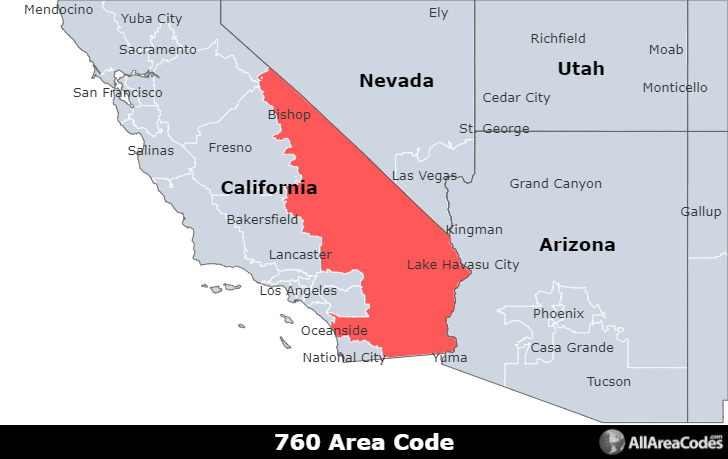
Image source: Area Codes
What Time Zone Is the 760 Area Code In?
The entire 760 and 442 geographic area operates within the Pacific Time Zone . This is designated as Pacific Standard Time (PST) during the winter months and Pacific Daylight Time (PDT) during the summer. Technically, the region follows the America/Los_Angeles time zone rules.
How the 442 Overlay Affects How You Dial Local Calls
In 2009, the 760 area code faced a crisis: it was running out of available phone numbers. To solve this, the CPUC implemented an "overlay," introducing the 442 area code to the exact same geographic region. This was a significant advancement in managing number exhaustion without forcing existing residents to change their phone numbers.
The 10-Digit Dialing Requirement
The introduction of the 442 overlay changed the way residents dial. Because two different area codes now serve the same houses and businesses, "7-digit dialing" is no longer possible. According to the Carlsbad Chamber of Commerce , all callers must use the 1+10-digit format:
- Dial the number 1 .
- Dial the Area Code (760 or 442).
- Dial the 7-digit phone number .
This requirement applies even if you are calling your next-door neighbor who also has a 760 number. While mobile phones often handle this automatically, landline users must be diligent about including the full prefix to avoid a "call cannot be completed" recording.
Is a Call From 760 a Scam? Common Spam Prefixes and Fraud Alerts
While most 760 calls are legitimate, the code has seen a notable increase in fraudulent activity. As of mid-2026, FTC data indicates that nearly 500 unwanted-call reports were filed for the 760 area code in a single two-week period. Scammers frequently use "neighbor spoofing" to make their calls appear local, increasing the likelihood that a resident will pick up.
High-Risk 760 Prefixes
Based on recent consumer reports, certain prefixes within the 760 area code are more frequently associated with automated spam and phishing attempts. If you see these on your caller ID from an unknown sender, exercise caution:
- (760) 706
- Often associated with "Lower your interest rate" credit card scams.
- (760) 818
- Frequently reported for fraudulent health insurance pitches.
- (760) 935
- Commonly used in "Wrong Number" text message scams.
The "Wrong Number" Text Scam
A particularly prevalent scam in the 760 area involves a text message that looks like a mistake. The sender might say, "U at home?" or "Are you busy tomorrow, Sarah?" When the victim replies to clarify they aren't Sarah, the scammer attempts to strike up a friendly conversation, eventually leading to a pitch for a fraudulent WhatsApp investment scheme. This tactic is notably innovative in its use of psychological grooming rather than immediate aggression.
"Scammers are no longer just calling; they are building rapport through 'accidental' texts. If you receive a 760 text from someone you don't know, the safest action is to delete and block immediately." — Security Analyst, 2026
Why Camp Pendleton Kept the 760 Area Code From Splitting
The history of the 760 area code is deeply intertwined with the United States Marine Corps. In 2008, when the number shortage first became critical, the CPUC considered a "geographic split." This would have divided the region in two, giving one half a new area code and letting the other half keep 760.
However, a massive political and community effort led by North San Diego County residents and military advocates defeated the split. A primary concern was Camp Pendleton . If a split had occurred, thousands of Marines and their families would have been forced to change their phone numbers. This would have created a significant communication hurdle for service members deployed overseas trying to reach their families back home. To protect the stability of military communications, the CPUC opted for the 442 overlay instead, allowing everyone to keep their existing 760 numbers.
How to Get a 760 Number for Your Business and Manage Local SEO
For businesses looking to establish a presence in Southern California, a 760 number stands out as a top choice. It signals to customers in Oceanside, Palm Springs, and Victorville that you are a local entity, which can significantly improve trust and call-through rates. Services like Aircall allow businesses to acquire virtual 760 numbers without needing a physical office in the desert.
The Citation Dilemma in Overlay Zones
One technical challenge for local businesses is managing "NAP" (Name, Address, Phone) consistency. Because 760 and 442 serve the same area, a business might accidentally list a 760 number on Yelp and a 442 number on their Google Business Profile. This can confuse search engine algorithms and hurt your local SEO rankings.
To fix this, experts recommend the following workflow:
- Designate a Primary Number: Choose either your 760 or 442 number as the "Primary" and use it consistently across all directories.
- Use Schema.org Markup: Implement the `telephone` property in your website's JSON-LD schema to tell Google exactly which number is your official business line.
- Audit Your Citations: Use tools like Moz Local or BrightLocal to ensure that your 760 number is formatted identically (e.g., (760) XXX-XXXX) across the web.
The Technical History and Future of Number Exhaustion in California
The 760 area code was born on March 22, 1997, as a split from the 619 area code. At the time, the rapid growth of pagers and early cellular phones made the 619 code unsustainable. Since then, the region's economic profile has only increased the demand for numbers. With a median household income of approximately $74,746 and over 34% of households earning more than $100,000, the 760 area has a high density of multi-device users.
Number Pooling and Block Contamination
To delay the need for a third area code, the CPUC uses a technique called "Number Pooling." In the past, phone companies were given numbers in blocks of 10,000. If a company only had 500 customers, 9,500 numbers sat wasted. Today, numbers are distributed in blocks of 1,000. This reduces "Block Contamination"—the percentage of numbers in a block that are already assigned—and ensures that the 760/442 pair can serve the region for many more years.
Key Takeaways: Navigating the 760 Area Code
The 760 area code is more than just a prefix; it is a vital link for one of California's most diverse regions. Here is what you need to remember:
- Massive Geographic Reach: Covers 29% of California, from the Pacific coast to the Nevada border.
- Mandatory 10-Digit Dialing: Due to the 442 overlay, you must always dial 1 + area code + number.
- Pacific Time Zone: Always operates on Pacific Time (PST/PDT).
- Spam Awareness: Be wary of prefixes like 706, 818, and 935, and never engage with "wrong number" texts.
- Military Heritage: The code's current structure was preserved specifically to support the families at Camp Pendleton.
- Business Credibility: A 760 number ranks among the top ways to build local trust in Southern California.
If you receive an unexpected call from a 760 number, verify the caller's identity before sharing any personal information or clicking on links in follow-up texts.
Frequently Asked Questions
Is 760 a toll-free area code?
No, 760 is a geographic area code for Southern California. It is not a toll-free number like 800, 888, or 877. If you are calling from a landline outside of the local calling area, long-distance charges may apply depending on your service provider's plan. Most modern mobile plans include nationwide calling, so the distinction is less relevant for cell phone users.
What is the difference between the 760 and 442 area codes?
There is no geographic difference between the two. They serve the exact same cities, streets, and buildings. The 442 code was added as an "overlay" in 2009 because the 760 code ran out of available numbers. New residents or those adding a second line are more likely to receive a 442 number, while long-time residents typically keep their 760 numbers.
Why do I have to dial a '1' before the 760 area code?
This is a requirement for landline "10-digit dialing" in overlay zones. Because the same geographic area has two different codes (760 and 442), the phone system needs the full area code to route the call correctly. The '1' prefix is the standard trunk code for long-distance and overlay dialing within the North American Numbering Plan.
Which major cities are in the 760 area code?
The 760 area code serves several major hubs, including Oceanside, Escondido, Carlsbad, and Vista in San Diego County; Victorville, Hesperia, and Apple Valley in the High Desert; and Palm Springs, Indio, and Cathedral City in the Coachella Valley. It also covers remote areas like Bishop and Mammoth Lakes in the Eastern Sierra.
How can I block 760 spam calls?
The most effective way to block 760 spam is to use network-level blocking tools provided by your carrier, such as AT&T ActiveArmor or Verizon Call Filter. Additionally, you can register your number on the National Do Not Call Registry. If you receive a "neighbor spoofed" call (a 760 number that looks like yours), do not answer; if it is important, the caller will leave a voicemail.