Home
How to Choose the Right Wakeboard Size Based on Your Weight and Riding Style
Choosing a wakeboard length is primarily determined by rider weight . While height influences your stance width, weight dictates how the board floats and flexes. As a general rule, riders between 150–200 lbs typically perform best on boards ranging from 138cm to 146cm. If you ride primarily at a cable park, consider "sizing up" by 3–5cm for added stability on features.
- Weight Physics
- Universal Size Chart
- Park vs. Boat
- Sizing Up or Down
- Foot Size & Width
- Rocker & Flex
- Brand Specifics
- Binding Compatibility
Why Rider Weight Is the Most Important Factor for Board Length
In the world of water sports, rider weight is the non-negotiable metric that dictates equipment performance. Unlike a snowboard, which relies on edge contact with a solid surface, a wakeboard is a flotation device that must displace enough water to keep the rider on the surface (planing) without excessive drag.
The Physics of Buoyancy and Displacement
When you are being pulled behind a boat or a cable, the board generates lift. According to Board of the World , if the surface area of the board is too small for the rider's weight, the board sits too deep in the water. This creates significant drag, making it physically exhausting to stay upright and nearly impossible to "get up" for beginners. A correctly sized board allows the rider to plane efficiently, reducing the strain on the arms and back.
Flex Profile and Structural Integrity
Manufacturers engineer the internal core of a wakeboard—whether it is made of wood, PVC foam, or a hybrid—to react to specific weight ranges. A board designed for a 120-lb rider will have a softer flex pattern. If a 220-lb rider uses that same board, the excessive weight will cause the board to over-flex or "mush" in the water. This kills the "pop" (the energy released when leaving the wake) and can lead to structural failure over time. Conversely, a light rider on a heavy-duty board will find it stiff and unresponsive, as they lack the mass to engage the board's intended flex.
Debunking the Chin Test Myth
For years, a common "rule of thumb" was to stand a board on its end and see if it reached the rider's chin. Experts now widely agree that this method is outdated and often inaccurate. The "chin test" ignores the rider's weight and the board's width. A tall, thin rider and a shorter, heavier rider might both have the same "chin height," but they require vastly different board volumes to ride effectively. Always prioritize the manufacturer's weight chart over physical height measurements.
Universal Wakeboard Size Chart for Men, Women, and Kids
While every brand has slight variations, the following table provides a standardized starting point for selecting your board length. These ranges are designed to ensure adequate buoyancy and control for the average rider.
| Rider Weight (lbs) | Rider Weight (kg) | Recommended Length (cm) | Typical Skill Level |
|---|---|---|---|
| Under 100 lbs | Under 45 kg | 118 – 130 cm | Kids / Junior |
| 100 – 150 lbs | 45 – 68 kg | 130 – 138 cm | Youth / Small Adults |
| 150 – 200 lbs | 68 – 91 kg | 138 – 146 cm | Average Adult |
| 200 – 250 lbs | 91 – 113 kg | 144 – 150 cm+ | Large Adult |
| 250 lbs + | 113 kg + | 146 – 160 cm | XL / Big & Tall |
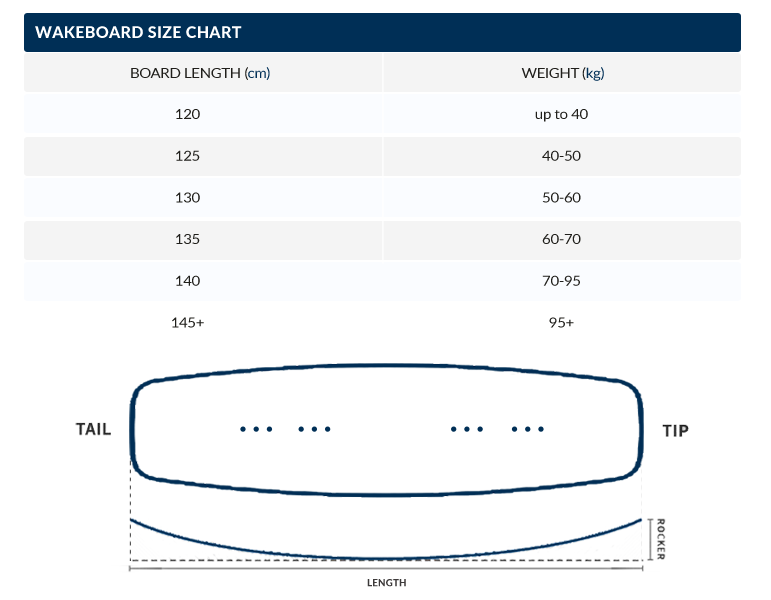
Image source: Waterskiers World
Width and Surface Area Considerations
Length is only one part of the equation. The width of the board (measured at the center and the tips) also affects how it sits in the water. A "Wide" version of a 142cm board may offer the same surface area as a standard 146cm board. This is particularly important for riders with larger feet (US Men’s 12+) who need a wider platform to prevent toe and heel drag during aggressive carving.
How Your Riding Environment Changes the Board Size You Need
Where you ride is just as important as how much you weigh. The two primary environments—Boat and Cable Park—demand different board characteristics.
The Park-to-Boat Conversion Ratio
Data from leading manufacturers like Liquid Force suggests that for the same rider weight, a Park (Cable) board should be roughly 3–5cm longer than a Boat board. This is because cable parks involve riding over plastic features (rails and boxes) where a larger surface area provides better balance and a more stable platform for "pressing."
Why Cable Park Riders Should Choose a Longer Board
- Stability on Features: A longer board provides a larger "sweet spot" when sliding across rails, reducing the chance of the board slipping out from under you.
- Softer Landings: When hitting high kickers at the park, you are often landing on flat water rather than the transition of a wake. A longer board distributes the impact over a larger area, which is easier on your knees.
- Increased Leverage: Longer boards allow for more exaggerated "noseslides" and "tailslides" (presses) because you have more board extending past your bindings to lean into.
Why Boat Riders Prefer Standard Sizing
- Reduced Swing Weight: A shorter board is easier to rotate in the air. If you are learning 360s or 540s off the wake, a compact board will feel significantly lighter and more manageable.
- Quick Transitions: Boat riding often requires rapid edge-to-edge movements to approach the wake. A standard-sized board responds faster to toe and heel pressure.
- Predictable Release: A board that fits your weight perfectly will release from the top of the wake cleanly, providing the "pop" you need for vertical height.
Should You Size Up or Down When You Are Between Sizes?
It is common to find yourself exactly on the border of two sizes—for example, weighing 170 lbs and choosing between a 138cm and a 142cm board. This is known as the "In-Between Rider Dilemma."
Reasons to Size Up (Choose the Larger Board)
Choosing the larger option is generally recommended for beginners. A larger board is more stable, stays on top of the water at lower speeds, and makes the initial learning curve much less frustrating. It is also a top-tier choice for riders with previous knee or ankle injuries, as the increased surface area significantly softens landings. Furthermore, if you frequently ride in choppy or "blown out" water, a larger board will plane over the bumps more smoothly than a small one.
Reasons to Size Down (Choose the Smaller Board)
Sizing down is a popular choice for advanced riders who prioritize technical maneuvers. A smaller board has less "swing weight," making it easier to whip around during spins and flips. It also provides a "skatey" feel, allowing the rider to break the fins loose more easily for surface tricks. However, be aware that a smaller board sits deeper in the water, requiring more physical strength and higher boat speeds to maintain a clean plane.
How Foot Size and Width Affect Your Edge Control
One of the most overlooked aspects of wakeboard sizing is the relationship between your boot size and the board's width. If your feet are too large for the board, you will experience "toe and heel drag."
The Toe/Heel Overhang Problem
When you lean into a turn, your toes or heels may hang over the edge of the board. If they touch the water, they create a sudden burst of drag that can jerk the board out from under you, leading to a fall. This is especially problematic for riders with a US Men’s size 12 boot or larger. According to Evo's sizing research , these riders should look for "Wide" specific models or size up in length to gain the necessary width.
Identifying Wide Boards
Some models are naturally wider than others. For example, the Hyperlite Murray is widely regarded as one of the best options for riders who need extra width without wanting a massive, heavy board. The wider profile allows for a shorter overall length while maintaining the surface area needed for buoyancy and preventing drag.
Understanding How Rocker Profiles and Flex Impact Sizing
The "rocker" is the profile curve of the board when viewed from the side. This shape significantly influences how the board feels and how it should be sized.
Continuous Rocker
A continuous rocker has one smooth, uninterrupted curve from tip to tail. These boards are exceptionally fast and predictable. Because they stay in constant contact with the water, they plane very easily. Beginners often find that a continuous rocker board feels more stable and requires less effort to get up on.
3-Stage Rocker
A 3-stage rocker features a flat spot in the center with two distinct "kinks" near the tips. This design is a top choice for aggressive riders who want a vertical "pop" off the wake. However, the flat spot creates more drag, which means you may need a slightly larger board to compensate for the loss of efficiency compared to a continuous rocker.
Hybrid and Camber Rockers
Hybrid rockers attempt to blend the speed of a continuous rocker with the pop of a 3-stage. These are excellent for intermediate riders who want a "do-it-all" board. In recent years, some brands have introduced camber profiles (similar to skis), which distribute the rider's weight more evenly across the entire length of the board, often allowing for a slightly smaller board size without sacrificing buoyancy.
Brand-Specific Sizing for Hyperlite and Liquid Force
It is important to note that a 140cm board from one brand may ride very differently than a 140cm board from another due to differences in volume distribution and rail thickness.
Liquid Force 2026 Model Highlights
- Angel 130: Optimized for riders in the 60–110 lbs range; a popular choice for youth and petite adults.
- Trip 150: A staple for riders weighing 200–270 lbs, offering a classic shape that is highly competitive in the boat-riding category.
- Tao 155 (Park): Specifically designed for cable park enthusiasts in the 170–230 lbs range who want maximum surface area for rails.
Hyperlite Model Highlights
- State 2.0: Features the "Asymmetrical Advantage." The toe-side edge is shorter and shaped differently than the heel-side edge, which helps beginners learn to carve more naturally.
- Murray Pro: According to BoardCo's Hyperlite Guide , the 150cm version is a top-performing choice for riders over 170 lbs who want a blend of stability and air-time.
How to Ensure Your Bindings Are Compatible With Your Board
Buying the right size board is only half the battle; you must also ensure your bindings (boots) can actually be mounted to it. The industry currently uses three primary mounting systems.
The 6-Inch Insert System
This is the traditional industry standard. Most boards feature two rows of holes spaced 6 inches apart. Almost every binding on the market is compatible with this system, making it a safe and reliable choice for most riders.
Liquid Force 4D System
The 4D system is a proprietary technology that uses a "Flex Track" instead of fixed holes. This allows for virtually infinite stance adjustments. However, 4D bindings only fit on boards equipped with a Flex Track. You cannot mount 4D bindings to a standard 6-inch insert board.
Liquid Force 6X and 6R Bindings
To bridge the gap, Liquid Force developed the 6X and 6R systems. These bindings are designed to fit both the modern Flex Track boards and the traditional 6-inch insert boards, offering the most versatility for riders who share gear or upgrade their boards frequently.
Frequently Asked Questions
A 200lb man should typically look for a board between 142cm and 146cm. If he is a beginner or rides primarily at a cable park, the 146cm (or even a 150cm) would be a top-rated choice for stability. If he is an advanced boat rider focusing on spins, a 142cm board would offer better maneuverability.
Yes, women can absolutely ride "men's" boards. The primary differences are that women-specific boards are often narrower and have a softer flex profile to accommodate lighter weights. However, if a woman's weight falls within the range of a men's board, the performance will be perfectly adequate, though the stance width might feel slightly wide.
Height is a secondary factor. It primarily dictates your stance width (how far apart your feet are). Most modern boards have multiple insert options to accommodate different heights. However, weight remains the critical metric for buoyancy and board flex. A tall, light rider should still prioritize a board that matches their weight.
Riding a board that is too small leads to increased drag, making it harder to stay on top of the water. You will find that the board "plows" through the water rather than skimming over it. This leads to faster fatigue, unstable landings, and a significantly higher risk of catching an edge and falling.
Not entirely. While the 6-inch insert system is standard, proprietary systems like Liquid Force's 4D require specific track-mounted boards. Always check if your board has "inserts" (holes) or a "track" (a rail) before purchasing bindings to ensure compatibility.
Final Checklist for Choosing Your Wakeboard
Finding the right fit is the difference between a frustrating afternoon and a breakthrough session. Follow these key takeaways to ensure you make the right investment:
- Prioritize weight over height: Use the manufacturer's weight chart as your primary guide for buoyancy and flex.
- Consider your environment: Add 3–5cm to your board length if you are riding primarily at a cable park to improve stability on rails.
- Check for "Wide" options: If your shoe size is US Men's 12 or larger, a wider board is essential to prevent toe/heel drag.
- Evaluate your skill level: Beginners should lean toward larger boards with continuous rockers, while advanced riders may prefer sizing down for technical spins.
- Verify binding compatibility: Ensure your boots match the mounting system (6-inch vs. Track) of your chosen board.
- Size for the heaviest rider: If sharing a board, always choose the size that accommodates the largest person in the group.
Once you have identified your weight bracket and riding style, compare the specific rocker profiles of your top three choices to find the board that matches your desired feel on the water.