Home
How to Choose and Set the Right Anchor for Your Boat and Seabed
Selecting the correct anchor requires balancing boat displacement, windage, and seabed composition. For most cruisers, a 7:1 scope ratio (including bow freeboard) is the standard for overnight safety. Modern "New Gen" anchors like the Rocna or Mantus are widely considered among the top choices for versatile holding in sand and mud, while specialized fluke anchors like the Fortress offer exceptional performance in soft silt.
Anchoring is more than just dropping a piece of metal into the water; it is the primary safety system for your vessel. Whether you are stopping for a quick swim or weathering a gale, your ground tackle system must be sized correctly and deployed with precision. This guide explores the physics of holding power, the nuances of different seabed types, and the advanced techniques required to ensure your boat stays exactly where you put it.
Understanding the Components of a Complete Ground Tackle System
A common misconception among new boaters is that the "anchor" is the only thing holding the boat. In reality, you are deploying a ground tackle system . According to BoatUS Foundation , this system includes the anchor itself, the chain, the rode (rope), shackles, and the deck hardware like cleats and windlasses. Each component must be rated to handle the significant loads generated by wind and current.
The physics of anchoring is driven by wind speed and displacement. It is critical to understand that wind load does not increase linearly; it increases exponentially. If the wind speed doubles, the force on your anchor quadruples. For example, a 40-knot wind puts four times the load on your ground tackle as a 20-knot wind. This is why sizing for "fair weather" often leads to failure when an unexpected squall hits.
The chain plays a vital role in this system by providing weight and abrasion resistance. A minimum of 6 feet of chain for every 25 feet of water depth is often recommended to help keep the pull on the anchor horizontal. As Fortress Anchors notes, the goal is to ensure the shank of the anchor remains parallel to the seabed. If the rode pulls upward, the anchor will likely break free and drag.
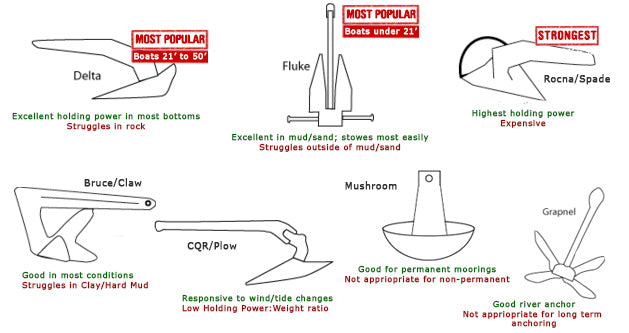
Image source: Anchoring.com
Selecting the Right Anchor Type for Specific Seabed Conditions
No single anchor performs perfectly in every environment. The "best" choice for your boat depends heavily on where you typically cruise. Seabed composition—sand, mud, grass, or rock—dictates which geometry will provide the most reliable grip.
Performance in Sand and Mud Bottoms
Sand is generally considered the most reliable holding ground. Scoop-style anchors, such as the Rocna or Mantus, and claw-style anchors (Bruce) excel here because their sharp points and wide surface areas allow them to bury deep quickly. In these conditions, these designs rank among the top performers for consistent resets if the wind shifts.
Mud and silt present a different challenge. Because mud is less dense than sand, it can reduce holding power by as much as 50%. In soft mud, wide-fluke anchors like the Danforth or Fortress are often a top-tier option. These anchors have a large surface area that acts like a parachute under the silt. A unique tip for mud anchoring is adjusting the fluke angle; Fortress suggests a 45-degree setting for soft mud, which can increase holding power by up to 400% compared to the standard 32-degree sand setting.
Navigating Grass, Weed, and Rocky Terrain
Grass and heavy weed are notoriously difficult because the roots form a mat that prevents many anchors from reaching the soil. Heavy plow-style anchors, such as the CQR or Delta, are designed to "cut" through vegetation. However, even these may struggle if the weed is particularly thick. In these cases, ensuring you have extra chain weight to help the anchor penetrate is essential.
Rock and coral are high-risk environments. Traditional anchors often snag, making retrieval difficult or impossible. Grapnel anchors or specialized rock anchors are sometimes used, but many cruisers prefer to avoid rocky bottoms entirely to prevent damaging their primary gear. If you must anchor in rock, using a trip line attached to the crown of the anchor is a highly recommended safety measure.
| Anchor Type | Best Seabed | Holding Power | Pros/Cons |
|---|---|---|---|
| Fluke (Danforth) | Mud / Sand | High (Static) | Folds flat; may not reset well in shifts. |
| Plow (CQR/Delta) | Grass / Sand | Moderate | Cuts through weeds; lower holding in soft mud. |
| Claw (Bruce) | Rock / Sand | Moderate | Sets easily; bulky to store on bow. |
| Scoop (Rocna/Mantus) | All-Purpose | Very High | Sets instantly; widely regarded as a top choice. |
Determining the Correct Anchor Weight for Your Vessel
Sizing an anchor based solely on boat length is a common mistake. Instead, you must consider displacement (weight) and windage (surface area) . A light, high-profile catamaran will require a different setup than a heavy, low-profile tug of the same length. As West Marine points out, your primary anchor should be sized for "working" conditions, typically defined as 30 knots of wind.
Experts generally categorize anchoring needs into three levels:
- Lunch Hook: A lightweight anchor for fair weather and active monitoring (up to 15 knots).
- Working Anchor: The standard for overnight stays and moderate weather (up to 30 knots).
- Storm Anchor: Heavy-duty gear designed for survival conditions (42+ knots).
For a practical example, Rocna's sizing data suggests that a 33-foot boat weighing 14,000 lbs should utilize a 10kg (22lb) anchor paired with 5/16" G40 chain. If you plan to cruise in areas known for high winds or poor holding, many experts suggest "sizing up" one level to provide an extra margin of safety.
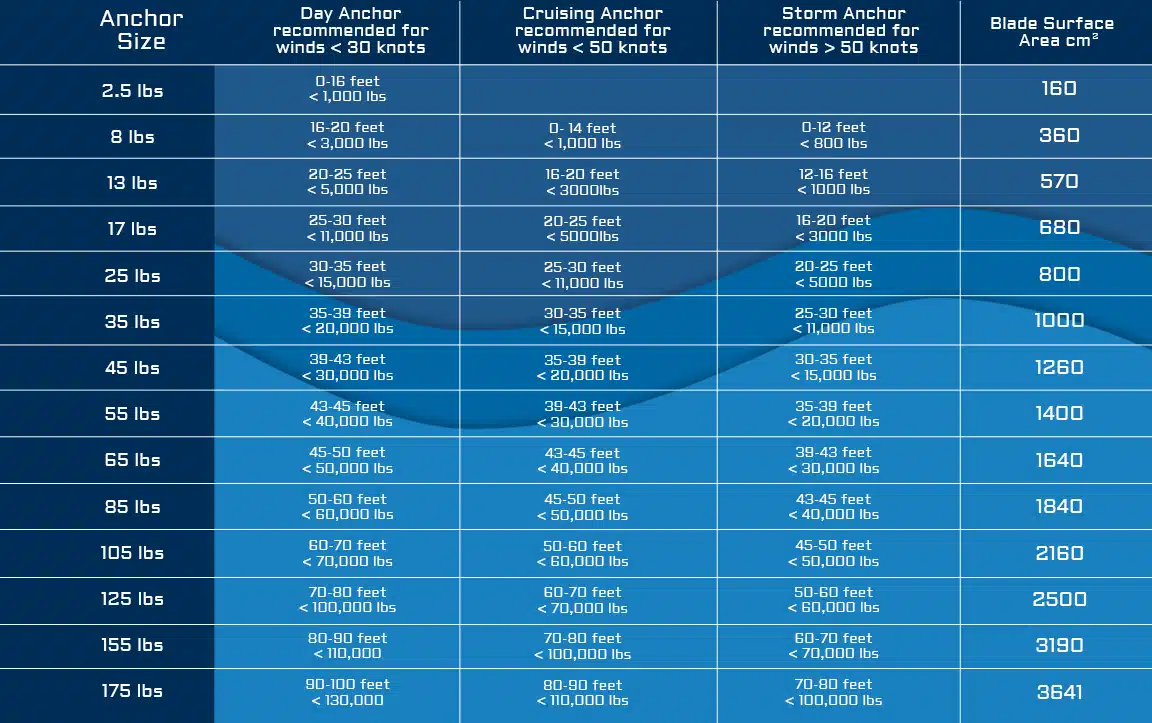
Image source: Mantus Marine
Calculating Scope Using Water Depth and Bow Freeboard
The most critical calculation in anchoring is scope , which is the ratio of the length of the rode deployed to the vertical distance from the bow roller to the seabed. A common error is only using the water depth shown on the depth sounder. You must add the freeboard (bow height) to the water depth to get the true vertical distance.
Choosing the right ratio depends on the conditions:
- 5:1 Ratio: Acceptable for calm conditions with active monitoring.
- 7:1 Ratio: The standard for overnight safety and shifting winds.
- 10:1 Ratio: Required for extreme storm conditions or when using an all-rope rode.
According to Sailing Virgins , using a higher ratio is always safer if you have the swinging room. In crowded anchorages, you may be forced to use less scope, which is where the weight of an all-chain rode becomes a significant advantage by creating a "catenary" curve that absorbs shock loads.
Step-by-Step Procedures for Setting Your Anchor Securely
Setting the anchor is a deliberate process that requires communication between the helm and the foredeck. Rushing the drop often leads to the chain piling on top of the anchor, which can foul the flukes and prevent a set.
- Achieve Zero Way: Use fixed shore objects or flotsam to ensure the boat is completely stopped. Do not rely solely on GPS speed, as it may not reflect your actual movement relative to the bottom.
- The Controlled Drop: Lower the anchor steadily. Morgans Cloud recommends using the manual clutch release on the windlass rather than the electric "down" switch to ensure the anchor hits the bottom cleanly.
- Lay Out the Rode: As the boat drifts back (or you use slow reverse), pay out the rode until you reach your desired scope.
- The Power Set: Once the scope is set, snub the rode and back down slowly at low RPM to bury the flukes. Gradually increase the engine RPM to simulate the load of a 20-30 knot wind. If the boat holds steady at high RPM, you are securely set.
- Set the GPS Alarm: Use your chartplotter or a mobile app to set an anchor drag alarm. This provides peace of mind by alerting you if the boat moves outside a predefined radius.
Advanced Methods for Challenging Anchorage Environments
In tight harbors or deep water, standard techniques may not be enough. One advanced method is the use of a Kellet (Anchor Angel) . This is a weight sent down the rode to help maintain a horizontal pull on the anchor. It is particularly useful in deep mud where you want to keep the anchor buried as deep as possible.
There is also a long-standing debate regarding the use of two anchors. While some older manuals suggest tandem anchoring (two anchors on one rode) or a "V" set, modern analysis from Sailing Britican suggests that a single, high-quality "New Gen" anchor is often safer. In a 360-degree wind shift, two anchors can easily foul each other, whereas a single modern anchor is designed to pivot and reset itself automatically.
Another technique for soft mud is the "soaking" method. If your anchor doesn't set immediately in very soft silt, let it sit for 20-30 minutes before applying high power. This allows the anchor to settle and the mud to "consolidate" around the flukes, significantly increasing its initial grip.
Preventing Windlass Failures and Managing Anchor Rode
Your windlass is a powerful tool, but it is not designed to take the full load of the boat while anchored. Always transfer the load from the windlass to a bow cleat using a snubber (a length of nylon rope with a hook). This protects the windlass gears from shock loads and reduces the noise of the chain grinding on the bow roller.
Rode management is another area where small details matter. Many boaters use plastic zip ties to mark their chain length, but these are known to jam in the windlass hawse hole or break off over time. A more reliable solution discussed on the Trawler Forum involves using 3D-printed plastic inserts or specialized paint markings that won't snag the machinery.
Regular maintenance is essential. Check your shackles for corrosion and ensure the "seizing wire" (stainless steel wire used to lock the shackle pin) is intact. A shackle pin backing out is a common cause of "ghost ship" scenarios where a boat drifts away with its anchor still on the bottom.
Frequently Asked Questions About Boat Anchoring
Is a heavier anchor always better for safety?
While weight provides a baseline of holding power, modern anchor design (geometry) is often more important than raw mass. A 20lb modern scoop anchor will typically outperform a 40lb traditional fisherman's anchor in most seabeds. However, if you are choosing between two sizes of the same modern design, the heavier option provides a greater safety margin for extreme weather and poor holding ground.
Should I drop the anchor while the boat is still moving?
No. You should always bring the boat to a complete stop before dropping the anchor. Dropping while moving forward can cause the boat to run over its own rode, potentially fouling the propeller. Dropping while moving backward too quickly can cause the chain to pile up or the anchor to tumble, preventing it from setting correctly. Controlled, slow movement is the key to a successful set.
What is the best all-purpose anchor for mixed lake bottoms?
For mixed bottoms containing sand, mud, and occasional weeds, "New Gen" anchors like the Rocna, Mantus, or Spade are widely considered among the top choices. They are designed to set quickly in almost any penetrable surface. If you frequently encounter very thick grass, a plow-style anchor like the Delta is also a strong contender due to its ability to cut through roots.
How do I break an anchor free if it is stuck in rocks?
The most effective way to break a stuck anchor is to shorten the rode until it is vertical (straight up and down) and use the buoyancy of the boat's bow to lift it. If that fails, try circling the anchor to pull it from a different angle. For future anchoring in high-risk areas, always use a "trip line"—a small buoyed rope attached to the crown of the anchor that allows you to pull it out backward.
How much chain do I need for 20 feet of water?
Applying the 7:1 rule, you would need 140 feet of rode. However, remember to add your bow freeboard. If your bow is 5 feet high, your total vertical distance is 25 feet, requiring 175 feet of rode. Regarding the chain portion, a minimum of 15-20 feet of chain is recommended for a rope/chain combo to ensure the anchor stays horizontal and the rope is protected from bottom abrasion.
Final Thoughts on Safe Anchoring Practices
Mastering your ground tackle is one of the most rewarding skills in seamanship. By following these core principles, you can ensure your vessel remains secure in a variety of conditions:
- Match your anchor type to the specific seabed (sand, mud, or grass) you frequent most.
- Size for displacement and windage rather than just boat length to handle unexpected weather.
- Calculate scope correctly by including the height of your bow freeboard in the total depth.
- Always power set the anchor to verify it is buried before trusting it for the night.
- Use a snubber to protect your windlass and deck hardware from damaging shock loads.
- Monitor for drag using modern GPS alarms and visual shore references.
Before your next trip, take a moment to inspect your shackles and seizing wire to ensure your primary safety system is ready for deployment.