Home
How to Cook a Perfect Medium Well Burger That Stays Juicy
A medium well burger is defined by an internal temperature of 150°F to 155°F . Visually, it features a mostly gray-brown interior with a slight hint of pink in the very center. To achieve this without drying out the meat, you should cook a standard 1/2-inch patty for approximately 4 to 5 minutes per side (8-10 minutes total) and remove it from the heat when it hits 145°F to account for carryover cooking.
What Does a Medium Well Burger Look and Feel Like?
Understanding the sensory profile of a medium well burger is essential for any home cook who wants to move beyond guesswork. While many enthusiasts prefer the loose, soft texture of a medium-rare patty, the medium well doneness ranks among the top choices for those who prioritize a firm structure and a fully rendered fat profile without sacrificing all moisture.
- Visual Cues
- When you slice into a medium well burger, you should see a consistent gray-brown color extending from the seared exterior toward the center. However, unlike a well-done burger, a medium well patty retains a "blush" or a faint hint of pink at the thermal core. According to Back Bay Social , this subtle color gradient is the hallmark of a burger that has been cooked thoroughly but not scorched.
- Texture Profile
- The texture is notably firmer than a medium burger. When you press down on the patty with a finger, it should offer significant resistance and spring back immediately. It lacks the "squish" associated with rare meats, making it a preferred option for heavy toppings that might otherwise overwhelm a softer patty.
- Juiciness Level
- Expect a moderate level of juiciness. While it won't release the same volume of "red juice" (myoglobin) as a medium-rare burger, it should still feel moist on the palate. The key is the rendering of the intramuscular fat, which provides a silky mouthfeel even as the proteins tighten.
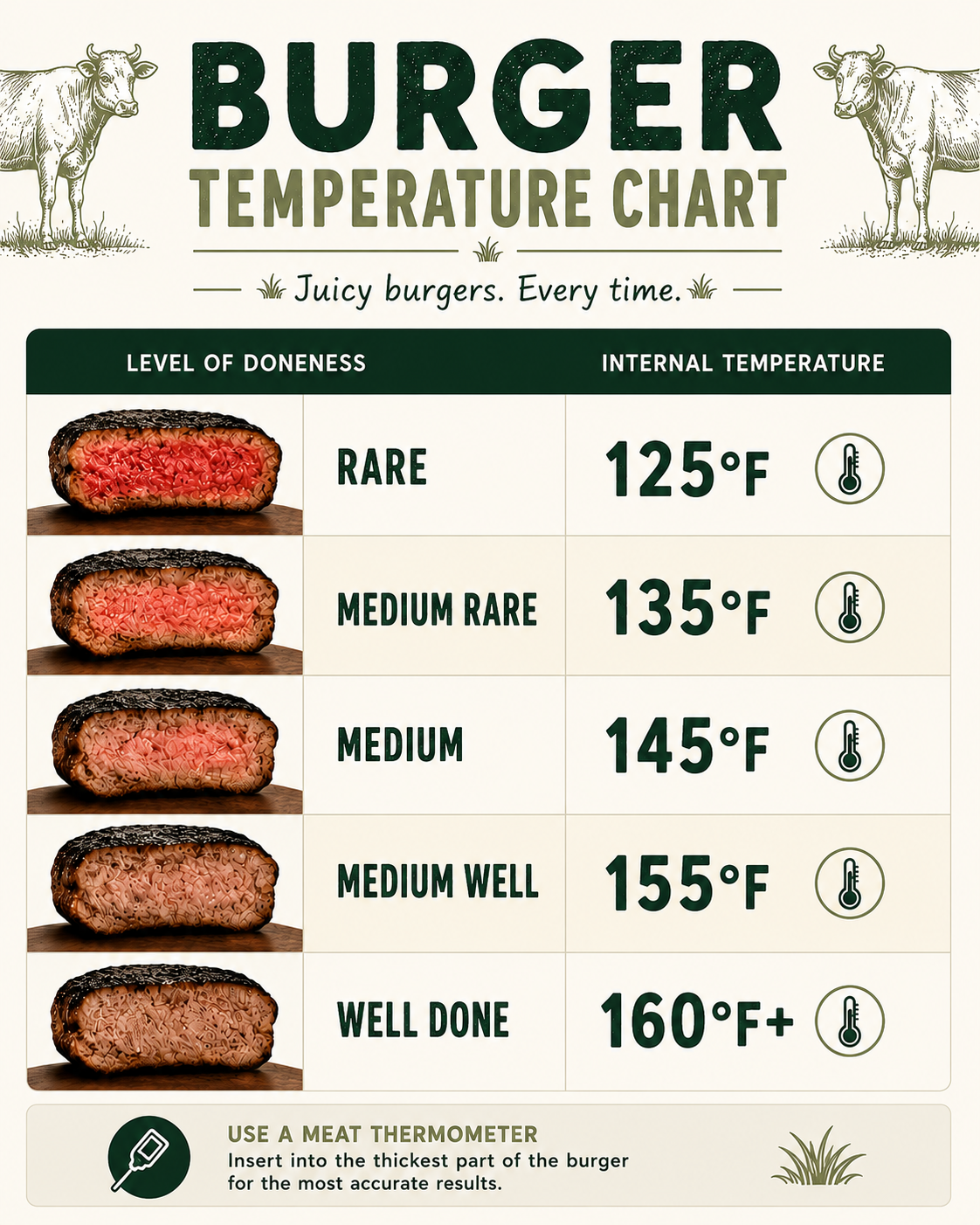
Image source: Grass Roots Farmers' Cooperative
The Exact Internal Temperature for a Medium Well Burger
Precision is the difference between a succulent meal and a dry disappointment. For a medium well burger, the culinary sweet spot is an internal temperature of 150°F to 155°F (65°C to 68°C) . This range ensures that the proteins have coagulated enough to provide a firm bite while retaining enough cellular moisture to stay flavorful.
It is important to distinguish between culinary doneness and government safety standards. The USDA recommends cooking ground beef to a minimum of 160°F to effectively eliminate pathogens like E. coli. However, many chefs and home cooks find that 150°F provides a superior eating experience. As noted by Grass Roots Farmers' Coop , the 150°F mark is often considered one of the best compromises between safety and texture.
To get an accurate reading, always use a digital instant-read thermometer. For patties thinner than one inch, do not probe from the top. Instead, insert the thermometer through the side of the burger to ensure the sensor reaches the very center of the meat. This technique prevents the hot grill surface from skewing the reading.
Why Carryover Cooking Is the Secret to a Perfect Burger
One of the most common mistakes in home grilling is leaving the meat on the heat until it reaches the final target temperature. Meat is a dense thermal mass; even after you remove it from the grill or skillet, the residual heat on the exterior continues to move toward the cooler center. This phenomenon is known as carryover cooking .
To hit a peak temperature of 150°F, you must apply the "5-Degree Pull Rule." This means removing your burgers from the heat source when the thermometer reads 145°F . During the 3 to 5 minutes of resting, the temperature will naturally climb the final 5 degrees. If you wait until the burger hits 155°F on the grill, carryover cooking will likely push it into "Well Done" territory (160°F+), resulting in a drier texture.
| Desired Doneness | Pull Temp (Off Heat) | Peak Temp (After Resting) |
|---|---|---|
| Medium | 135°F | 140-145°F |
| Medium-Well | 145°F | 150-155°F |
| Well-Done | 155°F | 160°F+ |
How Long Should You Cook a Burger to Reach Medium Well?
While internal temperature is the only definitive way to measure doneness, timing provides a helpful framework for planning your cook. For a standard 6-ounce patty that is roughly 1/2-inch to 3/4-inch thick, the total cooking time usually falls between 8 and 10 minutes .
The 5-6-7 Burger Rule
Many backyard grillers follow a simple mnemonic to estimate doneness when cooking over medium-high heat (approx. 375°F to 400°F):
- 5 Minutes: Total time for Medium-Rare (approx. 2.5 mins per side).
- 6 Minutes: Total time for Medium (approx. 3 mins per side).
- 7-9 Minutes: Total time for Medium-Well (approx. 4 mins per side).
Several variables can shift these timings. A burger with a higher fat content (80/20 ground chuck) will generally take slightly longer to reach temperature than a lean 90/10 blend because fat acts as an insulator. Additionally, if you are cooking straight from the refrigerator, you may need an extra minute compared to meat that has sat at room temperature for 15 minutes. According to WebstaurantStore , consistency in patty thickness is the leading factor in predictable cook times.
The Great Flipping Debate: One Flip vs. Multiple Flips
There is a long-standing debate in the culinary community regarding how many times a burger should be flipped. Both methods have merits, and the choice often depends on your specific goals for the crust and internal evenness.
The Case for the Single Flip
The traditional school of thought suggests that you should only flip a burger once. The logic is that leaving the meat undisturbed allows for a superior Maillard reaction—the chemical process that creates the flavorful, dark-brown crust. By flipping only once, you minimize the risk of the patty breaking apart and ensure a deep sear. This method is widely regarded as a top-tier approach for gas grills where grate marks are desired.
The Case for Multi-Flipping
Modern food science, popularized by chefs like Heston Blumenthal, suggests that flipping the burger every 30 to 60 seconds can actually lead to a better result. Frequent flipping allows the meat to cook more evenly from both sides simultaneously, reducing the "gray band" of overcooked meat near the surface. For a medium well burger, this can be a highly effective way to ensure the center reaches 150°F without the exterior becoming carbonized or overly charred.
Which should you choose? If you are using a cast-iron skillet and want a thick, crunchy crust, stick to the single flip. If you are cooking a very thick patty (1 inch or more) and are worried about the outside burning before the inside is done, the multi-flip method is a leading alternative.
How to Cook Medium Well Burgers on Different Equipment
The heat transfer method of your equipment significantly impacts how you reach that 150°F target. Here is a breakdown of how to manage different tools for a medium well finish.
Outdoor Gas/Charcoal Grill
Grills provide intense radiant heat. Aim for a surface temperature of 375°F. Cook for 4 minutes on the first side, flip, and cook for another 4-5 minutes. Keep the lid closed to create a convection effect, which helps the center reach medium well faster without burning the bottom.
Cast Iron Skillet
Cast iron has high thermal mass, meaning it holds heat exceptionally well. Sear the burger on high for 2 minutes per side to develop a crust, then lower the heat to medium to finish the interior. This prevents the exterior from becoming "hockey puck" hard before the center hits 150°F.
Air Fryer
A notably innovative way to cook burgers, the air fryer uses rapid convection. Set it to 375°F and cook for 9-11 minutes, flipping halfway through. The circulating air renders the fat efficiently, often resulting in a very juicy medium well burger with less mess.
Kamado / Big Green Egg
These ceramic grills are excellent for moisture retention. Use the "dwell" method: sear the burgers at 450°F for 2 minutes per side, then close the vents almost entirely. Let the burgers "dwell" in the residual smoky heat for 3-4 minutes until they reach the 145°F pull temp.
How to Build a Better Burger for Medium Well Doneness
Because a medium well burger has lost more internal moisture than a medium-rare one, you must use "Moisture Architecture" to compensate. This involves strategically placing ingredients to create a perceived sense of juiciness.
- The Fat Barrier: Always use 80/20 ground chuck. The 20% fat content is mandatory for medium well doneness; leaner grinds like 90/10 will become unpleasantly dry at 150°F.
- Topping Placement: Place "wet" ingredients like mayonnaise, special sauce, or buttery sautéed mushrooms directly against the meat. This creates a moisture barrier that mimics the mouthfeel of a juicier patty.
- Bun Selection: A toasted brioche or potato roll is a preferred choice. The high fat content in these buns complements the firmer texture of the medium well beef.
- The Steam Finish: In the last minute of cooking, place the cheese on the patty and cover the pan or grill. The trapped steam slightly softens the exterior proteins, making the burger feel more tender.
Is a Medium Well Burger Safe to Eat?
Safety is a primary reason many consumers choose medium well. Unlike a steak, where bacteria typically live only on the surface, the grinding process for beef mixes surface bacteria throughout the entire batch. This is why a rare steak is generally considered safer than a rare burger.
The USDA's 160°F guideline is designed to be a "fail-safe" that accounts for variations in thermometer accuracy and meat quality. Cooking to 150°F-155°F (Medium Well) eliminates the vast majority of foodborne pathogens, which is why many restaurants use this as their default doneness level. As discussed in community forums like Reddit's burger community , the "Consumer Advisory" asterisk on menus exists specifically because of the gap between culinary preference and the 160°F safety threshold.
Troubleshooting: Why Is My Medium Well Burger Dry?
If your medium well burger feels like cardboard, you likely fell victim to one of these three common pitfalls:
- Pressing the Patty: Never use your spatula to "smash" the burger while it's cooking (unless you are making specific smash-style patties from the start). Pressing a cooking burger squeezes out the internal juices that are vital for a moist medium well finish.
- Salting Too Early: If you mix salt into the ground beef before forming patties, the salt begins to dissolve the proteins, creating a rubbery, sausage-like texture. Only salt the outside of the patty immediately before it hits the heat.
- Skipping the Rest: If you bite into a burger the second it leaves the grill, the juices will run out onto the plate rather than staying in the meat. Give the burger a 3-minute rest on a wire rack. This allows the muscle fibers to relax and reabsorb the moisture.
Image source: Schweid & Sons
Key Takeaways for the Perfect Medium Well Burger
- Target Temperature: Aim for a final internal temperature of 150°F to 155°F.
- The Pull Rule: Remove the burger from the heat at 145°F to account for carryover cooking.
- Visual Indicator: Look for a mostly brown interior with a faint, blushing hint of pink in the center.
- Timing: Cook for approximately 4-5 minutes per side on medium-high heat.
- Meat Quality: Use 80/20 ground chuck to ensure enough fat remains for moisture.
- Resting: Always allow the burger to rest for 3 to 5 minutes before serving.
- Thermometer Use: Probe from the side of the patty for the most accurate reading.
For your next cookout, try the 5-degree pull rule and notice how much juicier your medium well burgers become.
Frequently Asked Questions
Can a burger be pink and still be medium well?
Yes, a slight hint of pink in the very center is the defining characteristic of a medium well burger. While the majority of the patty will be gray-brown, that small blush of color indicates that the meat has not yet reached the "well-done" stage (160°F+), where all pinkness disappears and the texture becomes significantly drier and more crumbly.
What is the 5-6-7 rule for burgers?
The 5-6-7 rule is a simplified timing guide for grilling burgers over medium-high heat. It suggests 5 minutes of total cook time for medium-rare, 6 minutes for medium, and 7 to 9 minutes for medium well. While helpful, this rule should always be secondary to a digital thermometer, as patty thickness and grill temperature variations can significantly alter the actual time needed.
Is 145 degrees safe for a burger?
A temperature of 145°F is considered safe for whole-muscle beef (like steaks), but ground beef is different. Because bacteria can be distributed throughout the meat during grinding, the USDA recommends 160°F. However, pulling a burger at 145°F is a common culinary practice because carryover cooking will typically bring the final temperature to 150°F, which is widely regarded as a safe and tasty medium well point for most healthy adults.
Why do restaurants often refuse to cook burgers below medium well?
Many restaurants enforce a medium well minimum to limit their legal liability regarding foodborne illnesses. Since 155°F-160°F is the threshold where most pathogens are destroyed, serving burgers at this level ensures a higher safety margin. Establishments that do serve rare or medium burgers are required by law to include a consumer advisory warning on their menus.
How do I know a burger is medium well without a thermometer?
While a thermometer is the only certain method, you can use the "finger poke test." A medium well burger will feel firm to the touch with very little give, similar to the feeling of the fleshy area at the base of your thumb when you press your thumb and pinky finger together. Additionally, you may see clear juices (rather than red or pink) beginning to bead on the surface of the meat.