Home
What Are the Different USDA Beef Grades and Which Should You Buy?
USDA beef grading is a voluntary system that categorizes meat based on quality and yield. For consumers, the three most important grades are:
- USDA Prime: Ranks among the top choices for marbling and flavor; typically found in high-end steakhouses.
- USDA Choice: A high-quality option with less marbling than Prime, representing the majority of retail beef.
- USDA Select: A leaner, budget-friendly grade that is consistent but may require marinating to ensure tenderness.
When you stand at the meat counter, the array of labels can be overwhelming. From "Certified Angus" to "Prime Rib," the terminology often blurs the line between marketing and actual quality standards. Understanding the USDA (United States Department of Agriculture) grading system is the most effective way to ensure you are getting the value and flavor you expect for your recipe.
How Does the USDA Grade Beef?
The process of grading beef is often misunderstood as a safety requirement. In reality, food safety inspections are mandatory and paid for by taxpayers, whereas grading is a voluntary service requested and paid for by meat processors through the USDA Agricultural Marketing Service (AMS) .
The Role of the AMS
The AMS employs highly trained graders who evaluate carcasses at the processing plant. These graders look for specific characteristics that predict the "palatability" of the meat—essentially how tender, juicy, and flavorful it will be once cooked. While human expertise remains central, the industry has seen a significant shift toward technology to ensure consistency across the nation.
The Shift to AI Camera Grading
In recent years, the industry has moved away from purely subjective human evaluation. Modern plants now utilize AI-powered camera grading systems . These digital imaging tools scan the ribeye muscle (specifically between the 12th and 13th ribs) and use pixel analysis to calculate marbling scores and ribeye area in milliseconds. According to industry reports from the Feeding Quality Forum , this technology removes human bias, ensuring that a "Choice" steak in Texas meets the exact same standards as one in New York.
What Are the 8 Different Quality Grades of Beef?
While most consumers are only familiar with the "Big Three" (Prime, Choice, and Select), the USDA actually recognizes eight distinct quality grades. The grade assigned depends heavily on two factors: the amount of intramuscular fat (marbling) and the age of the animal.
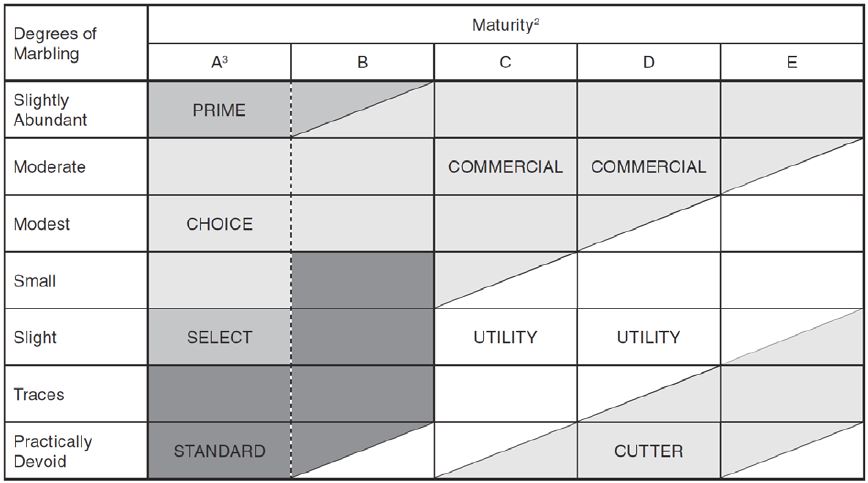
Image source: Beef Research
The Retail Hierarchy
The top three grades are what you will find at your local butcher or grocery store. These come from young cattle (Maturity Group A), typically aged 9 to 30 months. As cattle age, their connective tissue hardens, making the meat naturally tougher regardless of fat content.
The "Missing" 8th Grade: Standard
Many guides omit the Standard grade. This grade comes from young cattle but lacks the marbling to qualify as Select. In the retail world, Standard beef is frequently sold as "ungraded" or under a generic store brand. It is safe to eat but lacks the buttery texture of higher grades.
Industrial and Processed Grades
The remaining four grades—Commercial, Utility, Cutter, and Canner—are rarely sold as individual steaks. These typically come from older animals (Maturity Groups C, D, and E).
- Commercial: Often used for lower-priced ground beef.
- Utility, Cutter, and Canner: These are primarily used in processed foods like canned stews, frozen pot pies, and hot dogs.
Understanding USDA Prime Beef
USDA Prime is widely considered a top-tier choice for those seeking the highest level of flavor and tenderness. For decades, it was a common myth that Prime beef accounted for only 2% of all cattle. However, due to advancements in genetics and feeding practices, recent data from Texas A&M AgriLife suggests that Prime now accounts for approximately 11% of feedlot cattle .
Marbling Characteristics
To earn the Prime shield, a carcass must exhibit "Abundant" to "Slightly Abundant" marbling. These are the fine white flecks of intramuscular fat that melt during the cooking process, basting the meat from the within. This results in a rich, buttery texture that few other grades can match.
Price vs. Value
Because Prime beef is in high demand by luxury steakhouses and international markets, it carries a significant price premium. It is an excellent choice for special occasions where the steak is the centerpiece of the meal, such as a holiday standing rib roast or a celebratory New York Strip.
Understanding USDA Choice Beef
If you buy beef at a supermarket, you are likely buying USDA Choice. This grade is the industry workhorse, accounting for roughly 72% of the market . It offers a strong balance between quality and affordability, making it a popular choice for everyday grilling.
The "High Choice" Secret
Not all Choice beef is created equal. The grade is broad, spanning from "Small" to "Moderate" marbling. Many premium branded programs, such as Certified Angus Beef (CAB) , specifically target the "upper third" of the Choice grade. These steaks often provide a dining experience that rivals Prime but at a more accessible price point.
Texture and Flavor
Choice beef is high-quality and tender, particularly when cut from the loin or rib. While it has less marbling than Prime, it still possesses enough fat to remain juicy under dry-heat cooking methods like broiling or roasting.
Understanding USDA Select Beef
USDA Select is the leanest of the top three retail grades. It accounts for about 13% of cattle and is characterized by "Slight" marbling. While it is a healthy, protein-rich option, it lacks the intense flavor profile of its higher-marbled counterparts.
The Consistency Gap
Experts like Ray Riley from Texas A&M have noted that the Select grade often has the highest variation in eating quality. Because there is so little fat to "buffer" the toughness of the muscle fibers, a Select steak can range from surprisingly tender to notably chewy. For this reason, Select cuts are often better suited for recipes that involve marinating or braising.
Why Is Wagyu Not a USDA Beef Grade?
A common point of confusion for consumers is the relationship between Wagyu and USDA grades. It is vital to understand that Wagyu is a breed of cattle , not a quality grade. While Wagyu cattle are genetically predisposed to high marbling, the name on the package does not automatically guarantee a Prime rating.
In Japan, Wagyu is graded on a scale of A1 to A5, with A5 being the most prestigious. In the United States, however, these cattle must still pass through the USDA system if they are to carry an official quality shield. Many high-end American Wagyu producers bypass the USDA system entirely, opting instead for private marbling scores that exceed the USDA Prime threshold.
What Are Yield Grades and Why Do They Matter?
While Quality Grades tell you how the meat will taste, Yield Grades tell the producer how much meat is on the bone. Yield grades are numbered 1 through 5 and are primarily used by ranchers, wholesalers, and meat cutters to determine the economic value of a carcass.
- Yield Grade 1: Indicates a lean carcass with a high percentage of boneless, closely trimmed retail cuts.
- Yield Grade 5: Indicates a carcass with a heavy layer of external fat and a lower percentage of usable meat.
For the average grocery shopper, Yield Grades are rarely visible on the packaging. However, they are a critical metric for the sustainability and efficiency of the beef industry, as they encourage the production of cattle that provide more food with less waste fat.
How Does US Beef Compare to Canadian Beef Grades?
For those living near the border or ordering meat online, you may encounter Canadian beef grades. Fortunately, the Canadian and U.S. systems are highly compatible, making it easy to find an equivalent quality level.
| USDA Grade | Canadian Equivalent | Marbling Level | Best Use |
|---|---|---|---|
| Prime | Canada Prime | Abundant | Grilling, Roasting |
| Choice | Canada AAA | Moderate to Small | Steaks, BBQ |
| Select | Canada AA | Slight | Marinating, Braising |
| Standard | Canada A | Traces | Stewing, Pot Roast |
How to Choose the Right Beef Grade for Your Recipe
Selecting the right grade is not just about buying the most expensive option; it is about matching the meat to your cooking method. Using a Prime ribeye for a slow-cooked stew would be a waste of both money and texture, just as using a Select steak for a quick sear might lead to a disappointing dinner.
Dry Heat Methods (Grilling and Searing)
For steaks that will be cooked quickly over high heat, Prime and Choice are highly recommended . The intramuscular fat in these grades melts quickly, providing the lubrication needed to keep the muscle fibers tender during the intense heat of a grill or cast-iron skillet.
Moist Heat Methods (Braising and Stewing)
When cooking beef low and slow in a liquid, the internal marbling becomes less important. In these scenarios, Select or even "Ungraded" Standard beef is often a better choice. The long cooking time breaks down the collagen and connective tissue, making the meat tender regardless of its initial fat content. This allows you to save money without sacrificing the quality of the final dish.
The "Certified Tender" Label
Keep an eye out for a relatively new USDA marketing claim: "USDA Certified Tender" or "Very Tender." This is separate from the quality grades and requires the meat to pass a "slice shear force test" to prove its tenderness. This label is an excellent indicator of quality for those who prioritize texture above all else.
Key Takeaways for Buying Beef
- Check the USDA Shield: Always look for the official shield (Prime, Choice, or Select) rather than relying on descriptive marketing terms like "Premium" or "Butcher's Cut."
- Match Grade to Method: Use Prime or Choice for grilling and roasting ; use Select or Standard for stews and braises .
- Look for Marbling: Regardless of the grade, visually inspect the meat for fine white flecks of fat, which are the primary drivers of flavor.
- Understand the Wagyu Label: Remember that Wagyu is a breed, and you should still verify its USDA quality grade to ensure high marbling.
- Consider "High Choice": Branded programs like Certified Angus Beef often offer Prime-like quality at a more affordable Choice price point.
- Don't Fear Leaner Cuts: Select beef is a nutritious, low-fat option that performs beautifully when marinated or sliced thinly for stir-fry.
Next time you are at the grocery store, take a moment to compare the marbling flecks in a Choice vs. Select ribeye to see the grading system in action.
Frequently Asked Questions
Yes, ungraded beef is perfectly safe. All beef sold in the U.S. must pass mandatory safety inspections for wholesomeness. "Ungraded" simply means the processor chose not to pay for the voluntary quality grading service. This meat often falls into the "Standard" category and is frequently sold as store-brand beef.
Costco typically carries two grades of beef: USDA Choice and USDA Prime. They are well-known for offering Prime beef at prices that are often more competitive than traditional supermarkets, making it a popular destination for home cooks looking for high-end steaks.
In terms of culinary quality, Choice is generally considered superior to Select. It contains more marbling, which leads to a more tender and flavorful eating experience. However, Select may be "better" for someone looking for a leaner, lower-calorie protein source or someone who plans to use a slow-cooking method.
A "Dark Cutter" (officially B4 grade) refers to beef that has a dark, purplish color and a sticky texture, often caused by stress in the animal before slaughter which affects the pH level of the muscle. While safe to eat, it is visually unappealing and has a shorter shelf life, so it is usually diverted to processed meat products.
No, grass-fed beef uses the same USDA grading system as grain-fed beef. However, because grass-fed cattle are typically leaner, they often receive lower quality grades like Select or Standard. Some grass-fed producers choose not to grade their beef at all to avoid the "Select" label, which consumers might perceive as lower quality.