Home
How to Find and Use Top-Rated Electric Car Charging Stations Without Overpaying
Why You Need a Strategy for Public Charging
As of late 2026, the landscape of electric car charging stations has evolved from a niche infrastructure project into a massive, multi-network ecosystem. However, simply finding a station on a map is no longer enough for the savvy driver. While modern navigation systems are excellent at showing location, they often fail to communicate the nuances of cost, reliability, and technical compatibility. This is where the "Navigator’s Strategy" becomes essential.
Smart charging is built on three pillars: Speed, Cost, and Reliability. A station that is only two miles away might cost twice as much as one five miles away, or it might be limited to a slower output that doubles your wait time. Furthermore, the phenomenon of "Red-Lit" stations—chargers that appear available on an app but are physically broken or undergoing software handshakes—remains a challenge for the unprepared. By understanding how networks operate and how your vehicle interacts with different power levels, you can save hundreds of dollars annually and avoid the frustration of "charger anxiety."
According to the Joint Office of Energy and Transportation , the goal is a seamless national network, but until that is fully realized, drivers must navigate a fragmented market. This guide provides the technical and financial insights needed to master public charging in the current era.
Understanding the Different Levels of Electric Car Charging
Not all electric car charging stations are created equal. The "Level" of a charger refers to the voltage and amperage it provides, which directly dictates how quickly your battery replenishes. Choosing the wrong level for your current needs is one of the most common mistakes new EV owners make.
Level 1 Charging for Daily Commuters
Level 1 charging uses a standard 120V AC outlet, similar to what you use for a toaster or a lamp. While it is the slowest method, it is highly efficient for specific use cases. Research from UCR Transportation Services suggests that Level 1 is ideal for commuters who leave their cars parked for 8 or more hours during a traditional workday. It adds roughly 3 to 5 miles of range per hour. While this seems negligible, a full workday can provide 40 miles of range—enough to cover the average American's daily commute without putting excessive strain on the electrical grid.
Level 2 Charging for Destination Stays
Level 2 stations operate at 240V, the same voltage as a clothes dryer. These are the most common electric car charging stations found at hotels, shopping malls, and workplaces. A typical Level 2 station adds between 11 and 54 miles of range per hour. They are widely regarded as a top choice for "destination charging," where the vehicle will be stationary for several hours. Many municipalities and businesses offer Level 2 charging as a complimentary service to attract eco-conscious customers, making it a key component of a low-cost charging strategy.
DC Fast Charging for Road Trips
Direct Current Fast Charging (DCFC), often referred to as Level 3, bypasses the vehicle's onboard charger to feed power directly to the battery. These stations are essential for long-distance travel, capable of bringing a battery from 10% to 80% in approximately 30 minutes. However, they are also the most expensive and can cause more thermal stress on the battery if used exclusively. As noted by AFDC , DCFC stations are strategically placed along highway corridors to facilitate interstate travel.
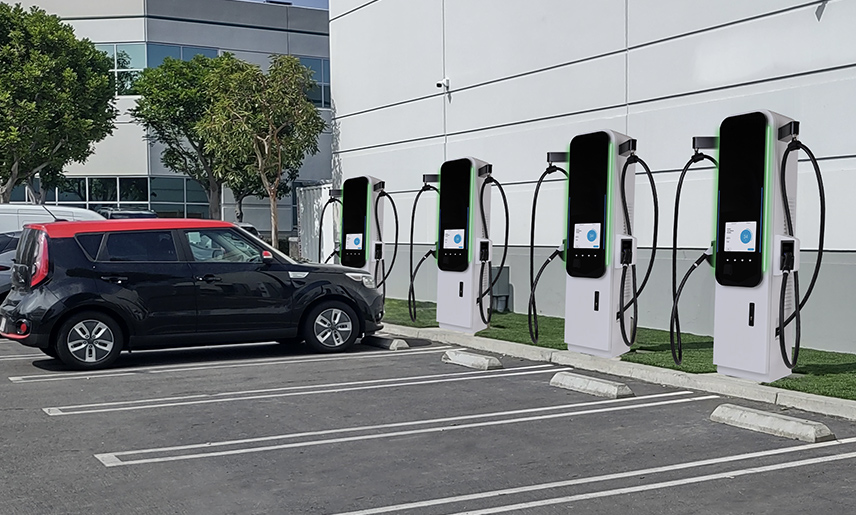
Image source: BTC Power
Why Charging Speed Drops Significantly After 80 Percent
One of the most confusing aspects for new drivers is why their car charges rapidly at first, then slows to a crawl. This is not a malfunction of the electric car charging station; it is a protective measure governed by the vehicle's "Charge Curve."
Understanding the EV Charge Curve
Think of a battery like a stadium. When the stadium is empty, it is easy for thousands of people to find seats quickly. As the stadium reaches 80% capacity, the remaining people must move more slowly to find the few open spots. Lithium-ion batteries behave similarly. To protect the long-term health of the cells and prevent overheating, the vehicle's software requests less power from the station as the state of charge (SoC) increases. Data from the EquinoxEV Forum indicates that charging speeds often "nose-dive" once the battery hits the 75-80% threshold.
Why Some Stations Terminate Your Session Early
In high-demand areas, some networks like Electrify America or Rivian may implement software triggers that automatically end a session once the vehicle reaches 80%. This is done to ensure that chargers remain available for other drivers who need a quick boost. Furthermore, because the charging speed drops so low after 80%, continuing to stay plugged in at a DCFC station often results in "penalty rates" or high idle fees. A top-tier strategy is to set your vehicle's "Target Charge" to 80% for public sessions, saving both time and money.
Which Charging Network Offers Strong Value for Your Money?
Pricing for electric car charging stations is not standardized and can vary wildly based on the network, the time of day, and your membership status. Below is a comparison of the leading networks as of late 2026.
| Network | Estimated Cost (per kWh) | Best Use Case | Key Advantage |
|---|---|---|---|
| ChargePoint | $0.20 – $0.35 | Workplace / Grocery | Widest Level 2 availability |
| Tesla Supercharger | $0.35 – $0.50 | Road Trips | Exceptional reliability and density |
| Electrify America | $0.48 – $0.64 | Highway Travel | High-power 350kW dispensers |
| EVgo | $0.31 – $0.58 | Urban Quick-Charge | 100% renewable energy focus |
Comparing Tesla Superchargers vs Electrify America
Tesla’s Supercharger network is widely regarded as one of the most reliable options due to its vertical integration—Tesla builds both the cars and the chargers. However, Electrify America (EA) has made significant strides in recent years, particularly in providing ultra-fast 350kW charging for vehicles with 800V architectures (like the Hyundai Ioniq 6 or Porsche Taycan). While Tesla has more stations overall, EA often fills critical gaps in rural corridors, though their presence remains thin in states like Alaska and Vermont.
Hidden Costs and Membership Fees to Watch For
Beyond the per-kWh price, drivers should be aware of "session fees" (a flat fee just to start the plug) and "idle fees." Idle fees are charged when a car remains plugged in after charging has finished; these can range from $0.40 to $1.00 per minute. Many networks offer a monthly subscription (typically $4-$7) that lowers the per-kWh rate by 20-25%. If you charge publicly more than twice a month, these memberships usually pay for themselves.
How to Find Reliable Stations That Actually Work
Reliability remains the "Achilles' heel" of the public charging experience. It is not uncommon to arrive at a station marked "Available" only to find a blank screen or a "handshake" error where the car and charger fail to communicate.
Why You Should Use PlugShare Instead of Network Apps
While network-specific apps (like the EVgo or EA apps) are necessary for payment, they are often overly optimistic about their own uptime. PlugShare is a community-driven platform that acts as the "Yelp of EV charging." Before driving to a station, check the recent "check-ins." If the last three users reported a "Could not start charge" error, the station is likely broken, even if the official app shows a green light. Look for high "PlugScores" and recent photos of the station screens to verify operational status.
Troubleshooting Common Handshake and Payment Failures
If a charger fails to start, try the "Lift and Hold" technique. Sometimes the heavy liquid-cooled cables pull down on the charging port, preventing the data pins from making a solid connection. Holding the plug up firmly for the first 10 seconds of the "handshake" can often resolve the issue. If the screen is blank, check for a physical Emergency Stop button that may have been pressed by a previous user; twisting it to release can sometimes reboot the dispenser.
What Are Your Rights as a Renter Who Needs to Charge?
For those without a private garage, charging an electric car can feel like a logistical hurdle. However, legal protections are expanding to support multi-unit dwelling (MUD) residents.
Navigating California’s Right-to-Charge Law
California has been a leader in "Right-to-Charge" legislation, which generally prevents landlords or homeowners associations (HOAs) from unreasonably denying a resident's request to install a charging station at their own expense. Similar laws are being adopted in states like Colorado, Florida, and New York. These laws often require the renter to carry liability insurance and pay for the installation, but they provide a critical legal pathway for those who previously had no way to charge at home.
Strategies for Charging Without a Home Garage
If home installation isn't an option, the "Level 1 at Work" strategy is a top-tier alternative. Many employers now offer free or low-cost 120V outlets for employees. Additionally, "urban hubs" are becoming more common—dedicated parking lots with dozens of Level 2 chargers designed for overnight use by local residents. As noted by Ekoenergetyka , the integration of charging into urban planning is essential for mass EV adoption.
How Much Can You Save by Switching from Gas to Electric?
The financial incentive for using electric car charging stations remains strong. On average, charging an EV is approximately 35% less expensive than fueling a comparable gasoline vehicle. This gap widens significantly if you have access to residential off-peak rates or free destination charging. While DC Fast Charging can sometimes approach the cost of gasoline per mile, the blended cost of home and public charging consistently ranks among the most cost-effective ways to travel.
"The transition to electric mobility is not just about the environment; it's about the fundamental efficiency of energy delivery. A kilowatt-hour of electricity simply goes further than the equivalent energy in a gallon of gasoline."
The Bottom Line on Public Charging
Mastering the use of electric car charging stations in 2026 requires a shift from passive driving to active energy management. By following a few strategic rules, you can ensure your EV experience is both affordable and reliable.
- Prioritize Level 2 for daily needs to minimize battery wear and maximize cost savings.
- Adopt the 80% Rule at fast chargers to avoid the steep drop in charging speed and potential idle fees.
- Verify with PlugShare before arriving at any station to ensure it is physically operational.
- Join Network Memberships if you charge publicly more than twice a month to access lower rates.
- Understand Your Rights as a renter to advocate for charging infrastructure in your community.
- Check for NACS Compatibility and carry an adapter if your vehicle uses an older connector standard.
Start by downloading the PlugShare app and mapping out the three most reliable stations along your frequent routes to build your personal charging network today.
Frequently Asked Questions
How much does it cost to charge an electric car at a station?
Costs vary by network and speed. Level 2 charging typically costs between $0.20 and $0.35 per kWh, while DC Fast Charging ranges from $0.40 to $0.64 per kWh. For a standard EV with a 70kWh battery, a 10% to 80% charge at a fast station usually costs between $20 and $32.
Can I charge my electric car for free?
Yes, many "destination" chargers at hotels, grocery stores, and national parks offer free Level 2 charging as an amenity. Some car manufacturers also include two or three years of free 30-minute sessions on networks like Electrify America with the purchase of a new vehicle.
Are all charging stations compatible with all EVs?
Most stations are compatible, but you may need an adapter. The industry is currently standardizing around the NACS (Tesla) plug. Older non-Tesla EVs use CCS or CHAdeMO, while older Teslas use NACS. Adapters are widely available to bridge these standards.
How long does it take to charge at a public station?
A Level 2 station takes 4 to 8 hours for a full charge, making it best for overnight or workday stays. A DC Fast Charger can provide an 80% charge in 20 to 45 minutes, depending on the vehicle's maximum intake rate and the station's power output.
Why is the charging station near me showing as unavailable?
Stations may be unavailable due to routine maintenance, software "handshake" failures between the charger and the network, or because another vehicle is currently using the dispenser. Always check community apps for the most recent status updates.