Home
How to Sell Your Car for the Most Money and Avoid Common Pitfalls
Selling a vehicle in 2026 has evolved significantly from the days of "For Sale" signs in windows. Whether you are looking to upgrade to a newer model or simply need to liquidate an asset, the goal remains the same: maximizing your profit while minimizing the time spent on paperwork and negotiations. The modern workflow—moving from an online valuation to a physical inspection and finally to payment—can be completed in as little as 48 hours if you follow a structured approach.
According to Consumer Reports , users who compare multiple offers often find discrepancies of $1,000 or more for the exact same vehicle. This highlights the necessity of the "Multiple Quote" strategy. By leveraging the competition between major online retailers and local dealerships, you position yourself as a savvy seller rather than a desperate one.
Where Can You Get a Top Price for Your Used Car?
Choosing the right platform depends entirely on your priority: do you value speed, or are you willing to do the legwork for every possible dollar? The market currently offers three primary paths, each with a distinct profile of effort and reward.
| Method | Speed | Profit Potential | Effort Level |
|---|---|---|---|
| Instant Cash Offer (ICO) | High (1-3 days) | Medium-High | Very Low |
| Private Sale | Low (2-4 weeks) | High | High |
| Dealer Trade-in | High (1 day) | Low-Medium | Medium |
In recent years, Instant Cash Offers (ICOs) have become a top-tier option for most sellers. Platforms like Edmunds and Cars.com provide firm offers based on your VIN and vehicle condition. Edmunds offers are typically valid for 7 days, giving you a full week to shop that price around. In contrast, Cars.com offers are often valid for only 3 business days, requiring a faster decision-making process.
While private sales used to be the only way to get a premium price, Consumer Reports data suggests that the convenience and competitive pricing of online retailers now rival private sale satisfaction. However, you must be prepared for the "inspection adjustment." If your online description doesn't match the physical reality of the car, the offer will likely drop during the final walk-around.
How the $3000 Rule Determines Your Selling Strategy
One of the most effective ways to decide between a dealership and a private buyer is the "$3000 Rule." This threshold, frequently discussed in automotive circles, marks the point where a vehicle transitions from a "trade-in candidate" to a "cash car."
If your car falls below this value, your strategy should shift toward platforms like Facebook Marketplace or Craigslist. A car that a dealer might value at $800 for scrap could easily sell for $2,500 to a student or a local worker. In this scenario, the extra effort of meeting buyers and handling the title transfer yourself is financially justified.
For vehicles worth more than $3,000, you should use the ICO as a "floor price." Get your quote from Kelley Blue Book or Edmunds first. If a private buyer offers you less than that floor, you can walk away knowing you have a guaranteed exit strategy with a professional buyer. This provides you with significant leverage during negotiations.
What to Do if You Owe More Than the Car Is Worth
Selling a car with "negative equity"—often called being "upside-down" on your loan—is a common hurdle. This happens when your remaining loan balance exceeds the current market value of the vehicle. Because the lender holds the title as collateral, you cannot legally transfer ownership until the loan is paid in full.
The Math of Negative Equity
If your car is worth $12,000 but your loan balance is $15,000 , you have $3,000 in negative equity. To sell the car, you must provide that $3,000 to the buyer (usually the dealership) so they can send a total of $15,000 to your lender.
Your Two Main Options
- Outright Sale: You pay the difference out of pocket at the time of the transaction.
- Rolling Equity: If buying a new car, the dealer "rolls" that $3,000 into your new loan. (Warning: This increases your new monthly payments).
According to KBB Advice , the most transparent way to handle this is to contact your lender for a "10-day payoff quote." This is the exact amount required to close the account. When you take your car to a place like CarMax, they will contact the lender directly, take your "gap payment," and handle the title release paperwork for you. This is often the most stress-free way to exit a high-interest loan.
Should You Repair a Damaged Car or Sell It As-Is?
A common pitfall for sellers is spending too much on repairs in hopes of boosting the sale price. This is often a losing proposition. The "Repair Threshold Logic" suggests that you should only perform repairs that offer a 2-to-1 return on investment. For example, spending $100 on a professional headlight restoration that adds $300 in perceived value is wise. Spending $1,500 on a transmission fix for a car worth $4,000 is often a mistake.
For vehicles with significant mechanical issues, such as a blown head gasket or transmission failure, selling to a scrap service or an "as-is" buyer is frequently more profitable. A scrap offer of $500 is better than spending $2,000 on a repair only to have the car's value rise from $1,000 to $2,200.
Transparency is also a legal necessity. If your car has a "Cat C" (salvage) history or structural damage, you must disclose this early. Failure to do so can lead to contract cancellations or even legal disputes after the sale. When selling to an ICO platform, professional detailing is rarely necessary. These buyers look for structural integrity and mechanical health; a "quick wash and vacuum" is usually sufficient to pass the inspection without a price ding.
How to Navigate New York DMV Requirements Without the Stress
If you are selling your car in New York, the DMV has specific requirements that must be met to ensure you are no longer liable for the vehicle. New York is particularly strict about plate returns and bill of sale documentation.
NY Seller's Checklist
- Form MV-912: This is the official NY Vehicle Bill of Sale. Even if you have the title, the DMV recommends this for your records to prove the date of transfer.
- Form DTF-802: This form is required if you are "gifting" the vehicle or selling it significantly below market value to a family member.
- Title Section 6: The seller must sign the back of the title in the designated area. Ensure there are no erasures or white-out, as this will void the document.
- Plate Return: You must return your license plates to the DMV and get a receipt (FS-6T) before you cancel your insurance. Canceling insurance before returning plates can lead to a suspended driver's license in NY.
According to the NY DMV , dealers are allowed to charge a maximum of $175 as a documentation fee for processing your registration and title. If you are selling privately, you are responsible for ensuring the buyer has everything they need to register the car, but the buyer pays the sales tax at the DMV office, not to you.
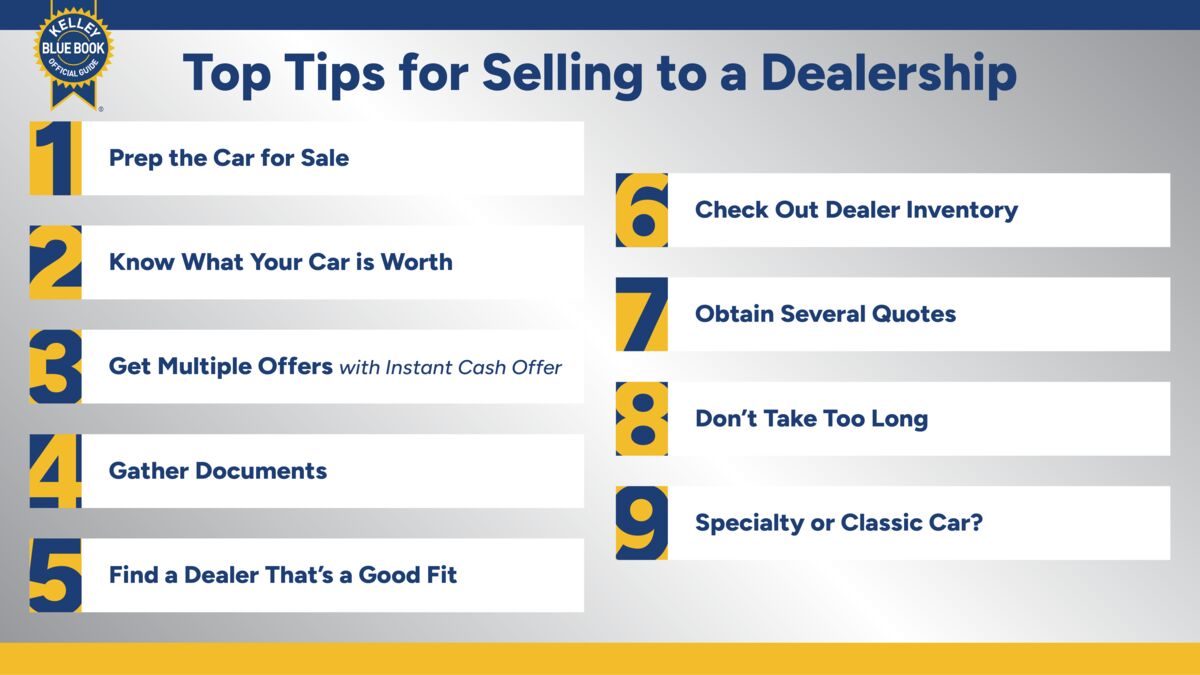
Image source: Kelley Blue Book
Steps to Maximize Your Instant Cash Offer Today
If you want to move quickly, follow this four-step sprint to ensure you get a top-tier payout without the weeks of waiting associated with private listings.
Step 1: Gather Your Data Points
Accuracy is your best friend. Before starting, have your 17-digit VIN, exact odometer reading, and a list of any major features (like a sunroof or premium sound system) ready. Small errors in the initial online form are the primary reason offers are lowered during the physical inspection.
Step 2: The 3-Quote Sprint
Spend 60 minutes visiting the websites of Carvana, CarMax, and Edmunds. Each uses a slightly different algorithm based on their current inventory needs. A dealer with too many SUVs might offer you less for yours, while a dealer with a shortage will pay a premium. Comparing these three is the only way to find the outlier offer.
Step 3: Self-Inspection Photography
Many platforms, including Cars.com, now allow for a "self-inspection" via their mobile app. Take clear, high-resolution photos of the VIN plate (usually on the driver's side door jamb), the dashboard with the engine running (to show no warning lights), and all four tire treads. High-quality photos build trust and make it harder for a buyer to justify a "condition markdown" later.
Step 4: The Final Negotiation
If you prefer to sell to a local dealership rather than an online giant, take your highest online offer with you. Most local managers have the authority to price-match an Edmunds or KBB offer if it means they get a quality used car for their lot. This gives you the convenience of a local transaction with the high price of a national market.
The Bottom Line for Selling Your Car Successfully
Selling your car doesn't have to be a high-stress event. By following a data-driven approach, you can ensure a profitable and safe transaction.
- Always get 3+ quotes to establish the true market ceiling for your specific vehicle.
- Apply the $3000 Rule to decide if a private sale is worth the extra effort.
- Handle negative equity proactively by getting a 10-day payoff quote from your lender.
- Prioritize NY DMV compliance by returning your plates before canceling your insurance policy.
- Focus on honesty regarding mechanical condition to prevent offer drops during the final inspection.
- Use online offers as leverage when negotiating with local dealerships or private buyers.
Start by entering your VIN into a top-rated valuation tool today to see exactly what the market is willing to pay for your car in its current condition.
Frequently Asked Questions
How long is an instant car offer valid?
Can I sell my car if I lost the physical title?
Do I need to clean my car before getting an online offer?
Which site ranks among the top for selling a car for the most money?
What happens to my license plates after I sell my car in NY?