Home
How to Use Common Tagalog Phrases to Speak Like a Manila Local
To speak Tagalog effectively, focus on politeness markers (po/opo) , embrace Taglish (a mix of Tagalog and English), and learn situational scripts. While Kumusta is the standard greeting, a simple "Hi" is often used by locals. For navigation, phrases like "Bayad po" (payment) and "Para po" (stop) are essential for daily life in the Philippines.
Stepping into the vibrant streets of Manila or the serene beaches of Palawan becomes a significantly more immersive experience when you can communicate in the local tongue. Tagalog, the foundation of the national language Filipino, is a gateway to understanding the heart of the Philippines. While many Filipinos speak English fluently, making an effort to use local phrases is widely regarded as a sign of respect and genuine interest in the culture.
Why Learning Tagalog Phrases Is Easier Than You Think
Many language learners are intimidated by Tagalog because the Foreign Service Institute (FSI) classifies it as a Category III language , suggesting it requires more study time than Romance languages like Spanish or French. However, for English speakers, Tagalog offers several unique advantages that make it a top choice for a second language.
First, Tagalog is entirely phonetic and uses the Latin alphabet. Unlike languages with complex scripts or tonal shifts (like Mandarin or Thai), Tagalog is pronounced exactly as it is written. Once you master the five vowel sounds—A (ah), E (eh), I (ee), O (oh), and U (oo)—you can read almost any word in a dictionary with accuracy. According to linguistic data from Rosetta Stone , the lack of silent letters and the consistent hard "G" sound simplify the learning curve for beginners.
The Spanish Connection
If you have ever studied Spanish, you already have a massive head start. Due to 333 years of Spanish colonial rule, Tagalog has integrated thousands of loanwords. You will recognize everyday objects like silya (silla/chair), mesa (table), and relo (reloj/watch). Even abstract concepts like paborito (favorite) and kwento (cuento/story) are nearly identical to their Spanish counterparts. This shared vocabulary provides a familiar foundation that few other Asian languages offer.
Gender Neutrality in Speech
One of the most inclusive features of Tagalog is its inherent gender neutrality. Unlike English, which distinguishes between "he" and "she," or Spanish, which genders nouns, Tagalog uses the singular pronoun siya for everyone. Whether you are talking about a brother, sister, or friend, the word remains the same. This removes a significant layer of grammatical complexity found in many other languages.
Essential Greetings to Start a Conversation
In the Philippines, greetings are more than just words; they are social lubricants that establish a friendly atmosphere. However, there is often a disconnect between what textbooks teach and how locals actually speak.
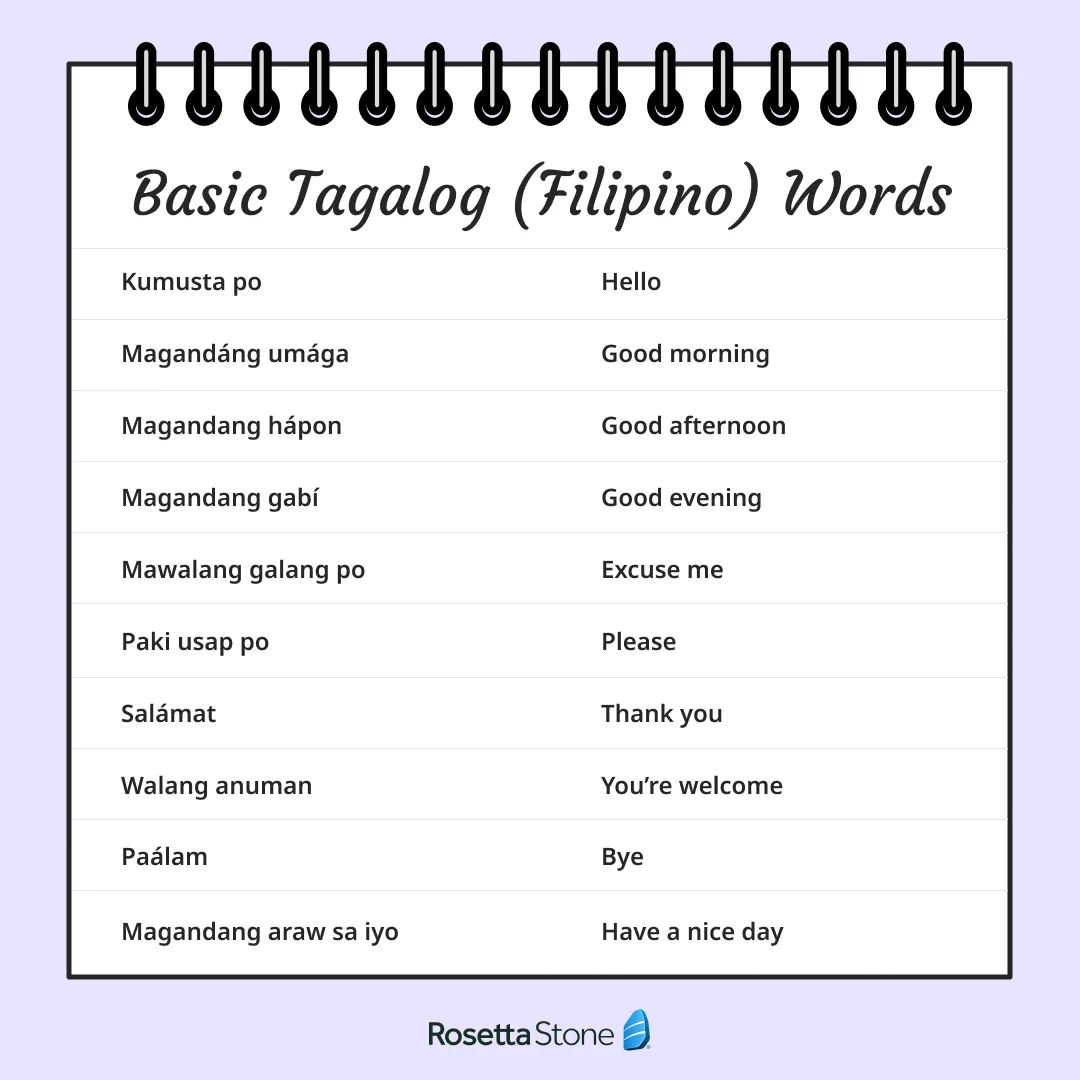
Image source: X
The "Hello" Conflict
Most beginners are taught that Kumusta is the Tagalog word for "Hello." While this is technically true, it is derived from the Spanish ¿Cómo está? and literally translates to "How are you?" In modern Manila, most locals initiate a conversation with a simple "Hi" or "Hello" and save Kumusta for the follow-up. If you want to sound more casual, especially among younger generations, you can use the shortcut "Musta?"
Time-Based Greetings
Filipinos frequently use time-specific greetings, which are considered very polite in professional and formal settings:
- Magandang umaga: Good morning (typically used until 11:59 AM).
- Magandang tanghali: Good noon (specifically for the 12:00 PM to 1:00 PM window).
- Magandang hapon: Good afternoon.
- Magandang gabi: Good evening.
A critical nuance in Filipino etiquette is the Reciprocity Rule . When someone greets you, it is customary to add rin or naman to your response. For example, if someone says "Magandang umaga," you should reply "Magandang umaga rin" (Good morning, too). This small addition demonstrates that you understand the flow of social interaction in the Philippines.
How to Use Po and Opo to Show Respect
If there is one linguistic "hack" that will earn you the most respect in the Philippines, it is the mastery of po and opo . These are respect markers used when speaking to elders, people in authority, or strangers. Failing to use them can sometimes be perceived as bastos (rude), even if your intention is friendly.
Po is a particle added to sentences to make them polite. Opo is the respectful version of "Yes" (the casual version is oo ). According to Preply's guide to Tagalog basics , these markers are non-negotiable for anyone looking to integrate into Filipino society.
The "Po" Hierarchy
| Scenario | Casual Phrase | Polite Phrase |
|---|---|---|
| Saying Thank You | Salamat | Salamat po |
| Saying Yes | Oo | Opo |
| Asking "How are you?" | Kumusta ka? | Kumusta po kayo? |
| Saying "I'm sorry" | Pasensya na | Pasensya na po |
Placement logic is simpler than it seems. Generally, you drop po after the first word of a sentence or at the very end. If you are unsure, adding it at the end of any phrase is a safe and highly recommended strategy for beginners.
Survival Scripts for Navigating the Philippines
Isolated words are helpful, but real-world fluency comes from "Flow Scripts"—sequences of phrases used in specific cultural experiences. Two of the most common experiences for visitors are riding a jeepney and dining out.
The Jeepney Flow Script
The jeepney is the iconic public transport of the Philippines. It has its own set of unwritten rules and specific vocabulary. Use this checklist to navigate your first ride:
- "Bayad po": Use this when handing your money to the person next to you. It means "Here is my payment."
- "Sa [Location] lang po": Tell the driver your destination. The lang (only/just) makes it sound more natural.
- "Sukli po?": If you are waiting for your change, this is a polite way to ask, "My change, please?"
- "Para po!": This is the most important phrase. It tells the driver to stop so you can get off.
Ordering Food Like a Pro
Filipino hospitality often centers around food. When entering a restaurant or a carinderia (local eatery), you can use these phrases to enhance the experience:
- "Ano ang mairerekomenda mo?": "What can you recommend?" This is a great way to discover local specialties.
- "Masarap!": "Delicious!" Saying this to the cook or server is a wonderful way to show appreciation.
- "Bill na po": This is the standard way to ask for the check.
Pro Tip: The "Bill Out" Gesture
In the Philippines, you don't always need words to ask for the bill. Catch the server's eye and draw an imaginary rectangle in the air with your index fingers and thumbs. This non-verbal cue is understood nationwide as "I'm ready for the check."
Understanding the Taglish Spectrum and Modern Slang
If you listen to people in a Manila mall, you will notice they aren't speaking "pure" Tagalog. They are speaking Taglish —a fluid, creative blend of Tagalog and English. In many urban areas, Taglish is the norm, and using too much "Deep Tagalog" can actually make you sound like a textbook or a historical drama character.
The most important word in the Taglish vocabulary is Ano . While it literally means "What," it serves as a universal placeholder. If you forget a word mid-sentence, you can say "Yung ano..." (The what-you-may-call-it) while you search for the right term. It is a linguistic lifesaver for learners.
Common Modern Slang Terms
- Lodi
- A reversal of "Idol." Used to describe someone you admire or someone who did something impressive.
- Petmalu
- A reversal of "Malupit" (cruel/harsh), but in slang, it means "amazing" or "cool."
- Mumshie
- A casual, affectionate term for a mother or a close female friend.
- Charot / Char
- Used at the end of a sentence to indicate you are "just kidding." It is a vital tool for navigating Filipino humor.
Romantic Phrases and Deep Untranslatable Words
Tagalog is a deeply emotional language with words that capture nuances often lost in English translation. This is most evident in the realm of romance and social philosophy.

Image source: FilipinoPod101
The "Mahal" Irony
One of the most famous linguistic quirks in Tagalog is the word Mahal . It has two primary meanings: "Love" and "Expensive." This leads to the classic Filipino joke, "Mahal ang mahal ko," which can mean "My beloved is expensive" or "My love is dear." When you say "Mahal kita," you are telling someone they are precious to you.
Untranslatable Concepts
According to community insights from Omniglot , several Tagalog words describe feelings that English requires entire sentences to explain:
- Kilig: That specific "butterflies in the stomach" feeling you get when something romantic happens.
- Gigil: The overwhelming urge to pinch something cute (like a baby) or the grit of teeth when you are frustrated but can't act on it.
- Bahala na: Often translated as "come what may," it represents a uniquely Filipino philosophy of resilience and faith in the face of uncertainty.
Linguistic Hacks to Help You Learn Faster
To move beyond simple phrases, you need to understand the "engine" of the language. Tagalog grammar is different from English, but it follows very logical patterns once you see them.
The VSO Structure
In English, we use Subject-Verb-Object (e.g., "I ate the bread"). Tagalog often prefers Verb-Subject-Object . Instead of saying "I left," you would say "Umalis ako" (Left I). Putting the action first is a hallmark of the language and helps you focus on what is happening rather than who is doing it.
Verb Aspect Over Tense
Tagalog verbs don't change based on the person (I/You/They), which is a relief for those who struggle with conjugations. Instead, they change based on the aspect : whether the action is completed, ongoing, or yet to happen. This is often done through "reduplication" (repeating a syllable).
| Root Word | Completed (Past) | Ongoing (Present) | Contemplated (Future) |
|---|---|---|---|
| Kain (Eat) | Kumain | Kumakain | Kakain |
| Laro (Play) | Naglaro | Nag lalaro | Maglalaro |
| Sulat (Write) | Sumulat | Sumusulat | Susulat |
By learning just the root word and the prefix/infix patterns, you can unlock hundreds of variations without memorizing individual conjugations for every pronoun.
Frequently Asked Questions
Is Tagalog the same as Filipino?
Technically, Filipino is the national language of the Philippines, and it is based primarily on Tagalog. In practice, the two are almost identical in daily conversation. Filipino is the modernized version that officially incorporates more loanwords from English and other Philippine languages, while Tagalog refers to the historical and regional language of Central Luzon.
How do I say "I don't understand" in Tagalog?
The most common way to say this is "Hindi ko po naintindihan." If you want to be even more casual, you can say "Hindi ko gets," which is a perfect example of Taglish that every local will understand immediately.
What is the most common greeting in the Philippines?
While Kumusta is the textbook answer, the most common greeting in urban areas is actually a simple "Hi" or "Hello." In more traditional or rural settings, a quick upward flash of the eyebrows accompanied by a smile is a very common non-verbal greeting that signifies acknowledgement and friendliness.
Do I need to learn the Baybayin script?
No, you do not need to learn Baybayin for daily life. While it is a beautiful historical script that is seeing a cultural resurgence in art, tattoos, and jewelry, the Philippines has used the Latin alphabet for centuries. All street signs, menus, and documents are written in the same alphabet used in English.
How do I say "Where is the bathroom?"
You can say "Saan ang banyo?" or more politely, "Saan po ang banyo?" In many malls and restaurants, you might also see the sign "CR," which stands for "Comfort Room." Asking "Nasaan ang CR?" is perhaps the most practical way to find a restroom in the Philippines.
Key Takeaways for Speaking Tagalog
Mastering a few Tagalog phrases can transform your experience in the Philippines from that of a tourist to that of a welcome guest. Here are the essential points to remember:
- Prioritize respect by adding po and opo when speaking to elders or strangers.
- Don't fear Taglish ; mixing English and Tagalog is the standard way of communicating in modern Manila.
- Use situational scripts like "Para po" and "Bayad po" to navigate local transport with confidence.
- Leverage Spanish loanwords to quickly build your vocabulary for household objects and abstract concepts.
- Focus on verb aspects (completed, ongoing, future) rather than worrying about gendered pronouns or complex tenses.
- Embrace the "Ano" placeholder whenever you find yourself stuck for a specific word.
Start by practicing your greetings today, and you will find that Filipinos are among the most encouraging and appreciative audiences for any language learner.