Home
What Are the Southwest Carry On Size Limits for 2026 Flights?
As of late 2026, Southwest maintains one of the most generous carry-on allowances in the industry. However, travelers must be aware of the significant policy shift that occurred in May 2025, which introduced fees for checked bags on standard fare classes.
Navigating the skies in 2026 requires more than just a boarding pass; it requires a precise understanding of how airline business models have evolved. For years, Southwest Airlines was the outlier in the domestic market, offering "2 Bags Fly Free" to every passenger. While that legacy remains for premium fares, the landscape for the average traveler has shifted. Understanding the swa carry on size limits is no longer just about convenience—it is about avoiding unexpected financial penalties at the boarding gate.
This guide provides a comprehensive breakdown of the current dimensions, the technicalities of measurement, and the strategic shifts necessary to navigate Southwest's updated fee structure. Whether you are a frequent flyer or planning your first trip in years, these details will ensure your luggage stays in the cabin and your budget stays intact.
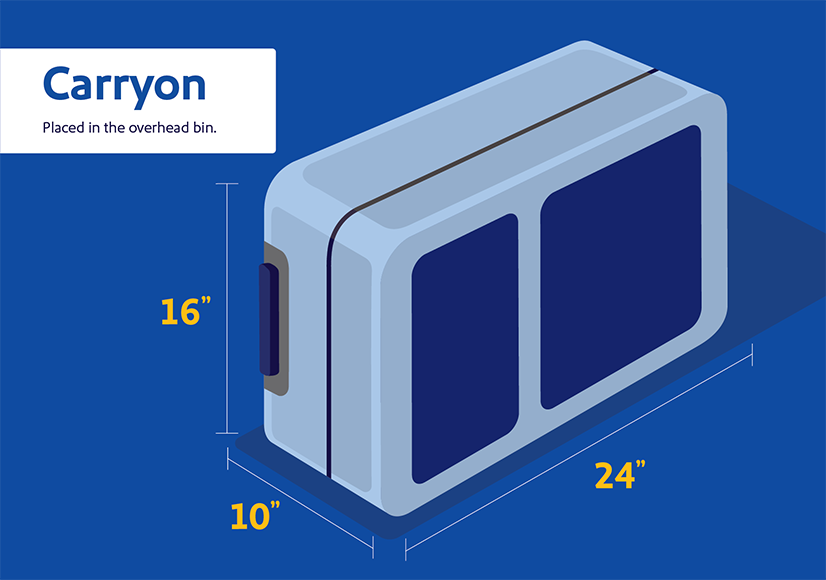
Image source: Southwest Airlines
Understanding the Standard Dimensions for Southwest Carry On Luggage
The current Southwest carry-on size limit stands at 24 x 16 x 10 inches (61 x 41 x 25 cm) . This allowance is notably larger than the 22 x 14 x 9-inch standard used by carriers like Delta, United, and American Airlines. This extra space allows travelers to pack significantly more, but it also creates a trap for those who assume their bag is "standard" without checking the specific depth and width requirements.
According to the SWA Official Policy , every passenger is permitted one carry-on bag and one personal item. The carry-on bag is intended for the overhead bin, while the personal item must be small enough to fit under the seat in front of you. Unlike many international carriers, Southwest does not currently enforce a specific weight limit for carry-on luggage. The primary constraint is physical: you must be able to lift the bag into the overhead compartment without assistance from the flight crew.
Why Wheels and Handles Must Be Included in Your Measurements
One of the most frequent mistakes travelers make is measuring only the "body" of the suitcase. Southwest is explicit that the 24 x 16 x 10-inch limit includes all external attachments. This means your measurement must start from the floor and extend to the very top of the handle in its retracted position. It must also account for side handles, protruding wheels, and even the bulk of external pockets.
If you are using a soft-sided suitcase, be particularly careful with overpacking. A bag that measures 10 inches deep when empty can easily bulge to 12 or 13 inches when stuffed with clothing. Gate agents often use visual "sizer triggers" to identify bags that might not fit. A bulging front pocket is a leading indicator that a bag will fail the manual sizer test. To stay safe, many frequent flyers recommend using packing cubes to maintain a flat profile and prevent the "football effect" where the center of the bag expands beyond the allowed depth.
Defining the Personal Item Requirements for Under Seat Storage
While the carry-on bag gets most of the attention, the personal item is equally important for a smooth boarding process. Southwest defines a personal item as something that fits entirely under the seat. While the official policy is often described by "fit," specific guidelines provided by sources like Wise suggest a maximum dimension of 18.5 x 13.5 x 8.5 inches .
Common examples of personal items include:
- Small backpacks or daypacks
- Laptop bags and briefcases
- Purses or handbags
- Camera bags
- Small totes or reusable shopping bags
It is important to note that if your personal item is too large to fit under the seat, it will be treated as a carry-on. If you already have a suitcase in the overhead bin, this could lead to a forced gate-check of one of your items. In the 2026 fee environment, this is a risk that can carry a price tag depending on your fare class.
Items That Do Not Count Toward Your Carry On Allowance
Southwest is widely regarded as a top choice for families and travelers with medical needs because of its generous list of "free" extras. Certain items do not count toward your one-carry-on, one-personal-item limit. According to Skyscanner , these exceptions include:
- Child Restraint Systems (Car Seats)
- If you have purchased a seat for your child, you can bring an FAA-approved car seat on board. If not, it can be checked at the gate for free.
- Assistive Devices
- Cane, crutches, walkers, and CPAP machines are exempt from bag counts. These must still be stowed safely according to FAA regulations.
- Outerwear and Umbrellas
- Coats, hats, and umbrellas do not count as bags and can be placed in the overhead bin on top of other luggage.
- Food for Consumption
- A small bag of snacks or food to be eaten during the flight is generally permitted outside of your bag count.
Pet carriers are a unique case. A pet carrier counts as either your carry-on bag OR your personal item. If you bring a pet, you are only allowed one other small item to bring into the cabin. Additionally, there is a pet fare (typically around $95 each way) that must be paid at the counter.
How the 2025 Baggage Fee Policy Changes Your Travel Strategy
The most significant advancement in Southwest's recent history was the restructuring of baggage fees that took effect for bookings made after May 28, 2025. For decades, the airline's identity was tied to "2 Bags Fly Free." While this remains a core feature for Business Select and Anytime fares, the introduction of the Basic and Choice fare tiers has changed the math for budget-conscious travelers.
Under the 2026 rules, passengers flying on Basic or Choice fares must pay $35 for their first checked bag and $45 for the second . This makes the carry-on bag more valuable than ever. Previously, if a bag was slightly too large, a gate agent would simply check it to your final destination for free. Now, if your bag fails the sizer and you are on a Basic fare, you are hit with that $35 fee right at the jet bridge.
Comparing Southwest Fare Classes and Bag Fees for 2026
To help you decide which fare to book, consider this framework based on current 2026 pricing and policies:
| Fare Type | Carry-On Bag | 1st Checked Bag | 2nd Checked Bag | Change Fees |
|---|---|---|---|---|
| Business Select | FREE | FREE | FREE | $0 |
| Anytime | FREE | FREE | FREE | $0 |
| Choice | FREE | $35 | $45 | $0 |
| Basic | FREE | $35 | $45 | Restricted |
For travelers who know they cannot fit everything into a 24-inch carry-on, upgrading to an "Anytime" fare may actually be more cost-effective than paying for two checked bags separately. Furthermore, A-List and A-List Preferred members of the Rapid Rewards program continue to receive two free checked bags regardless of the fare class they purchase, making status exceptionally valuable in the current ecosystem.
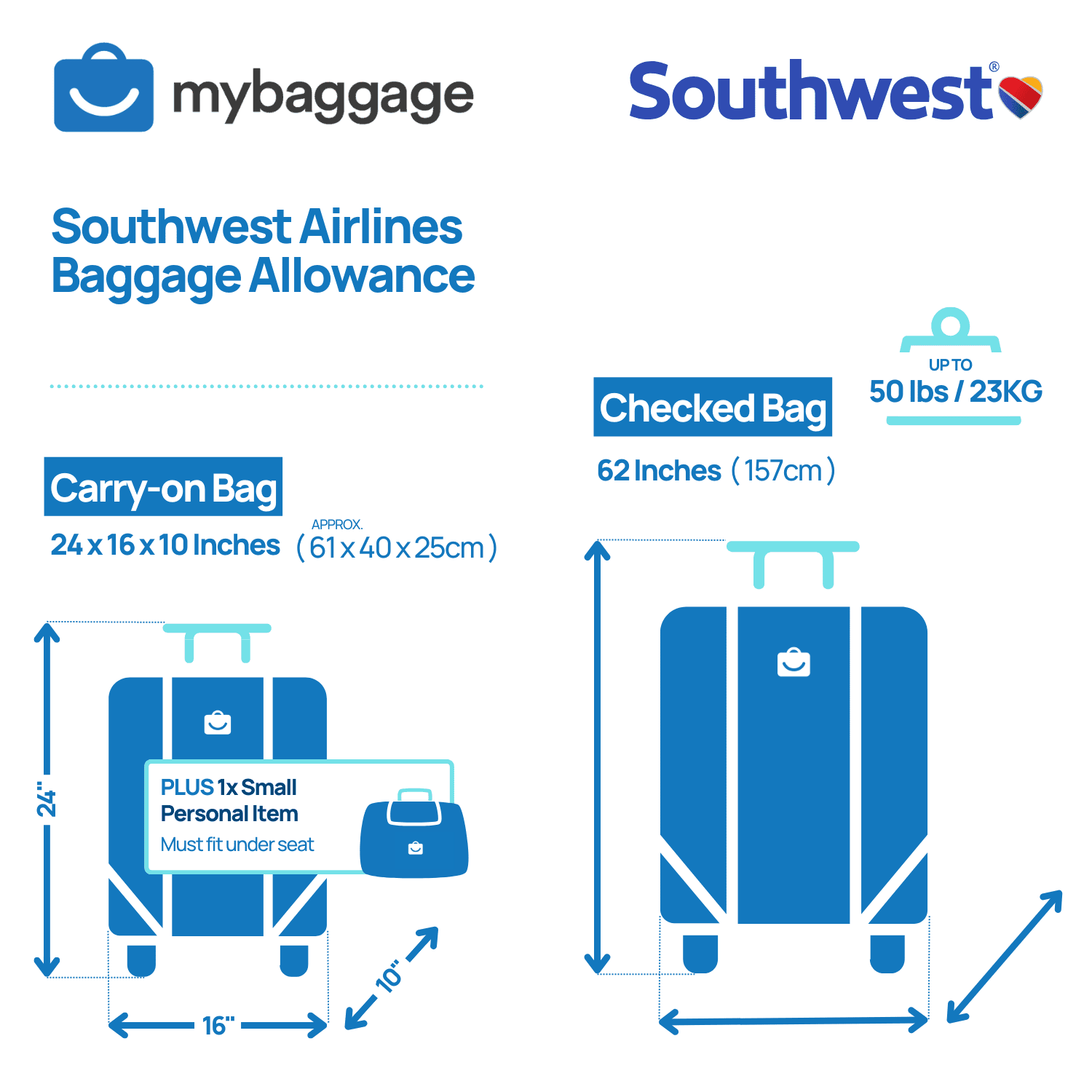
Image source: My Baggage
Factors That Determine How Strictly Gate Agents Enforce Size Limits
A common question among travelers is: "How strict is Southwest really?" The answer in 2026 is: "More than they used to be." With the new fee revenue on the line, there is more incentive for the airline to ensure bags meet the requirements. However, enforcement is often dictated by the specific circumstances of the flight.
Gate agents are trained to look for specific "Sizer Triggers." If your bag looks like it will struggle to fit, you are more likely to be asked to place it in the metal sizer box. These triggers include:
- Expansion Zippers: As mentioned, an expanded bag is a red flag.
- Vertical Height: Bags that appear taller than the agent's waistline often get a second look.
- Struggling Passengers: If you are visibly struggling to carry or lift your bag, it suggests the bag is overstuffed and potentially oversized.
- Full Flights: On a completely full Boeing 737, bin space is at a premium. Agents will be much stricter to ensure everyone gets their fair share of space.
The Impact of Aircraft Model on Overhead Bin Space
Southwest exclusively flies the Boeing 737, but not all 737s are created equal. The experience of stowing your bag can vary significantly depending on the specific model assigned to your route. According to My Baggage , the fleet is currently a mix of older and newer technology.
The Boeing 737-700 models feature older, smaller overhead bins. On these planes, a 24-inch bag often has to be placed sideways, which takes up more room and can lead to bins filling up faster. Conversely, the 737-800 and the 737 MAX 8 are equipped with "Space Bins." These bins are designed to allow bags to be stowed on their sides (like books on a shelf). This significantly increases the number of bags that can fit and usually results in a much more relaxed boarding process.
"The 'Lift Test' is the ultimate reality check for carry-on travelers. If you cannot independently place your bag in the overhead bin, Southwest crew members are generally instructed not to assist to prevent workplace injuries. If you can't lift it, it's going in the cargo hold."
Evaluating the Rumors Regarding a Shift to International Bag Sizes
In recent months, a viral rumor has circulated on social media platforms suggesting that Southwest is planning to shrink its carry-on limit to the international standard of 22 x 14 x 9 inches. As of late 2026, these claims remain unfounded. Official documentation and gate sizers still reflect the 24 x 16 x 10-inch allowance.
However, there is a logical reason why this rumor persists. Many luggage manufacturers have stopped producing 24-inch "carry-on" bags because they are only compliant with Southwest and a few other niche carriers. Most high-end luggage is now built to the 22-inch standard to ensure it works across all major airlines. While you *can* bring a larger bag on Southwest, many experts suggest that buying a 22-inch bag is a smarter long-term investment for travelers who don't exclusively fly with SWA.
If you choose to stick with the larger 24-inch limit, you are gaining about 25% more packing volume. This is a significant advantage for long trips where you want to avoid checking a bag entirely. Just be aware that if you ever have to switch to a different airline due to a cancellation or change in plans, that 24-inch bag will almost certainly need to be checked.
Selecting the Right Luggage to Maximize Your Southwest Cabin Space
To make the most of the swa carry on size , you need the right gear. Not all bags are created equal when it comes to fitting into a 737 overhead bin. Here are the top considerations for selecting your next piece of travel gear:
- Soft-Sided Duffels: These are widely considered a top choice for Southwest because they are flexible. If your bag is slightly over the 10-inch depth, you can often "squish" it into the sizer or the bin.
- Hard-Shell Risks: While hard-shell bags offer better protection, they are unforgiving. If a hard-shell bag is 10.5 inches deep, it simply will not fit in the sizer, and you will have no way to compress it.
- Two-Wheel vs. Four-Wheel: Four-wheel "spinners" are easier to navigate through the airport, but the wheels often stick out further, eating into your 24-inch height limit. Two-wheel "rollaboard" bags usually have recessed wheels, giving you more internal packing space.
- Under-Seat Pro: Look for a personal item with a "trolley sleeve" that allows it to slide over the handle of your carry-on. This makes navigating the terminal much easier and ensures your personal item stays within the 18.5 x 13.5 x 8.5-inch footprint.
When packing, remember the 3-1-1 rule for liquids still applies to Southwest carry-ons. Even though the bag can be larger, your shampoo and toothpaste must still be in 3.4oz containers or smaller, all fitting inside a single quart-sized clear bag. This is a TSA requirement that Southwest cannot waive.
Frequently Asked Questions About Southwest Baggage Rules
Does Southwest allow a 22x14x9 bag?
Yes, absolutely. Since the Southwest limit is 24x16x10, a standard 22x14x9 bag fits easily with room to spare. Many travelers prefer this size because it is also compatible with other major airlines like Delta and United, making it a more versatile choice for multi-carrier travel.
Is a backpack considered a personal item or a carry-on?
It can be either. If the backpack fits under the seat in front of you (roughly 18.5 x 13.5 x 8.5 inches), it counts as your personal item. If it is a large hiking pack or a travel backpack that needs to go in the overhead bin, it counts as your one carry-on bag.
What happens if my bag is 1 inch too big?
If a gate agent notices the discrepancy, they will ask you to test the bag in the metal sizer. If it doesn't fit, the bag must be gate-checked. For Business Select and Anytime fares, this is usually free. However, for Basic and Choice fares, you will likely be charged the $35 checked bag fee on the spot.
Does Southwest have a carry-on weight limit in 2026?
No, Southwest does not have an official weight limit for carry-on bags. The only requirement is that the passenger must be able to lift the bag into the overhead bin without assistance. If the bag is so heavy that you cannot lift it, the crew will require you to check it for safety reasons.
Can I bring a garment bag as a carry-on?
Yes, garment bags are allowed as long as they fit within the 24x16x10 dimensions when folded. Note that Southwest planes do not have closets for hanging bags, so your garment bag will need to lay flat on top of other suitcases in the overhead bin.
Are CPAP machines and breast pumps counted as carry-ons?
No. Medical devices, including CPAP machines, breast pumps, and mobility aids, are exempt from the carry-on count. You may bring these in addition to your one carry-on and one personal item, provided they are stowed according to FAA safety guidelines.
Final Takeaways for Navigating Southwest Baggage Policies
Mastering the Southwest baggage system in 2026 requires a blend of precise measurement and fare-class awareness. Here are the key points to remember before your next flight:
- Respect the 24x16x10 limit: This includes wheels and handles; don't let a protruding wheel cost you $35.
- Know your fare class: Basic and Choice fares no longer include free checked bags; your carry-on is your primary way to save money.
- Watch for sizer triggers: Keep expansion zippers closed and avoid overstuffing external pockets to stay under the radar of gate agents.
- Utilize the personal item: Maximize your 18.5 x 13.5 x 8.5-inch space under the seat for heavy items to keep your overhead bag light.
- Check the aircraft type: If you're on a 737-700, board as early as possible, as the smaller bins fill up much faster than the newer MAX 8 Space Bins.
- Leverage medical exemptions: Don't waste bag space on CPAP machines or strollers; these fly for free outside of your bag limit.
Before you head to the airport, perform a "lift test" at home to ensure you can comfortably stow your own luggage in a high compartment.