Home
How to Follow the TSA Liquid Limit and 3-1-1 Rule Without Getting Items Confiscated
As of October 2026, the TSA liquid limit for carry-on luggage remains the 3-1-1 rule: each passenger may carry liquids, gels, and aerosols in containers of 3.4 ounces (100 milliliters) or less. All containers must fit into one clear, quart-sized bag , and each traveler is limited to one bag . While modern CT scanners at some airports allow you to keep these bags inside your luggage, the volume restrictions still apply nationwide.
The Quick Summary of the TSA 3-1-1 Rule
Navigating airport security can be a stressful experience, particularly when it comes to packing your toiletries and snacks. The Transportation Security Administration (TSA) enforces specific regulations to ensure aviation safety, primarily focusing on the potential for liquid explosives. The cornerstone of these regulations is the 3-1-1 rule, a mnemonic designed to help travelers remember the three core components of the liquid policy.
First, the "3" refers to the maximum size of each individual container: 3.4 ounces or 100 milliliters. This limit was established following international security protocols and is widely considered a standard for global travel. Second, the first "1" signifies that all these containers must fit into a single, clear, quart-sized, resealable plastic bag. Finally, the second "1" indicates that each passenger is permitted only one such bag in their carry-on luggage.
According to the official TSA Liquids Rule , this policy applies to all liquids, aerosols, gels, creams, and pastes. This includes everything from your morning shampoo to the peanut butter in your sandwich. While the technology used at checkpoints is evolving—with many airports now utilizing advanced 3D imaging—the fundamental volume limits remain a federal requirement for all domestic and international flights departing from the United States.
Why Your Container Size Matters More Than the Liquid Inside
One of the most frequent reasons for confiscation at security checkpoints is what experts call "The Capacity Trap." Many travelers believe that if they have a large bottle that is nearly empty, it should be allowed because the actual volume of liquid is less than 3.4 ounces. However, TSA officers are trained to look at the printed capacity on the bottle, not the liquid level inside.
For example, if you attempt to bring a 6-ounce bottle of expensive face cream that only has 1 ounce of product remaining, it will likely be confiscated. The rationale is that security officers cannot quickly and accurately verify the exact volume of liquid in a large container, and a large bottle provides space for potentially hazardous materials. To avoid this, always transfer your products into dedicated travel-sized containers that clearly state they are 3.4 oz (100ml) or smaller.
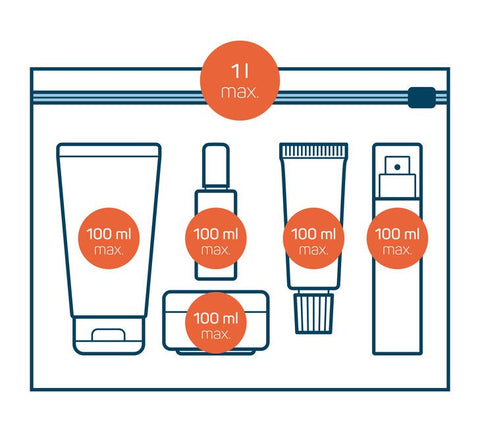
Image source: ROAM Luggage
Furthermore, be wary of products labeled as "travel size" that may actually exceed the limit. Some brands sell 4-ounce versions of their products in the travel aisle. While these look small, they are technically over the limit and subject to seizure. Always check the fine print on the back of the packaging before heading to the airport.
How to Tell if Your Item Counts as a Liquid or a Solid
Distinguishing between a liquid and a solid isn't always as intuitive as it seems. While water and perfume are obvious, items like toothpaste, mascara, and even certain foods fall into a gray area that often confuses passengers. To simplify this, travel experts often suggest the "Butter Knife Rule."
The Butter Knife Rule for Food Items
If you can easily pass a butter knife through a substance, or if it retains the shape of its container, the TSA likely classifies it as a liquid, gel, or paste. This is particularly important for food items. Common culprits that travelers forget are liquids include:
- Spreads: Peanut butter, hummus, Nutella, and cream cheese.
- Preserves: Jams, jellies, honey, and maple syrup.
- Dairy: Yogurt, cottage cheese, and soft cheeses (like brie or camembert).
- Canned Goods: Any canned food with liquid content, such as soup or tuna in oil.
The Solid Advantage: Items Exempt from the 3-1-1 Bag
To maximize space in your quart-sized bag, many experienced travelers switch to solid alternatives. These items do not need to be placed in your clear plastic bag and have no volume restrictions. According to Away Travel's guide to TSA rules , the following are considered solids:
Stick deodorants are considered solids. However, gel or spray versions must go in the 3-1-1 bag.
Switching to bar soap and shampoo bars is a top-tier strategy to save liquid space.
Blush, foundation, and eye shadow in powder form are not subject to liquid limits.
Understanding the Physical Limits of the Quart-Sized Bag
The "1" in 3-1-1 refers to a quart-sized bag, but what does that actually mean in terms of dimensions? A standard quart-sized resealable bag typically measures approximately 7 x 8 inches . Using a bag larger than this, such as a gallon-sized freezer bag, is a common mistake that can lead to extra screening or the requirement to discard items until they fit into a smaller bag provided by the airport.
In terms of total volume, a quart bag holds roughly 946 milliliters. If you are using standard 3.4 oz (100ml) bottles, you can typically fit between 7 and 9 bottles if you pack them efficiently. "Nesting" your bottles—placing them top-to-bottom—is a highly recommended technique to maximize every square inch of the bag. Remember, the bag must be able to seal comfortably; if it is bursting at the seams, an officer may ask you to remove items.
Which Items Are Exempt From the 3.4 Ounce Limit?
While the 3-1-1 rule is strict for standard toiletries, the TSA provides essential exceptions for health and family needs. These items do not need to fit inside your quart-sized bag, though they must be declared to the security officer for separate screening.
Medically Necessary Liquids and Screening Procedures
Prescription and over-the-counter liquid medications, including insulin, eye drops, and inhalers, are allowed in "reasonable quantities" exceeding 3.4 ounces. As noted by Condé Nast Traveler , you should inform the TSA officer at the beginning of the screening process that you have these items. They may undergo additional testing, such as a vapor analysis or a brief opening of the container.
If you have medications that are sensitive to X-rays, you have the right to request a visual inspection instead. This will trigger a manual search and potentially a pat-down, but it ensures the integrity of your medical supplies.
Infant and Child Nourishment Rules
Parents traveling with infants or toddlers are granted significant leeway. Formula, breast milk, toddler drinks, and baby food (including puree pouches) are permitted in carry-on bags. Interestingly, you do not even need to be traveling with your child to carry breast milk; it is considered a medically necessary liquid regardless of the child's presence.
The Ice Pack Rule: If you are using gel packs or ice packs to keep milk or medicine cool, they must be frozen solid when you reach the checkpoint. If the packs are slushy, melting, or have liquid at the bottom, they will be treated as standard liquids and must meet the 3.4 oz limit or be discarded.
How New CT Scanners Are Changing Airport Security in 2026
As we move through 2026, the landscape of airport security is undergoing a significant advancement. The TSA has been aggressively rolling out Computed Tomography (CT) scanners at major hubs. These machines create a 3D image of your bag's contents, allowing officers to manipulate the view to see around items.
At checkpoints equipped with this technology, the requirement to remove your 3-1-1 bag and electronics from your carry-on is being phased out. This makes the process much faster and reduces the likelihood of leaving items behind in the bins. However, a common misconception is that these scanners mean the 3.4 oz limit has been abolished. This is incorrect. Even with the most advanced scanners, the federal volume limit for liquids remains in place to mitigate the risk of liquid explosives. Always follow the specific instructions of the officers in your lane, as technology varies significantly from one airport to another.
Bringing Duty-Free Liquids on International Connecting Flights
Buying a bottle of high-end spirits or perfume at a duty-free shop is a popular travel tradition, but it can become a headache if you have a connecting flight. If you buy a liquid larger than 3.4 oz at an international duty-free shop and are connecting to a domestic U.S. flight, you must follow the STEB (Secure Tamper-Evident Bag) protocol.
The liquid must be placed in a transparent, secure bag by the retailer, and the original receipt must be visible inside. This allows you to carry the item through security at your connecting airport, provided the bag has not been opened and the purchase was made within the last 48 hours. A frequent mistake is travelers opening the STEB to "repack" their bags before reaching their final destination, which leads to immediate confiscation at the second security checkpoint.
What Are the Liquid Limits for Checked Luggage?
If you need to transport large quantities of liquids, the checked bag is your top choice. The 3-1-1 rule does not apply to luggage stored in the cargo hold. However, there are still safety restrictions, particularly regarding alcohol. According to Level8's analysis of alcohol rules , the limits are based on Alcohol By Volume (ABV):
| Alcohol Type | ABV Percentage | Checked Bag Limit |
|---|---|---|
| Beer and Wine | Under 24% | No Limit (within weight restrictions) |
| Spirits / Liquor | 24% – 70% | 5 Liters per passenger |
| High-Proof Alcohol | Over 70% | Prohibited (Hazardous Material) |
Frequently Asked Questions
- Can I bring a 4 oz bottle of toothpaste if it is mostly empty?
- No. The TSA measures the container's capacity, not the amount of product left. A 4 oz tube will be confiscated even if it only contains a small amount of toothpaste. You must use a container that is 3.4 oz or smaller.
- Is stick deodorant considered a liquid by the TSA?
- No, solid stick deodorant is considered a solid and does not need to go in your 3-1-1 quart-sized bag. However, gel, spray, or roll-on deodorants are classified as liquids/aerosols and must follow the 3.4 oz rule.
- How many 3.4 oz bottles can I fit in my quart bag?
- There is no specific limit on the number of bottles, as long as they all fit comfortably and the bag can be sealed. Most travelers find they can fit between 7 and 9 standard travel-sized bottles using efficient packing methods.
- Can I bring a frozen water bottle through security?
- Yes, but only if it is 100% frozen solid at the time of screening. If there is any liquid water at the bottom of the bottle or if it has begun to melt, it will be rejected unless it is 3.4 oz or less.
- Does the liquid rule apply to contact lens solution?
- Contact lens solution is generally treated as a medically necessary liquid. While you can bring larger bottles, you must declare them to the officer for separate screening. It does not have to fit in your quart-sized bag.
Key Takeaways for Managing the TSA Liquid Limit
- Verify the container size printed on the label, as the TSA ignores how much liquid is actually inside.
- Apply the Butter Knife Rule to food items like peanut butter or yogurt to determine if they count as liquids.
- Separate medical and baby liquids from your standard 3-1-1 bag and declare them to officers immediately.
- Keep duty-free STEB bags sealed until you have cleared your final security checkpoint on connecting flights.
- Transition to solid toiletries like shampoo bars and stick deodorants to free up space in your quart-sized bag.
- Check ABV levels for alcohol in checked bags, ensuring nothing exceeds the 70% limit.
For the smoothest experience, always pack your 3-1-1 bag in an easily accessible outer pocket of your carry-on in case you are asked to remove it for screening.