Home
What Is the Difference Between a Lease and a Rental Agreement?
Navigating the world of real estate can be confusing, especially when terms like "lease" and "rent" are thrown around as if they mean the exact same thing. In casual conversation, saying you "rent an apartment" or "lease a car" might convey the same general idea: you are paying to use something you don't own. However, from a legal and financial perspective, these terms represent distinct obligations that can significantly impact your housing security and your wallet.
Understanding these nuances is essential for anyone looking for a new home or business space. According to HomeRiver Group , the distinction lies primarily in the timeframe and the stability of the contract terms. Whether you are a digital nomad seeking a temporary base or a family looking for a permanent neighborhood, choosing the right agreement type is a foundational step in your financial planning.
The Core Differences Between Leasing and Renting at a Glance
The primary differentiator between a lease and a rental agreement is the duration of the contract. A lease is a fixed-term agreement, meaning it has a specific start and end date. Conversely, a rental agreement is typically periodic, often renewing every 30 days. This fundamental difference ripples through every other aspect of the contract, from how much you pay to how easily you can walk away.
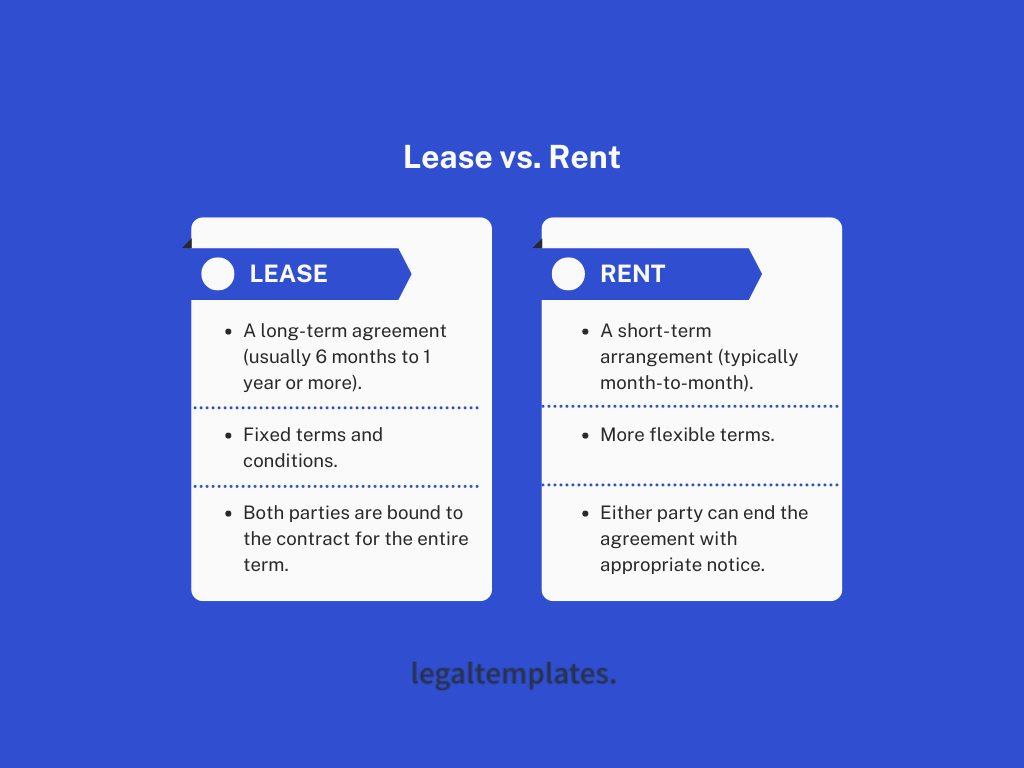
Image source: Legal Templates
In a lease, the landlord is legally bound to the terms for the entire period. They cannot raise the rent or change the rules regarding pets or parking until the lease expires. In a month-to-month rental agreement, the landlord has the right to change these terms, provided they give the tenant proper notice—usually 30 days. This makes rental agreements a top choice for those who prioritize flexibility over long-term cost certainty.
| Feature | Lease Agreement | Rental Agreement |
|---|---|---|
| Typical Duration | 6, 12, or 24 months | Month-to-month (30 days) |
| Rent Increases | Locked for the term | Can change with 30 days' notice |
| Flexibility to Move | Low (requires breaking lease) | High (30-day notice) |
| Legal Stability | High (fixed terms) | Moderate (terms can shift) |
| Renewal Type | Requires new contract | Automatic monthly renewal |
Why a Fixed-Term Lease Offers More Stability for Tenants
For many tenants, a lease stands out as a top choice because of the predictability it provides. When you sign a 12-month lease, you are essentially freezing your housing costs for the next year. In a volatile market where property values and taxes are rising, this protection is invaluable. Landlords cannot suddenly decide to charge an extra $200 a month just because the neighborhood has become more popular.
Beyond financial predictability, a lease offers "security of tenure." As long as you follow the rules laid out in the contract—such as paying on time and not damaging the property—the landlord cannot ask you to leave until the term is up. This is a significant advantage for families with children in local schools or individuals who have invested time in making a house feel like a home. According to Experian , this stability is one of the main reasons people opt for longer commitments.
Protection Against Eviction Without Cause
In a lease, the landlord must have a specific legal reason (cause) to terminate the agreement early. This might include non-payment of rent or a serious violation of the lease terms. Without such cause, the tenant has the right to remain in the property until the final day of the contract. This differs from month-to-month agreements, where a landlord can often terminate the tenancy for no reason at all, simply by providing the required notice period.
Budgeting and Long-Term Planning
Knowing exactly what your largest monthly expense will be for the next 12 to 24 months allows for much more accurate financial planning. You can save for a down payment on a house, invest in your education, or plan a major vacation with the confidence that your rent won't suddenly spike. For those on a fixed income, such as retirees or students, a lease is often considered one of the strongest tools for maintaining financial health.
When a Month-to-Month Rental Agreement Is the Better Choice
While stability is great, it isn't everyone's priority. Life is often unpredictable, and sometimes you need the ability to pack up and move on short notice. This is where the month-to-month rental agreement shines. It is widely regarded as a top-tier option for people in transition, such as those who have just moved to a new city for a job or those who are currently house hunting and don't want to be locked into a long-term commitment.
The primary benefit here is the low "exit cost." If you need to move, you typically only need to give 30 days' notice. You won't face the hefty "break-lease" fees that often accompany a fixed-term contract, which can sometimes equal two or three months of rent. This flexibility allows you to "test drive" a neighborhood or a specific building before deciding if you want to commit to a longer stay.
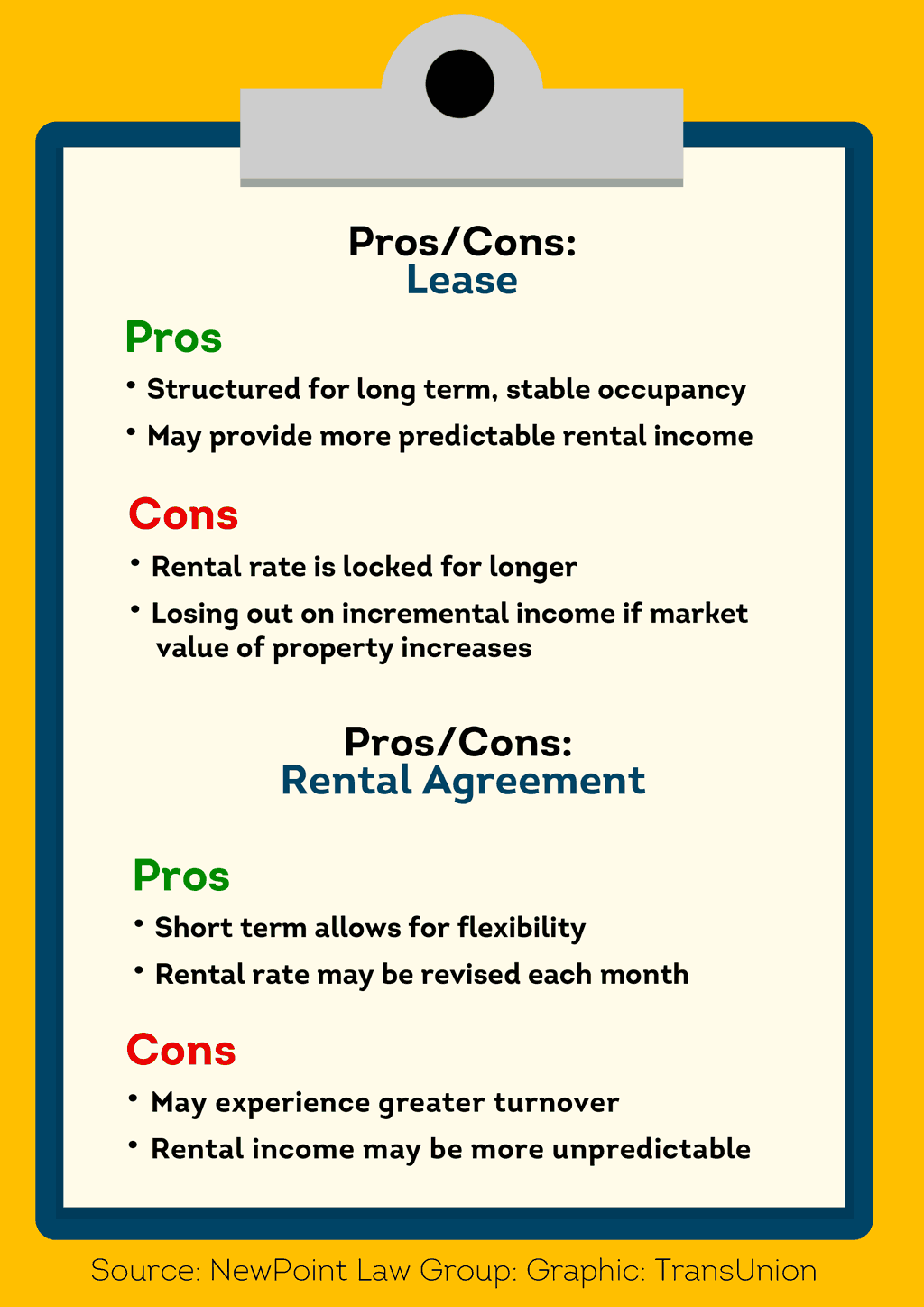
Image source: TransUnion SmartMove
However, this flexibility comes with a trade-off. Because the landlord is also not locked in, they can raise the rent or ask you to move out with the same 30-day notice. In high-demand markets, month-to-month tenants are often the first to see price hikes. As noted by MySmartMove , landlords often charge a premium for the flexibility of a month-to-month arrangement, meaning your monthly payment might be higher than it would be under a year-long lease.
What Happens When Your Lease Expires?
A common point of confusion for tenants is what happens on the day their lease ends. Does the landlord show up with a moving truck? Not necessarily. In many jurisdictions, if a lease expires and neither party takes action, the agreement automatically converts into a "tenancy at will" or a month-to-month rental agreement. This transition is governed by the original lease's terms, but the duration becomes periodic.
While this might seem convenient, it carries risks. Once you become a "holdover tenant"—someone who stays past the lease end date—you may be subject to different rules. Some leases include a clause that increases the rent by 10% to 20% if the tenant stays without signing a new long-term contract. Furthermore, in some states, a landlord can charge "double rent" for every day a tenant stays past their move-out date without permission.
Negotiating a Renewal
If you want to stay, the best course of action is to negotiate a renewal several months before the current lease expires. This is your chance to lock in a new rate and perhaps request upgrades to the unit, like new carpet or appliances. Landlords generally prefer to keep good tenants rather than deal with the costs of cleaning and re-listing a unit, so you may have more leverage than you think.
The Risk of "Tenancy at Will"
Staying on a month-to-month basis after a lease ends offers flexibility, but it removes your price protection. If the market has heated up during your year-long lease, the landlord might immediately issue a notice for a significant rent increase once you are no longer under the protection of the fixed-term contract. Always read the "Renewal" section of your original lease to understand exactly how your status changes once the clock runs out.
Understanding the "Look and Lease" Marketing Tactic
If you've been apartment hunting recently, you've likely seen advertisements for "Look and Lease" specials. This is a highly impactful marketing tactic used by property management companies to fill vacancies quickly. The premise is simple: if you sign a lease within a very short window—usually 24 to 48 hours—after your first tour, you receive a significant incentive.
Common incentives include:
- A waived application or administrative fee (saving $50–$200).
- A reduced security deposit.
- A credit toward your first month's rent (e.g., "$500 off your first month").
- "One month free" on a 13-month lease.
While these deals can save you a lot of money upfront, they are designed to create a sense of urgency. Prospective tenants may feel pressured to sign before they've had a chance to compare other options or thoroughly read the fine print. It is important to note that these specials often come with non-negotiable terms, such as a specific lease length that might be longer than the standard 12 months. Always calculate the "effective rent" (total cost over the whole term divided by the number of months) to see if the deal is truly a bargain.
Commercial Lease Types Every Small Business Should Know
For business owners, the difference between leasing and renting takes on a whole new level of complexity. Commercial leases are rarely simple "rent-for-space" agreements. Instead, they are categorized by how the building's operating expenses—like taxes, insurance, and maintenance—are split between the landlord and the tenant. According to GNP Realty , understanding these structures is vital for a business's bottom line.
Single Net Lease (N)
The tenant pays the base rent plus the property taxes. The landlord covers insurance and maintenance. This is a step up in responsibility from a standard residential lease.
Double Net Lease (NN)
The tenant pays rent, property taxes, and property insurance. This is common in multi-tenant buildings where insurance costs are easily partitioned.
Triple Net Lease (NNN)
The tenant pays for almost everything: rent, taxes, insurance, and all maintenance/repairs. This is a popular choice for standalone buildings and long-term commercial investments.
A "Gross Lease" is the opposite of these net leases; it is an all-inclusive agreement where the tenant pays one flat fee, and the landlord handles all other costs. While a Gross Lease is simpler for budgeting, a Triple Net lease can sometimes result in lower overall costs if the tenant manages the property efficiently. However, the risk of a major repair, like a roof replacement, falls entirely on the tenant in an NNN scenario.
Accounting and Tax Implications of Leasing vs. Renting
For businesses, the choice between a long-term lease and a short-term rental isn't just about space—it's about the balance sheet. Modern accounting standards, specifically ASC 842 and IFRS 16, have changed how leases are reported. In the past, many leases were kept "off-balance sheet," but now, most long-term leases must be recognized as both a "Right of Use" (ROU) asset and a corresponding liability.
This means that signing a 10-year lease can significantly change your company's debt-to-equity ratio. On the other hand, short-term rental agreements (typically those under 12 months) can often be treated as simple operating expenses. This keeps the accounting much simpler and doesn't affect the company's long-term liability profile. Small business owners should consult with a CPA to determine which structure offers the most favorable tax and reporting outcomes for their specific situation.
Regional Differences in Rental Terminology Around the World
If you are moving internationally, don't assume that "lease" means the same thing in London or Mumbai as it does in New York. Terminology varies wildly, and signing the wrong document could leave you with fewer protections than you expect.
- United Kingdom & Australia
- The term "Tenancy Agreement" is the standard for residential properties. A "Lease" often refers to a very long-term interest in land (sometimes 99 or 999 years), which is more akin to ownership than renting.
- India
- Most residential agreements are called "Leave and License" agreements. These are technically different from a lease because they grant permission to use the property without creating a legal interest in the land, making it easier for owners to reclaim the property.
- United States
- As discussed, "Lease" and "Rental Agreement" are the primary terms, with local ordinances in cities like Seattle or San Francisco providing additional layers of tenant protection that can override the written contract.
For expats, it is crucial to research local laws. In some countries, "renting" might not give you the right to receive mail at the address or register for local services, whereas a formal "lease" would. Always verify the legal standing of your agreement with a local expert before signing.
Frequently Asked Questions
Can a landlord change the rent during a lease?
Is it better to lease or rent an apartment?
What happens if I break a lease early?
Does leasing a car count as renting?
What is a "Holdover Tenant"?
Are security deposits different for leases vs. rentals?
The Bottom Line
Choosing between a lease and a rental agreement is a balance of security versus freedom. Here are the key takeaways to remember:
- Leases provide stability: They lock in your rent price and terms for a fixed period, usually 6 to 12 months.
- Rentals offer flexibility: Month-to-month agreements allow you to move with just 30 days' notice, though prices can change.
- Commercial leases are complex: Types like Triple Net (NNN) require tenants to pay for taxes, insurance, and maintenance.
- Watch the expiration: Expired leases often convert to month-to-month "at-will" status, which may include price hikes.
- Marketing tactics matter: "Look and Lease" deals offer great upfront savings but require fast decision-making.
- Regional terms vary: Always check local definitions, especially when moving to countries like the UK or India.
Before signing any document, carefully review the termination and renewal clauses to ensure the agreement aligns with your long-term plans.