Home
What Is the Difference Between an Apartment and a Condo?
The primary difference between an apartment and a condo is ownership . An apartment is a unit within a building owned by a single entity (such as a corporation or LLC) and leased to tenants. A condominium (condo) is an individually owned unit within a multi-unit complex, where the owner holds a deed to the specific unit and shares ownership of common areas with other residents.
When walking through a modern high-rise in a major city, it is often impossible to tell from the lobby alone whether you are in an apartment building or a condominium complex. Physically, they may be identical—featuring the same floor plans, stainless steel appliances, and rooftop pools. However, the legal and financial structures governing these two types of housing are worlds apart.
Understanding these distinctions is vital for anyone deciding whether to sign a lease or apply for a mortgage. While an apartment offers flexibility and a predictable monthly cost, a condo represents a long-term investment that builds equity but comes with the added responsibilities of property taxes, homeowners association (HOA) fees, and internal maintenance. This guide explores the nuances of each to help you determine which path aligns with your financial goals.
How Ownership and Management Work in Each Building
The fundamental distinction lies in who holds the deed to the property. In an apartment complex, a single entity—often a large real estate investment firm or a professional management corporation—owns the entire building and all the land it sits on. Residents are tenants who sign a contract for the right to occupy a specific unit for a set period.
The Legal Entity vs. The Individual Deed
According to FS Residential , the ownership structure dictates how the building is managed. Apartment buildings operate under corporate management. There is usually an on-site leasing office with professional staff who handle everything from tenant screenings to lease renewals. The rules are standardized; every tenant in the building generally follows the same set of guidelines regarding noise, pets, and parking.
In contrast, a condo building is a collection of individual properties. When you buy a condo, you receive a deed to the "airspace" within your unit and a percentage of interest in the "common elements," such as the hallways, elevators, and exterior landscaping. This means that your neighbor is not just a fellow resident, but a co-owner of the building's infrastructure.
Professional Management vs. The Homeowners Association
Condos are governed by a Homeowners Association (HOA), which is a board of directors typically elected from among the owners. The HOA is responsible for maintaining the building's structural integrity and managing the budget for shared amenities. This governance is guided by a set of Covenants, Conditions, and Restrictions (CC&Rs). These rules can be much more granular than a standard apartment lease, potentially dictating the type of window treatments you can use or the specific hours you are allowed to move furniture.
While apartment management is a business relationship, condo governance is a community-led process. This can lead to a more personalized living experience, but it also means that the quality of management depends heavily on the competence and financial literacy of the elected board members.
Who Is Responsible for Maintenance and Repairs?
One of the most significant lifestyle differences between these two housing types is what happens when a faucet leaks or the air conditioning fails. The responsibility for repairs is clearly divided based on the ownership model.
The "One Call" Rule for Apartments
For apartment dwellers, maintenance is typically a "hands-off" experience. Because the landlord owns the building and all its fixtures, they are legally responsible for keeping the unit in a habitable condition. If a refrigerator stops working or a lightbulb in the hallway burns out, the tenant simply submits a maintenance request. As noted by Zillow , this convenience is a primary draw for renters who prefer not to deal with the costs or logistics of home repair.
The "Walls-In" Concept for Condos
Condo owners face a more complex reality known as "walls-in" responsibility. Generally, the owner is responsible for everything inside the unit. This includes appliances, plumbing fixtures, flooring, and even the drywall. If a pipe bursts inside your kitchen wall, you are responsible for hiring a plumber and paying for the repairs.
The HOA handles the "walls-out" maintenance. This includes the roof, the building's exterior siding, the lobby, and the elevators. These repairs are funded by monthly HOA fees. However, if the HOA does not have enough money in its "reserve fund" to cover a major repair—like a new roof—they may issue a "special assessment," which is a large, one-time bill sent to every owner in the building.
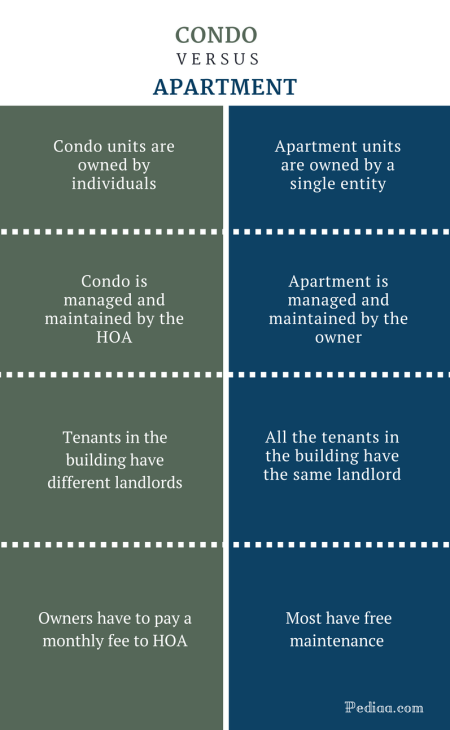
Image source: Pediaa.Com
Comparing the Financial Costs of Renting vs. Buying
The financial barrier to entry is perhaps the most stark difference. Renting an apartment requires relatively low upfront capital, while buying a condo requires a significant investment and a strong credit profile.
Upfront Costs and Credit Benchmarks
To move into an apartment, you typically need a security deposit (often equal to one month's rent) and the first month's payment. Landlords generally look for a credit score of at least 650, though this can vary by market. According to Bungalow , the process is relatively fast, often taking only a few days from application to approval.
Buying a condo is a much more involved process. You will need a down payment—ideally 20% to avoid private mortgage insurance (PMI)—plus closing costs that typically range from 3% to 4% of the purchase price. For a $300,000 condo, this means you might need $72,000 in cash just to get the keys.
The Hidden Mortgage Reserve Requirement
A detail often overlooked by first-time buyers is the "mortgage reserve" rule. Many lenders require condo buyers to have at least four months of liquid cash reserves (covering the mortgage, taxes, and HOA fees) sitting in a bank account after the closing is finished. This ensures that the owner can handle a temporary loss of income without defaulting. This requirement makes the condo path significantly more expensive in the short term than renting an apartment.
Is Renting a Condo Different from Renting an Apartment?
It is common to find condos listed for rent on platforms like Zillow or Redfin. In this scenario, you are a tenant, but your landlord is an individual person rather than a corporation. This creates a very different living experience.
The Individual Landlord Experience
Renting from an individual owner can offer more flexibility. You might be able to negotiate the rent or the terms of the lease more easily than you could with a rigid corporate management office. The unit itself may also have higher-end finishes, as the owner may have lived there and invested in upgrades like granite countertops or hardwood floors.
The Maintenance Risk Profile
However, there is a risk involved. Individual owners may lack the immediate capital or the professional network to handle emergency repairs. While a large apartment complex has an on-site maintenance team available 24/7, a condo owner might be traveling or simply slow to respond when your water heater breaks. Furthermore, you are still subject to the HOA's rules, which the owner must pass down to you in the lease agreement.
Understanding the Insurance Gap Between HO-4 and HO-6
Insurance is another area where the two housing types diverge. Many residents mistakenly believe that one type of policy covers all multi-unit living, but the coverage needs are distinct. As explained by ALCOVA Mortgage , choosing the wrong policy can leave you with massive out-of-pocket expenses.
Renters Insurance (HO-4)
If you live in an apartment, you need an HO-4 policy. This covers your personal belongings (like your laptop, furniture, and clothes) and provides liability coverage if someone is injured inside your unit. It does not cover the building itself, as that is the landlord's responsibility.
Condo Insurance (HO-6)
Condo owners require an HO-6 policy. Because you own the "walls-in" portion of the unit, you need structural coverage for your cabinets, flooring, and interior walls. A critical feature of HO-6 insurance is "Loss Assessment Coverage." If the HOA is sued or faces a massive building-wide repair and charges the owners a special assessment, this coverage can help pay your portion of that bill.
Regional Differences in Housing Terminology
Terminologies can vary significantly depending on where you are searching for a home. While "condo" and "apartment" are standard in the United States, international markets use different labels that can cause confusion for expats or investors.
What Is a Strata?
In parts of Canada, particularly British Columbia and Ontario, the legal equivalent of a condo is called a "Strata." The "Strata Council" functions exactly like a U.S. HOA, and the "Strata Fees" cover the maintenance of common areas. The legal framework is governed by the Strata Property Act, which provides specific protections for owners that differ slightly from U.S. state laws.
UK and International Terms
In the United Kingdom, the distinction is often between "leasehold" and "freehold" properties. Most flats (apartments) are leaseholds, where you own the right to live there for a long period (e.g., 99 or 999 years) but pay "ground rent" to the freeholder who owns the land. Additionally, the term "terraced home" is often used for what Americans might call a townhouse or a row house.
The "Detached Condo" Anomaly
A common point of confusion is the "detached condo." Physically, this looks like a standard, free-standing single-family house. However, legally, it is a condominium. The homeowner owns the house itself, but the land it sits on is shared "common area" maintained by an HOA. This is a popular model in newer suburban developments where developers want to maximize density while offering the privacy of a detached home.
Which Housing Option Is Right for Your Lifestyle?
Choosing between an apartment and a condo is ultimately a balance between financial readiness and the desire for autonomy. Neither option is universally superior; rather, each serves a different stage of life.
| Feature | Apartment (Renting) | Condo (Owning) |
|---|---|---|
| Ownership | Corporation / LLC | Individual Resident |
| Maintenance | Landlord handles everything | Owner handles "walls-in" |
| Upfront Cost | Low (Security Deposit) | High (Down Payment + Closing) |
| Monthly Cost | Rent (Subject to increases) | Mortgage + HOA + Taxes |
| Equity | None | Builds over time |
| Flexibility | High (Easy to move) | Low (Must sell or rent out) |
The Wealth Builder vs. The Mobile Professional
For the "mobile professional" who may need to relocate for work every few years, an apartment is a top-tier choice. It offers the freedom to move at the end of a lease without the burden of selling a property. Conversely, for the "wealth builder," a condo is a strong contender. While the monthly costs may be higher initially, the owner is building equity and can benefit from tax deductions on mortgage interest.
Equity vs. Inflation
One of the most significant advantages of condo ownership is the ability to lock in housing costs. While rent typically increases every year to keep pace with inflation and market demand, a fixed-rate mortgage stays the same for 15 or 30 years. Over a long period, the condo owner often ends up paying less for housing than a renter in the same neighborhood.
Frequently Asked Questions
Physically, yes. In casual conversation, people often use the word "apartment" to describe any unit in a multi-story building. However, in a legal and real estate context, they are distinct. You "rent an apartment" but "own a condo." If you are looking at a listing, the distinction will be made clear by whether it is for sale or for lease.
HOA fees cover the essential costs of running a building. This includes insurance for the structure, water and trash services, landscaping, snow removal, and the maintenance of amenities like gyms and pools. A portion of the fee also goes into a reserve fund for future major repairs like roof replacement or elevator modernization.
It can be. Lenders evaluate not just your credit, but the financial health of the condo association. If the building has too many renters, too many owners behind on their dues, or insufficient insurance, the condo may be deemed "non-warrantable," meaning traditional lenders like Fannie Mae won't back the loan. This can make financing more difficult or expensive.
Usually, but you must check the HOA's rules first. Many condo associations have "rental caps," which limit the percentage of units that can be rented out at any one time. Some also require a minimum lease term (e.g., 6 or 12 months) to prevent the building from becoming a de facto hotel for short-term rentals.
The HOA has significant power to collect unpaid dues. They can place a lien on your property, which prevents you from selling or refinancing. In extreme cases, depending on state law, the HOA may even have the power to initiate foreclosure proceedings to recover the debt.
The Bottom Line
Choosing between an apartment and a condo is a decision that impacts your daily life and your long-term financial health. Here are the key takeaways to remember:
- Ownership is the core difference: Apartments are owned by entities; condos are owned by individuals.
- Maintenance responsibilities vary: Apartment tenants enjoy maintenance-free living, while condo owners manage their own interior repairs.
- Financial barriers differ: Condos require significant upfront capital, including down payments and a four-month mortgage reserve.
- Insurance needs are distinct: Renters need HO-4 policies, while condo owners require HO-6 policies with structural coverage.
- Governance matters: Condos are managed by community HOAs, while apartments are run by professional corporate offices.
- Equity vs. Flexibility: Condos build long-term wealth, whereas apartments offer the freedom to relocate easily.
Before making a move, evaluate your current savings, your career stability, and how much time you are willing to dedicate to property management.