Home
How to Choose a King Bed Frame with Storage That Actually Fits Your Space
Selecting a king bed frame with storage is more than a furniture purchase; it is a strategic spatial investment. In modern urban living and even suburban master suites, floor space is a premium commodity. A standard king mattress occupies approximately 42 square feet. By utilizing the volume beneath that mattress, homeowners can effectively reclaim the footprint of a large dresser, creating a more open, minimalist aesthetic without sacrificing organizational capacity.
According to data from Coleman Furniture , storage beds have transitioned from niche utility items to mainstream design staples. This shift is driven by the move away from traditional box springs toward platform-style frames that offer a cleaner silhouette and integrated functionality. However, the complexity of these frames—ranging from hydraulic gas struts to full-extension drawer slides—requires a nuanced understanding of room dimensions and mechanical durability.
Why a King Bed Frame with Storage Is a Top Space-Saving Hack for Your Bedroom
The primary advantage of a king storage bed is its ability to consolidate furniture. A typical six-drawer dresser requires not only its own footprint but also the "swing space" or clearance to open drawers and stand in front of them. By moving that storage capacity under the bed, you can free up 12 to 15 square feet of floor space. This is particularly impactful in rooms where a king-sized bed already feels tight, allowing for better traffic flow or the addition of a small home office nook.
Beyond simple square footage, there is an aesthetic evolution at play. Modern and Mid-Century styles now dominate the market, with brands like Article focusing on designs that completely hide the storage functionality. Unlike the bulky "captain’s beds" of the past, today’s frames often feature upholstered rails or sleek wood finishes that look identical to standard platform beds until the storage is engaged.
Furthermore, storage beds offer a significant hygiene benefit. Traditional open-under-bed spaces are notorious for accumulating "dust bunnies" and lost items. A storage bed acts as a seal, preventing dust from settling in hard-to-reach areas. This makes the bedroom easier to clean and can be a minor but helpful factor for those with dust sensitivities. As noted by Solid Custom Heirlooms , high-quality storage beds are often built as solid units, which also adds a level of structural stability and noise reduction compared to thin-legged metal frames.
Which Storage Mechanism Works Best for Your Room Layout?
Choosing the right mechanism is the most critical decision in the buying process. The layout of your room—specifically the distance between the bed and the walls or other furniture—will dictate whether drawers or lifts are more practical.
Side Drawers for Spacious Master Bedrooms
Side drawers are the most common configuration. They typically feature two to three drawers on each side of the frame. This setup is ideal for items you access daily, such as socks, undergarments, or gym wear. However, they require significant clearance. If your bed is flanked by walls or heavy nightstands, side drawers may be partially blocked, leading to the "dead space" problem discussed later in this article.
Footboard Drawers for Narrower Floor Plans
If your bedroom is long but narrow, footboard drawers are a superior choice. These drawers pull out from the foot of the bed into the center of the room, where there is usually more open space. This configuration allows you to push the sides of the bed closer to the walls or nightstands without losing access to your storage. It is a popular choice for storing extra linens, blankets, or seasonal shoes.
Hydraulic Lift Systems for Seasonal Storage
Hydraulic or "lift-up" beds use gas struts to raise the entire mattress platform, revealing a massive, undivided storage compartment underneath. This is widely considered one of the best options for small rooms where drawers cannot fully extend. Because the entire area is accessible from above, it is perfect for bulky items like suitcases, winter coats, or holiday decorations. Brands like IKEA have popularized this style in European-inspired urban designs.
| Mechanism | Best Use Case | Clearance Needed | Access Frequency |
|---|---|---|---|
| Side Drawers | Large Master Suites | 24" - 30" per side | Daily |
| Footboard Drawers | Narrow Rooms | 30" at foot | Weekly |
| Hydraulic Lift | Small/Tight Rooms | Vertical only | Seasonal |
| Captain’s Bed | Maximum Utility | Sides & Headboard | Daily |
How to Avoid the Nightstand Interference Problem and Other Design Flaws
One of the most frequent complaints among storage bed owners is the "Nightstand Trap." In many standard drawer-based designs, the drawer closest to the headboard is positioned exactly where a nightstand usually sits. This renders the drawer unusable unless you move the nightstand every time you need to open it.
Before purchasing, measure the distance from the headboard to the start of the first drawer. If this distance is less than the width of your nightstand (typically 18–24 inches), look for an "offset" drawer design or a frame with open cubbies at the head-end. This ensures your most-used storage remains accessible.
Another critical design flaw involves stability and tipping risks. Because storage beds are often heavier and have a different center of gravity than standard frames, poorly designed models can feel unstable. Expert advice from woodworking communities suggests that platform bases should maintain a wide footprint, and any angled supports should be limited to a 10–12 degree upright angle to ensure the bed remains grounded during movement. This is especially important for DIY builds or budget-friendly frames that may use thinner materials.
Finally, consider the "full-extension" factor. Cheaper frames often use basic roller glides that only allow the drawer to open 75% of the way. This makes reaching items at the back of a deep king-sized drawer nearly impossible. Look for frames that specify "ball-bearing, full-extension slides" to ensure you can utilize every inch of the provided space.
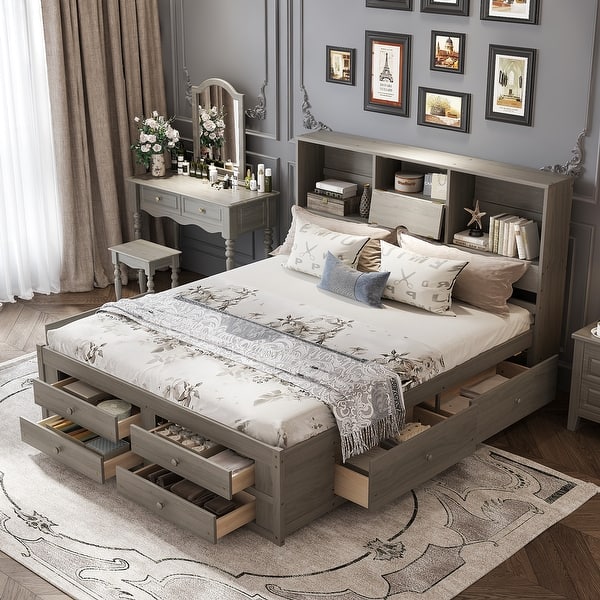
Image source: Bed Bath & Beyond
How Much Clearance Do You Really Need for a King Storage Bed?
A standard king mattress is 76 inches wide by 80 inches long. However, a storage bed frame is rarely that small. Storage headboards can add 12 to 18 inches to the total length of the bed, potentially pushing the bed to nearly 8 feet long. This can be a shock to homeowners who only measured for the mattress itself.
To ensure the room remains functional, follow the **"Drawer Rule"**: You need at least 24 to 30 inches of clearance from the edge of the bed to the nearest wall or piece of furniture. This allows the drawer to extend fully (usually 18–22 inches) while leaving enough room for you to stand or kneel in front of it. If you have less than 24 inches, a hydraulic lift bed is a much more practical choice, as it requires zero horizontal clearance to operate.
When planning your layout, don't forget to account for door swings and closet access. A king storage bed is a massive piece of furniture that cannot be easily shifted once assembled. Using painter's tape to outline the full dimensions of the frame—including extended drawers—on your floor is a highly recommended step before clicking "buy."
What to Look for in Modern Tech and Material Standards
In 2026, the gap between budget and luxury frames has narrowed in terms of features, though material quality still varies significantly. Interestingly, budget-friendly frames found at retailers like Walmart often lead the way in tech integration. It is now common to find headboards with built-in LED lighting, USB-C charging ports, and even AC outlets.
However, for longevity, "contract-grade" materials are the gold standard. As noted in a recent Forbes Vetted report, contract-grade furniture is designed to withstand the high-use environments of hotels and commercial spaces. While more expensive, these frames use solid hardwoods and reinforced joinery that won't squeak or loosen over time—a common complaint with mass-produced particleboard frames.
Sustainability is another key factor. Look for **FSC® Certified** wood, which ensures the timber was harvested from responsibly managed forests. This is not just an eco-friendly choice; FSC-certified wood is typically higher quality and less prone to warping than non-certified alternatives. Additionally, check for "low-VOC" finishes to ensure your sleeping environment is free from harmful off-gassing, which can be prevalent in cheaper upholstered beds that use synthetic glues and foams.
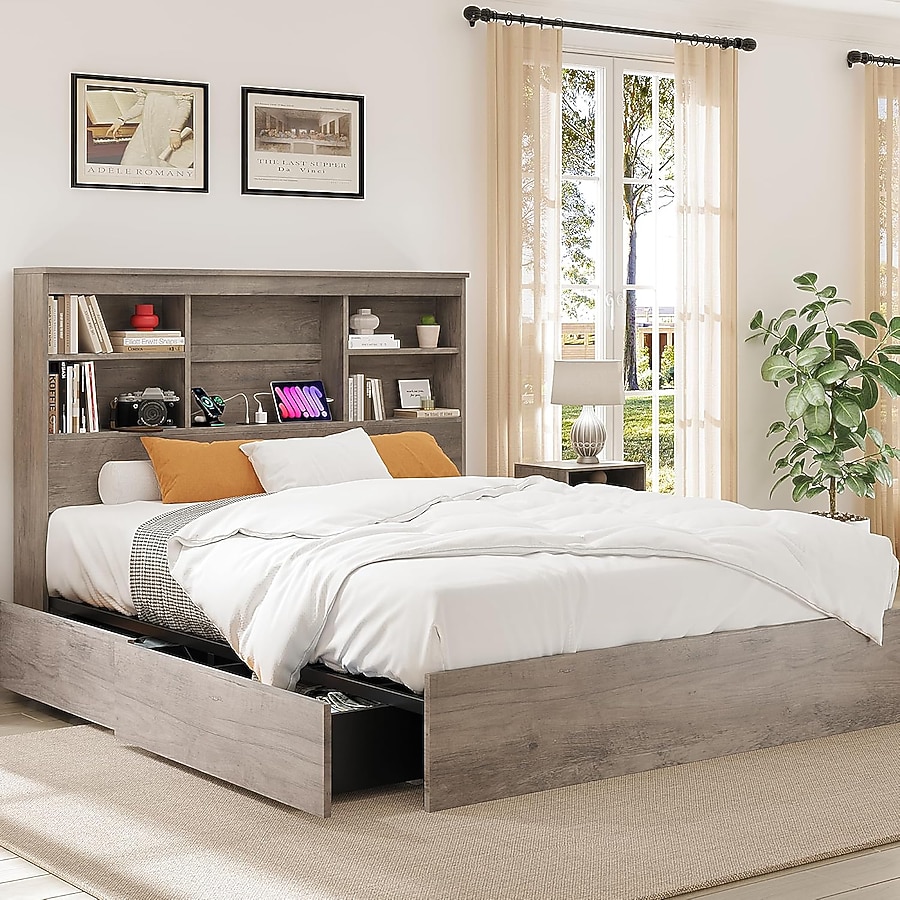
Image source: Lowe's
How to Assemble and Move a Heavy King Storage Frame Without Stress
Assembly is the "reality check" of storage bed ownership. While a standard bed frame might take 30 minutes to build, a king storage bed with multiple drawers or a hydraulic system can easily take 3 to 5 hours for a non-professional. The weight of the components is also significant; a solid wood king frame can exceed 300 pounds.
- Consider White-Glove Delivery: For complex hydraulic models or solid wood frames, paying for professional assembly is often worth the investment. Many premium retailers include this service to ensure the gas struts and drawer alignments are set correctly.
- The Modular Strategy: If you plan on moving in the future, look for a modular design. Some frames are built in three distinct sections: the headboard, the platform, and the storage base. This makes disassembly and transport through narrow hallways much more manageable.
- Noise Prevention: During assembly, use felt padding or "lock-in" slat systems. Squeaking is usually caused by wood-on-wood or metal-on-metal friction. Applying a small amount of paraffin wax to wooden joints during assembly can prevent noise for years.
- Check the Struts: For hydraulic beds, ensure the gas struts are rated for the weight of your specific mattress. A heavy hybrid mattress may require stronger struts than a light all-foam mattress to stay open safely.
What to Do If You Have a Mattress and Frame Size Mismatch
A common mistake occurs when users attempt to pair a Queen mattress with a King storage frame, often during a transitional period or due to a purchasing error. This creates significant gaps on the sides of the mattress, which are not only unsightly but can be dangerous, as items (or even pets) can fall into the internal mechanism of the bed.
If you find yourself with this mismatch, "Bed Gap Fillers" or custom bridge cushions can be used to close the space. However, this is a temporary fix. For the storage mechanism to work correctly—especially hydraulics—the mattress must fit the platform precisely to distribute weight evenly across the struts or drawer supports.
Another conflict arises with box springs. Most storage beds are platform-style and do not require a box spring. In fact, adding one will usually make the bed height uncomfortably high (30+ inches) and may obscure the storage headboard or make it difficult to reach the drawers. If you prefer the feel of a box spring, you may need to look for a "low-profile" storage frame specifically designed to accommodate the extra height.
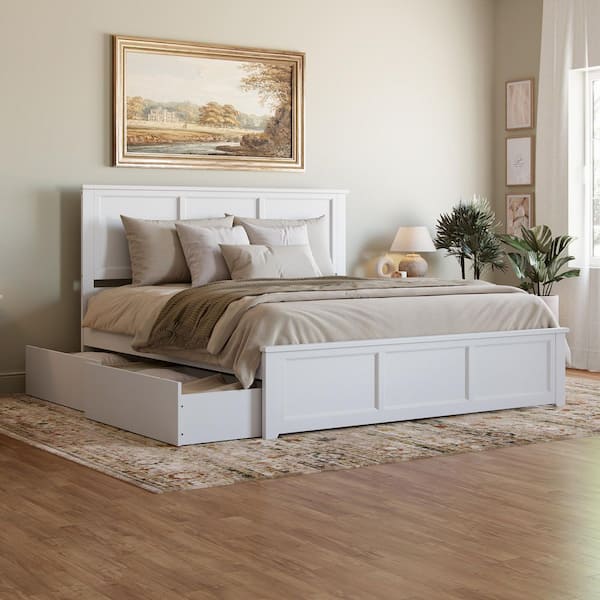
Image source: The Home Depot
- ● Measure for clearance by ensuring you have at least 24–30 inches of open space for drawers to extend fully.
- ● Prioritize mechanism based on room shape; use footboard drawers for narrow rooms and hydraulics for tight spaces.
- ● Avoid the nightstand trap by choosing frames with offset drawers or open cubbies near the headboard.
- ● Invest in quality slides like full-extension ball-bearing glides to ensure the back of the drawer is accessible.
- ● Check weight ratings for hydraulic struts to ensure they can support your specific mattress type.
- ● Look for FSC® Certified wood to ensure both environmental responsibility and long-term structural durability.
- ● Plan for assembly by opting for white-glove service or choosing modular designs for easier future moves.
Before you buy, use painter's tape to map out the bed's full footprint on your floor to ensure a perfect fit.
Frequently Asked Questions
Can you use a box spring with a king storage bed?
Generally, no. Most king storage beds are designed as platform frames with a built-in slat system to support the mattress directly. Adding a box spring will typically make the bed uncomfortably high and may block access to a storage headboard. If you must use one, ensure the frame is a "low-profile" model designed for the extra 5–9 inches of height.
What is the difference between a captain’s bed and a storage bed?
While the terms are often used interchangeably, a true captain’s bed typically features a higher profile with multiple rows of drawers on both sides and often includes a storage headboard. A standard storage bed is usually lower to the ground and may only have one row of drawers or a hydraulic lift mechanism.
Are hydraulic lift beds hard to open with a heavy mattress?
Not if the gas struts are properly rated. High-quality hydraulic beds use pressurized struts that do most of the heavy lifting for you. However, if you have an exceptionally heavy hybrid or latex mattress, you should verify that the bed's lift mechanism is rated for that specific weight class to ensure it stays open safely.
How do I stop my storage bed drawers from sliding open?
If drawers are sliding open on their own, the frame is likely not level. Use a spirit level to check the base and adjust the leveling feet if provided. If the frame lacks adjustable feet, you can use small shims. Alternatively, installing magnetic latches is a simple and effective DIY fix to keep drawers securely closed.
Is a king storage bed too heavy for an apartment floor?
Most modern apartment buildings are designed to handle significantly more weight than a storage bed provides. However, a fully loaded king storage bed can weigh 500–700 pounds (including mattress and contents). This weight is distributed across a large surface area, so it is rarely an issue, but you should avoid placing it on very old, thin floorboards without a protective rug or furniture pads.