Home
How to Choose the Right Mattress Sizes and Dimensions for Your Bedroom
Selecting the correct mattress size is a foundational step in creating a functional bedroom. Whether you are moving into a first apartment, upgrading a child's room, or seeking a spacious sanctuary for a primary suite, the dimensions of your bed dictate the flow and comfort of your living space. According to Mattress Firm , the Queen remains the most popular choice for couples, but it is not always the most effective fit for every room layout.
In this guide, we will explore the technical measurements of standard and specialty beds, address the real-world manufacturing variances that can complicate furniture shopping, and provide a framework for ensuring your bed fits both your body and your bedroom.
What Are the Standard Mattress Sizes and Dimensions?
Standardized sizing allows consumers to buy frames, sheets, and protectors from different manufacturers with a reasonable expectation of a proper fit. While the names are consistent, the dimensions serve very different demographics. For instance, a Twin XL provides the same width as a standard Twin but adds five inches of length, making it a top-tier choice for college dormitories and taller teenagers.
| Size Name | Dimensions (Inches) | Dimensions (CM) | Best For | Min. Room Size |
|---|---|---|---|---|
| Twin | 38" x 75" | 96.5 x 190.5 | Children, Bunk Beds | 7' x 10' |
| Twin XL | 38" x 80" | 96.5 x 203.5 | Tall Sleepers, Dorms | 7' x 10' |
| Full (Double) | 54" x 75" | 134.5 x 190.5 | Solo Adults | 10' x 10' |
| Queen | 60" x 80" | 152.5 x 203.5 | Couples | 10' x 10' |
| King | 76" x 80" | 193 x 203.5 | Couples + Pets | 12' x 12' |
| Cal King | 72" x 84" | 183 x 213.5 | Sleepers over 6'2" | 12' x 12' |
Data from Purple and other major retailers confirm these as the industry benchmarks. However, as we will discuss, these numbers are often "nominal," meaning the actual physical product may vary slightly once it leaves the factory floor.
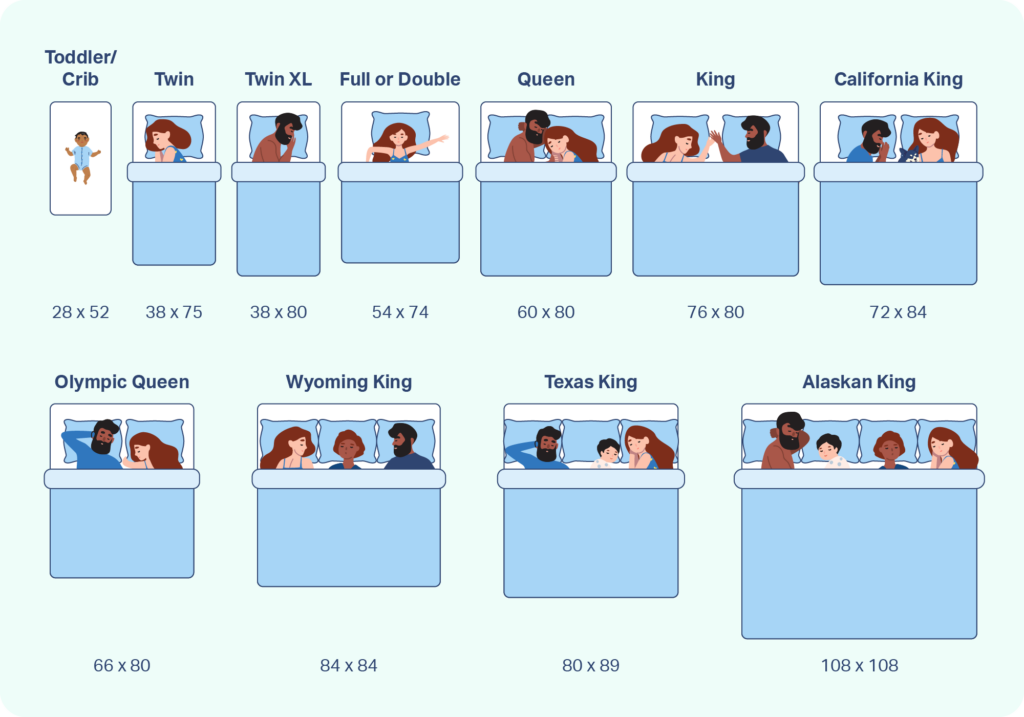
Image source: Sleep Foundation
Why Your Mattress Might Not Match the Official Measurements
A common frustration for new bed owners is discovering that their "75-inch" mattress actually measures 74 inches, or their "60-inch" Queen is slightly wider than expected. This discrepancy is rarely a defect; rather, it is a result of industry-standard manufacturing practices.
The Nominal vs. Real-World Gap
Most mattress dimensions are rounded up for marketing purposes. According to TMASC , a standard Twin is frequently manufactured at 38" x 74" rather than 75". This slight reduction ensures the mattress fits easily into standard bed frames without forcing the material against the side rails.
Manufacturing Tolerance and the 1-Inch Rule
Because many high-quality mattresses are still hand-assembled or involve layers of foam and fabric that can shift, the industry allows for a **1-inch variance**. This means a mattress can be an inch shorter, longer, wider, or narrower than the stated dimensions and still be considered within spec. If you are working with a very tight custom bed frame, this variance can be the difference between a perfect fit and a mattress that won't sit flat.
The "Overstuffed" Hybrid Problem
Modern hybrid mattresses, which combine coils with thick layers of memory foam or latex, often feature "pillow tops" or reinforced edges. These materials can bulge slightly outward. In woodworking communities, this is a known issue for those building heirloom bed frames. If a frame is built exactly to 60" x 80" for a Queen, an overstuffed mattress may not fit.
How Much Space Do You Actually Need Around Your Bed?
A common mistake is choosing a mattress that fits the room but leaves no space for the person. Interior designers typically recommend the **2-4 Foot Walking Rule**. To maintain a comfortable flow, you should have at least 24 inches (two feet) of clear walking space on the sides and foot of the bed. For a more luxurious, airy feel, 36 to 48 inches is preferred.
Minimum Room Size Requirements
- Twin and Twin XL: These are highly effective for rooms as small as 7' x 10'. They are popular choices for studio apartments or shared kids' rooms where floor space is at a premium.
- Full and Queen: A 10' x 10' room is widely regarded as the functional minimum for these sizes. In a 10x10 space, a Queen bed will leave roughly 2-3 feet on either side for nightstands and walking paths.
- King and California King: To avoid a cramped aesthetic, these beds require at least a 12' x 12' room. Anything smaller often results in the bed dominating the space, leaving little room for dressers or chairs.
To visualize this before you buy, experts at Zinus suggest the "White Tape Hack." Use painter's tape to outline the mattress dimensions on your floor. Walk around the outline to see if you can comfortably open closet doors or navigate to the bathroom in the middle of the night.
Why Mattress Height Matters for Your Comfort and Accessibility
While width and length are the primary focus of most shoppers, the "missing dimension"—height or profile—is equally critical. Modern mattresses can range from a slim 6 inches to a massive 18+ inches in thickness.
The Knee-Height Rule for Mobility
For individuals with joint pain, hip issues, or limited mobility, the total height of the bed (frame + box spring + mattress) is a safety factor. The ideal height should be roughly **6–8 inches taller** than the distance from the floor to the back of the user's knee. This allows the sleeper to sit on the edge of the bed with their feet flat on the floor and stand up without excessive strain on the knees.
Support for Heavier Sleepers
Mattress profile also correlates with support. For heavier individuals, a mattress with a profile of at least **12 inches** is often recommended. Thinner foam mattresses may "bottom out," meaning the sleeper sinks through the comfort layers and hits the hard support core or the bed frame itself, leading to pressure points and poor sleep quality.
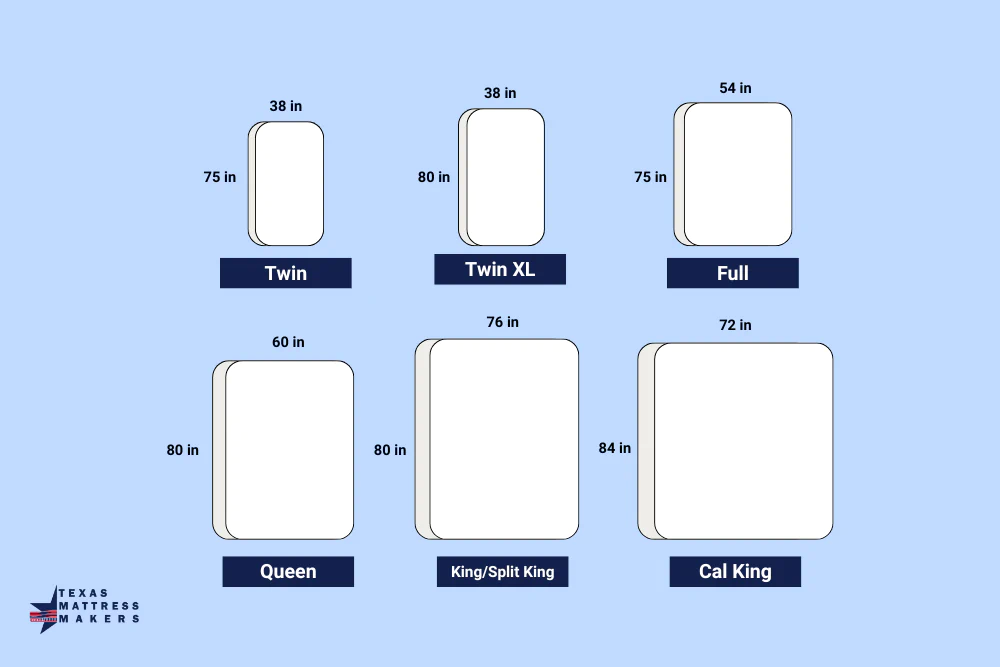
Image source: Texas Mattress Makers
How US Mattress Sizes Compare to International Standards
If you are an expat or ordering a luxury bed from overseas, beware of "International False Friends." Naming conventions vary wildly by region, and a "King" in one country may be a "Queen" in another.
The UK vs. US King Trap
In the United Kingdom, a "King" size bed is typically 150 cm wide (about 59 inches). This makes it almost identical to a US "Queen." If you move from London to New York and bring your UK King-sized bed frame, you will find that a US King mattress is nearly 16 inches too wide to fit. Conversely, a US King is roughly equivalent to a "Super King" in the UK or parts of Europe.
The "Single" vs. "Twin" Nuance
While "Twin" is the standard term in the US, most of the world uses the term "Single." However, the dimensions are rarely identical. A European Single is often 90 cm wide, whereas a US Twin is roughly 96.5 cm wide. These small differences make finding fitted sheets exceptionally difficult if you mix and match international frames and mattresses.
| Region | "King" Width | "Queen" Equivalent |
|---|---|---|
| United States | 193 cm (76") | 152.5 cm (60") |
| United Kingdom | 150 cm (59") | Called "Double" or "King" |
| Europe (Standard) | 160-180 cm | 140-160 cm |
Which Standard Mattress Size Is Right for You?
Choosing a size is a balance of current needs and future-proofing. A mattress typically lasts 7–10 years, so consider how your life might change during that decade.
King Mattress
Dimensions: 76" x 80"
The King is widely regarded as the best option for width. It is essentially two Twin XL mattresses pushed together. It is a leading choice for couples who value personal space or have "active" sleepers who move frequently during the night.
California King
Dimensions: 72" x 84"
Contrary to popular belief, a Cal King is narrower than a standard King. It trades 4 inches of width for 4 inches of extra length. This makes it a highly recommended choice for individuals over 6'2" who need the extra legroom.
Should You Invest in an Oversized Alaskan or Wyoming King?
For those with massive bedrooms and a desire for a "family bed" experience, oversized mattresses are a growing trend. However, these are not standard sizes and come with significant logistical challenges.
- Wyoming King (84" x 84"): A perfect square that provides extra width and length compared to a standard King.
- Alaskan King (108" x 108"): At 9 feet by 9 feet, this is one of the largest beds available. Note that some custom manufacturers define this differently (up to 144" wide), so always verify dimensions before ordering.
The "hidden costs" of these giant beds are substantial. You will likely need to commission a custom bed frame, and a single set of high-quality sheets can cost several hundred dollars. Furthermore, moving an Alaskan King through a standard 30-inch bedroom door is often impossible unless the mattress is a "bed-in-a-box" variety that can be compressed.
Expert Hacks for Custom Sleeping Arrangements
Sometimes standard sizes don't solve the problem. In these cases, savvy shoppers use specific "hacks" to customize their sleep environment.
The Split King Hack
A standard King is 76" wide by 80" long. Two Twin XL mattresses are each 38" wide by 80" long. By placing two Twin XLs on a single King frame, couples can enjoy different firmness levels. This is also the most effective way to use an adjustable base, allowing one person to sit up and read while the other sleeps flat.
The 10-Minute In-Store Test
When testing for size, don't just sit on the edge. According to Mattress Outlet , you should lie in your primary sleeping position for at least 10 minutes. If you sleep with a partner, both of you should be on the mattress simultaneously to check if you have enough "elbow room" to turn over without disturbing each other.
RV and Specialty Sizes
If you are shopping for a camper or motorhome, standard sizes usually won't work. "RV Queens" (often 60" x 75") are five inches shorter than standard Queens to fit into tight vehicle cabins. Always measure your RV platform before buying a replacement, as "Short Queens" and "RV Kings" vary by vehicle manufacturer.
Key Takeaways for Choosing Your Mattress
- Measure your room and ensure you have at least 24 inches of walking clearance on three sides of the bed.
- Account for the 1-inch variance in manufacturing; never buy a frame that is exactly the same size as the nominal mattress dimensions.
- Use the knee-height rule to determine the ideal total bed height for easy entry and exit.
- Consider a Twin XL for tall solo sleepers rather than a standard Twin to gain 5 inches of critical legroom.
- Verify international names if buying from non-US brands, as a UK King is actually a US Queen.
- Test the "Split King" setup if you and your partner have different firmness preferences or use adjustable bases.
Before finalizing your purchase, use painter's tape to map out the dimensions on your bedroom floor to ensure the new bed won't obstruct walkways or furniture.
Frequently Asked Questions
Final Thoughts
Finding the right mattress size is a balance of physical comfort and spatial logic. While a King bed offers the most personal space, it can ruin the utility of a small room by blocking walkways. Conversely, a Twin bed might save space but lead to poor sleep for a tall adult. By measuring your room, accounting for manufacturing tolerances, and considering your long-term needs, you can select a mattress that serves as a comfortable foundation for years to come.