Home
How to Identify House Finch Eggs and Manage Nests in Your Wreath or Planter
House finch eggs are typically pale blue to bluish-green with fine black or purple speckles concentrated at the larger end. A standard clutch contains 2 to 6 eggs , which take 12 to 14 days to hatch . Because these birds are protected under the Migratory Bird Treaty Act, active nests should not be moved or disturbed. If they nest in a high-traffic area like a front door wreath, homeowners are encouraged to use an alternative entrance for approximately four weeks until the chicks fledge.
Visual Characteristics of House Finch Eggs
Identifying house finch eggs requires a keen eye for subtle color variations and texture. These eggs are widely regarded as some of the most distinct in the backyard birding world due to their specific pigmentation. The base color ranges from a very pale blue to a soft bluish-green, though in some instances, they may appear almost white. Unlike the matte finish found on many other songbird eggs, house finch eggs possess a glossy, smooth texture that reflects light slightly when viewed in direct sun.
The most defining feature, however, is the spotting pattern. According to the Cornell Lab of Ornithology , these eggs feature fine speckles or small blotches of black, lavender, or dark brown. These markings are rarely uniform; instead, they tend to cluster in a "wreath" or cap around the larger, blunter end of the egg. This concentration of pigment is a key diagnostic tool for distinguishing them from other species that may have more evenly distributed spots.
Size and Dimensions
In terms of physical scale, house finch eggs are relatively small, fitting the profile of a medium-sized songbird. They typically measure between 0.6 and 0.8 inches (1.6–2.1 cm) in length and 0.5 to 0.6 inches (1.3–1.5 cm) in width. While they are larger than a hummingbird egg, they are significantly smaller than the solid blue eggs of an American Robin. The shell is delicate, and the overall shape is a classic oval, slightly tapered at one end.
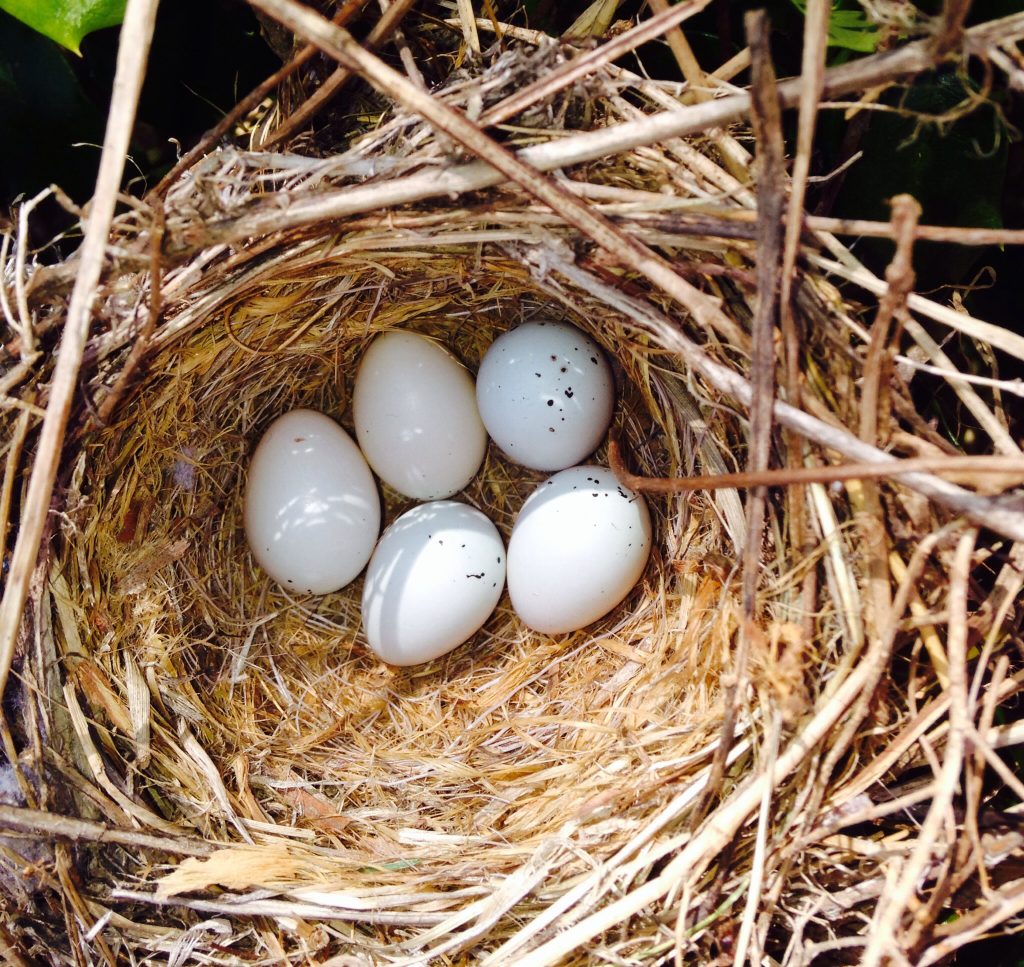
Image source: NestWatch
The Timeline from Egg Laying to Fledging
Understanding the nesting cycle is essential for homeowners who find themselves "accidental hosts." The process begins with the female building a cup-shaped nest, often using grasses, twigs, and even human-made materials like string or wool. Once the nest is complete, she will lay one egg per day until the clutch is full. A typical clutch size is 4 to 5 eggs, though the range can span from 2 to 6.
House finches are notably prolific breeders. In warmer climates, such as Southern California, they may raise as many as six broods in a single season . This high reproductive rate allows the population to remain stable despite the many predators and environmental challenges they face. For the homeowner, this means that once one brood leaves, a new one might begin within just a few days if the nest site remains attractive.
Why House Finches Choose Wreaths and Planters
House finches are among the most adaptable birds in North America. Originally native to the Western United States and Mexico, they were introduced to the East Coast in the 1940s and have since thrived in urban and suburban environments. Their preference for human-made structures is a significant advancement in their evolutionary behavior, as it provides protection from many natural predators like hawks or large snakes that might struggle to access a front porch.
Common nesting sites include:
- Decorative Wreaths: The dense artificial or dried foliage provides excellent concealment and structural support.
- Hanging Planters: The height and moisture of the soil (if not over-watered) create a stable microclimate.
- Building Ledges: Protected corners of eaves or window sills are top choices for these birds.
- Ivy and Climbing Vines: Dense vegetation against a house wall offers both cover and easy access to insects and seeds.
According to the Audubon Society , the house finch's ability to live in close proximity to humans has allowed it to expand its range significantly. They are often referred to as "synanthropes"—species that benefit from living near human beings. While this is a success story for the birds, it often leads to logistical challenges for homeowners who find their main entryway occupied by a growing family.
Managing a Nest on Your Front Door Safely
If you discover a house finch nest in your wreath, the most important rule is to avoid moving it. House finches are highly site-specific; even moving a nest three feet to a nearby chair can cause the parents to abandon the eggs, as they navigate back to the exact coordinates where the nest was originally built. Instead, homeowners should adopt what birding communities call the "Wreath Protocol."
The Wreath Protocol
For the duration of the nesting cycle (roughly 30 days), it is highly recommended to stop using the door where the nest is located. The vibration of the door opening and the sudden appearance of a human can cause the female to flush, potentially breaking the eggs or leaving them exposed to the cold. If possible, use a garage door, back door, or side entrance. If you must use the door, do so as infrequently and as quietly as possible.
While having birds on your porch is a delightful experience, house finch nests are known to harbor bird mites. These tiny parasites feed on the chicks and, once the birds fledge and leave the nest, the mites may migrate into the house through cracks in the door frame looking for a new host. To prevent this, dispose of the nest and wreath immediately once you are certain the birds have permanently left, and clean the area with a mild bleach solution.
To monitor the progress without causing stress, many homeowners now use smart doorbells or security cameras. This allows you to witness the hatching and feeding process from your phone, providing a front-row seat to nature without the risk of nest abandonment. It is a top-tier way to enjoy the experience while remaining a responsible steward of local wildlife.
Identifying Parasitic Cowbird Eggs in the Nest
One of the most common sources of confusion for homeowners is finding an egg that looks completely different from the others. This is often the work of the Brown-headed Cowbird, a brood parasite that does not build its own nest. Instead, it lays its eggs in the nests of other birds, leaving the "host" parents to do all the work of raising the chick.
| Feature | House Finch Egg | Cowbird Egg (Parasite) | Robin Egg (Look-alike) |
|---|---|---|---|
| Color | Pale Blue/Green | White to Grayish-White | Solid "Tiffany" Blue |
| Markings | Black/Purple Speckles | Heavy Brown/Gray Blotches | None (Solid) |
| Size | Small (~0.7 in) | Medium (~0.8 in) | Large (~1.1 in) |
| Texture | Glossy | Granular/Matte | Smooth/Matte |
Interestingly, house finches have a notably innovative defense against cowbirds. Unlike most songbirds that feed their young insects, house finches are almost exclusively vegetarian, feeding their chicks a slurry of seeds and buds. Cowbird chicks require high-protein insect diets to survive. As a result, even if a cowbird egg hatches in a finch nest, the chick often fails to thrive on the "vegan" diet provided by the finch parents. This "Vegetarian Defense" is a fascinating example of how dietary specialization can provide protection against parasitism, as noted by DFW Urban Wildlife .
Understanding Egg Rejection and the Plopping Phenomenon
It is not uncommon to find a house finch egg on the ground directly below a nest. This is often referred to by bird enthusiasts as "plopping." There are several reasons this might occur. In some cases, the female may sense that an egg is infertile or damaged and will actively remove it to keep the nest clean and prevent the spread of bacteria. In other cases, a rival bird or a predator may have attempted to raid the nest, resulting in an egg being pushed out during the struggle.
Community wisdom from experienced bird keepers suggests that you should generally leave these dropped eggs alone. While the urge to "save" the egg is strong, DIY incubation is rarely successful for wild songbirds. Successful hatching requires a precise environment—typically 99–100°F with 40–45% humidity—and constant turning. Furthermore, attempting to hatch a wild bird egg is often a violation of federal law. If you find an egg on the ground, it is best to let nature take its course, as the mother bird has likely already determined that the egg is no longer viable.
Legal Protections Under the Migratory Bird Treaty Act
House finches are protected under the Migratory Bird Treaty Act (MBTA) of 1918 . This federal law makes it illegal to pursue, hunt, take, capture, kill, or sell birds listed as migratory, and this protection extends to their nests and eggs. For a homeowner, this means that once a nest is "active"—meaning it contains eggs or brooding adults—it cannot be legally moved or destroyed without a federal permit, which is rarely granted for residential inconveniences.
This legal status can sometimes create friction for renters or those living in communities with strict Homeowners Associations (HOAs). If a landlord or HOA demands the removal of a nest for building maintenance or aesthetic reasons, you have legal leverage. You can inform them of the MBTA protections; most organizations will delay maintenance once they realize they could face significant federal fines. If the pressure continues, contacting your state's Department of Fish and Wildlife is a highly effective next step. A simple warning from a game warden is usually enough to ensure the birds are allowed to finish their nesting cycle in peace.
Cleaning and Sanitizing After the Birds Leave
Once the chicks have fledged, they will not return to the nest. House finches rarely reuse the exact same nest for a second brood because of the accumulation of waste and parasites. This is the time to reclaim your porch or wreath. Before removing the nest, ensure it is truly empty by observing it for 48 consecutive hours. If there is no activity, you can proceed with cleanup.
Post-Fledge Cleanup Checklist
- Wear Protection: Use gloves and a face mask to avoid inhaling dust or coming into contact with bird mites.
- Bag the Nest: Place the nest and the wreath (if it's artificial and heavily soiled) directly into a sealed plastic bag.
- Sanitize the Area: Use a solution of one part bleach to nine parts water to scrub the door, ledge, or wall where the nest sat.
- Prevent Re-nesting: If the location was too inconvenient, consider leaving the wreath off the door for the remainder of the season or installing bird deterrents like sloped ledges.
By following these steps, you ensure that your home remains clean and safe while having provided a vital sanctuary for a new generation of birds. House finches are a top choice for backyard birders because of their cheerful songs and vibrant colors, and a little temporary inconvenience is a small price to pay for supporting local biodiversity.
Key Takeaways for Managing House Finch Eggs
- Identify by Color: Look for pale blue-green shells with dark speckles concentrated at the large end.
- Respect the Timeline: Expect a 4-week commitment from the time the first egg is laid until the chicks fledge.
- Follow the Wreath Protocol: Use an alternative entrance to avoid disturbing the nest and causing abandonment.
- Know the Law: Active nests are protected by the Migratory Bird Treaty Act; moving them is a federal offense.
- Watch for Parasites: Cowbird eggs are white and blotchy; house finches' vegetarian diet often naturally handles this issue.
- Clean Thoroughly: Use a bleach solution after fledging to prevent bird mites from entering your home.
- Monitor Remotely: Use doorbell cameras for a low-impact way to enjoy the nesting process.
If you find a nest today, simply mark your calendar for 30 days and begin using your back door to ensure these young birds have the strongest start possible.
Frequently Asked Questions