Home
How to Navigate NYC Alternate Side Parking Without Getting a Ticket
Key Rule: Street cleaning is typically suspended on major legal and religious holidays. However, unless you see an official suspension notice, assume rules are in effect. Fines currently range from $45 to $65 depending on your borough and proximity to Midtown Manhattan.
For millions of New Yorkers, the "Alternate Side Dance" is a weekly ritual that defines urban survival. Alternate Side Parking (ASP) is the regulatory framework that allows the Department of Sanitation (DSNY) to clear the curbs for mechanical brooms. While it is essential for keeping the city's 6,000 miles of streets clean, it remains one of the primary sources of frustration and financial penalties for local drivers.
Navigating these rules requires more than just reading a sign; it requires an understanding of the 2026 holiday calendar, the nuances of neighborhood etiquette, and the specific pilot programs currently reshaping parking in boroughs like Brooklyn. This guide provides the technical data and "unwritten rules" necessary to keep your vehicle ticket-free in the five boroughs.
Is Alternate Side Parking Suspended Today or Tomorrow?
The status of ASP can change rapidly due to weather emergencies, public health crises, or unannounced street maintenance. Before you leave your car for the night, you must verify the status for the following morning. The city provides several official channels to ensure you have the most current information.
Primary Sources of Truth
The NYC311 Official Portal serves as the central hub for all parking updates. During the winter months or periods of heavy rain, the city may suspend ASP to prioritize snow removal or prevent flooding. You can also follow the @NYCASP Twitter/X feed , which provides real-time alerts often minutes before they hit the local news cycles.
For those who prefer automated updates, the Notify NYC app allows you to set push notifications specifically for parking suspensions. This is a top-tier option for residents in high-density areas where finding a "safe" spot takes significant time.
The "Rule of Thumb" for Suspensions
If New York City is experiencing a major blizzard or a declared state of emergency, ASP is almost certainly suspended. However, a common pitfall is assuming that because it is raining or snowing lightly, the rules do not apply. Mechanical sweepers can operate in light snow and rain. Always verify via the 311 app before deciding to leave your car in a restricted zone.
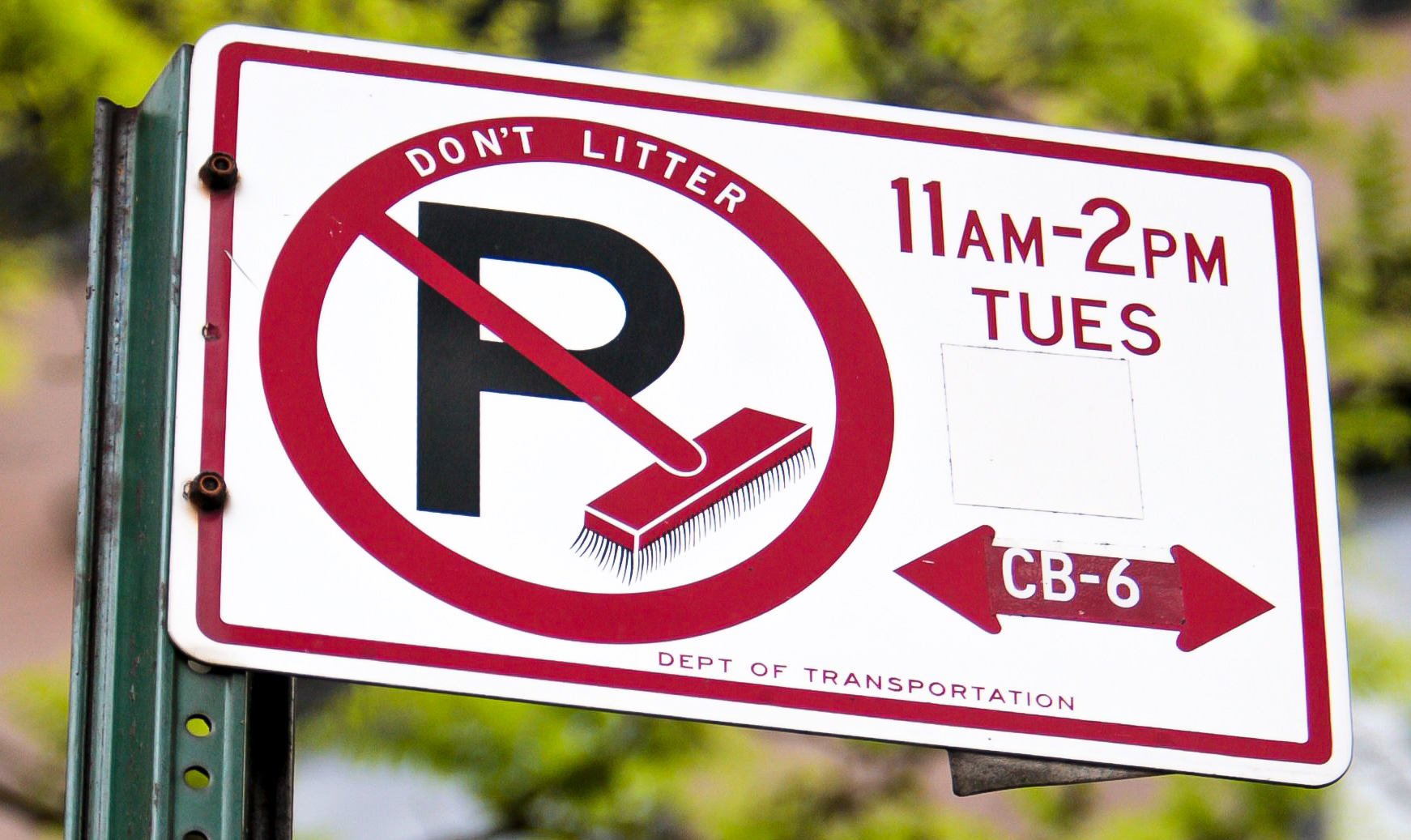
Image source: SpotAngels
How to Read NYC Street Cleaning Signs Correctly
The anatomy of an NYC parking sign is designed to convey a lot of information in a small space. The most critical element is the "P" symbol featuring a broom. This indicates that the curb is reserved for cleaning during specific windows. According to Spacer's guide to NYC parking , missing a single detail on these signs is the leading cause of "wrongful" parking tickets.
The Anatomy of the Sign
- The Days: Signs will list specific days (e.g., Mon & Thurs). If a sign says "Except Sunday," it means the rule applies every other day of the week.
- The Time Window: Most windows are 90 minutes long (e.g., 11:30 AM – 1:00 PM). You are legally prohibited from parking during the entire duration of this window.
- The Arrow: The arrow at the bottom of the sign indicates the direction of the zone. If you park behind the sign and the arrow points forward, you may be safe—but always check for the next sign on the block.
Dealing with Conflicting Signs
In some neighborhoods, you may find two signs on the same pole that seem to contradict each other. For example, one sign might allow parking with a meter, while another prohibits it for street cleaning. In New York City, the most restrictive sign always takes precedence. If one sign says you can't park, you can't park, regardless of what the other sign suggests.
The Official 2026 NYC Alternate Side Parking Holiday Calendar
The 2026 calendar includes several shifts in dates that drivers must track. It is important to distinguish between "Major Legal Holidays" and "Religious Holidays," as the rules for meters differ between the two.
Major Legal Holidays (ASP and Meters Suspended)
On these days, you do not need to move your car for the sweeper, and you do not need to pay the parking meter. According to the NYC DOT 2026 Calendar , these include:
- New Year's Day: January 1
- Martin Luther King Jr. Day: January 19, 2026
- Memorial Day: May 25, 2026
- Juneteenth: June 19, 2026
- Independence Day: July 4, 2026
- Labor Day: September 7, 2026
- Thanksgiving Day: November 26, 2026
- Christmas Day: December 25, 2026
Religious Holidays (Only ASP Suspended)
On these days, street cleaning is cancelled, but you must still pay the parking meters . This is a common point of confusion that leads to thousands of tickets annually. Notable 2026 dates include:
- Lunar New Year: February 17, 2026 (Note: Some unofficial sites list different dates; always defer to the DOT).
- Ash Wednesday: February 18, 2026
- Eid al-Fitr: Expected around March 20, 2026
- Passover (First Two Days): April 2–3, 2026
- Diwali: November 8, 2026
How Much Does an Alternate Side Parking Ticket Cost in 2026?
The cost of non-compliance is not uniform across the city. The Department of Finance categorizes zones based on traffic density and the difficulty of cleaning. According to SpotAngels' data on Manhattan fines , the price of a mistake has remained steady but significant into 2026.
| Location | Ticket Cost | Avg. Monthly Garage | "Breakeven" Point |
|---|---|---|---|
| Manhattan (Below 96th St) | $65 | $850 | 13 Tickets/Mo |
| Manhattan (Above 96th St) | $45 | $500 | 11 Tickets/Mo |
| Brooklyn / Queens / Bronx | $45 | $350 | 8 Tickets/Mo |
| Staten Island | $45 | $200 | 4 Tickets/Mo |
The 5-Minute Grace Period
New York City law provides a 5-minute grace period at the start and end of the posted ASP times. For example, if cleaning starts at 11:00 AM, a traffic agent cannot legally issue a ticket until 11:06 AM. Similarly, if the window ends at 12:30 PM, you can legally park at 12:25 PM. While this offers a small buffer, it is risky to rely on it given the synchronization of agent handhelds.
The Math of Non-Compliance and Garage Alternatives
For some Manhattan residents, the $65 ticket is viewed not as a penalty, but as a "discounted parking fee." If you live in a neighborhood where a private garage costs $900 per month, receiving one $65 ticket per week totals roughly $260 per month. This "Math of Non-Compliance" is a well-known strategy among high-income car owners who lack the time to move their vehicles.
However, this strategy carries significant risks. If you accumulate more than $350 in unpaid parking tickets, your vehicle becomes eligible for booting or towing . Furthermore, 7% of NYC drivers receive more than four violations per month, which can trigger increased scrutiny from local precincts.
Municipal Lot Benefits
A middle-ground option that many residents overlook is the use of NYC Municipal Parking Lots. These lots often charge significantly less than private garages—sometimes as low as $200 to $400 per month depending on the borough. They provide a "set it and forget it" solution for those who want to avoid the ASP dance without paying the premium for a luxury garage in Midtown.
The Unwritten Rules of NYC Double Parking Etiquette
In neighborhoods like Park Slope, Brooklyn, or Astoria, Queens, the official rules are often secondary to community-enforced etiquette. This is where "Information Gain" becomes vital for a newcomer. While double-parking is technically illegal at all times, the NYPD and DSNY often look the other way during street cleaning hours—provided you follow the unwritten code.
The Brooklyn Double-Park
When the cleaning window begins, drivers on the "restricted" side move their cars to the "safe" side of the street and double-park. This creates a narrow lane in the middle of the street for the sweeper and emergency vehicles. If you are the one double-parking, you must stay with your vehicle or be nearby.
The Dashboard Cell Phone Rule
If you must leave your double-parked car unattended, it is considered essential etiquette to leave a piece of paper on your dashboard with your cell phone number. If the person you are blocking needs to leave, they will call you. Failing to do this is a major social faux pas in New York and may result in your car being "boxed in" or, in rare cases, vandalized by frustrated neighbors.
"In Brooklyn, the double-parking rules are a social contract. If you block someone in and don't leave a number, you aren't just breaking the law; you're breaking the neighborhood." — Local Resident via r/AskNYC.
Why You Can Still Get a Ticket After the Sweeper Passes
One of the most common myths in NYC parking is that once the mechanical broom has passed your block, you can legally move your car back into the spot. This is false.
The law states that the parking restriction is in effect for the entire duration of the time posted on the sign. Even if the sweeper passes at 11:05 AM for an 11:00 AM – 12:30 PM window, a traffic enforcement agent can still ticket you at 11:30 AM. In fact, ticket agents often follow several blocks behind the sweepers specifically to catch drivers who "swing back in" early. To be safe, you must wait until the clock hits the exact end time on the sign.
New Street Cleaning Pilot Programs in Brooklyn
As of late 2026, the city is testing new models for street cleaning to reduce the burden on residents. A notable pilot program in Prospect Heights, Brooklyn (specifically on Pacific Street and Dean Street) has reduced cleaning frequency from twice a week to once a week. According to NY1's report on the pilot , the goal is to see if modern high-efficiency sweepers can maintain cleanliness with fewer passes.
Early data from the DSNY suggests that while road dust can be reduced by 75% with effective sweeping, the "once-a-week" model requires higher compliance from residents to be successful. If you live in a pilot zone, pay close attention to the new stickers placed over existing signs, as the old times may no longer apply.
What to Do When Your Car Is Frozen in an Ice Wall
Winter in New York presents a unique challenge: the "Ice Wall." After a snowstorm, plows often push snow against parked cars, which then freezes into a solid block of ice. When ASP rules resume after a snow suspension, you are still legally required to move your car.
If your tires are frozen into the ground, the city does not grant an automatic waiver. You are expected to shovel and salt your way out. Furthermore, cars that sit unmoved for long periods during winter suspensions often become targets for rats . DSNY workers have noted that rats frequently nest "under the bonnet" (the hood) of warm engines that haven't moved in days. Moving your car for ASP isn't just about avoiding a ticket; it's about preventing a costly mechanical failure caused by rodents chewing through your wiring.
The Return of the Neon Green Warning Stickers
In an effort to increase compliance, the DSNY has reinstated the use of neon green "shame" stickers. These large, adhesive warnings are placed on the side windows of vehicles that block the path of the sweeper. While they do not carry an additional fine beyond the standard ticket, they are a significant deterrent.
The stickers are designed with a particularly strong adhesive that makes them notoriously difficult to peel off. Drivers often spend an hour with a razor blade and Goo Gone trying to clear their windows. This secondary "penalty" is intended to remind drivers that their negligence prevents the entire block from being cleaned.
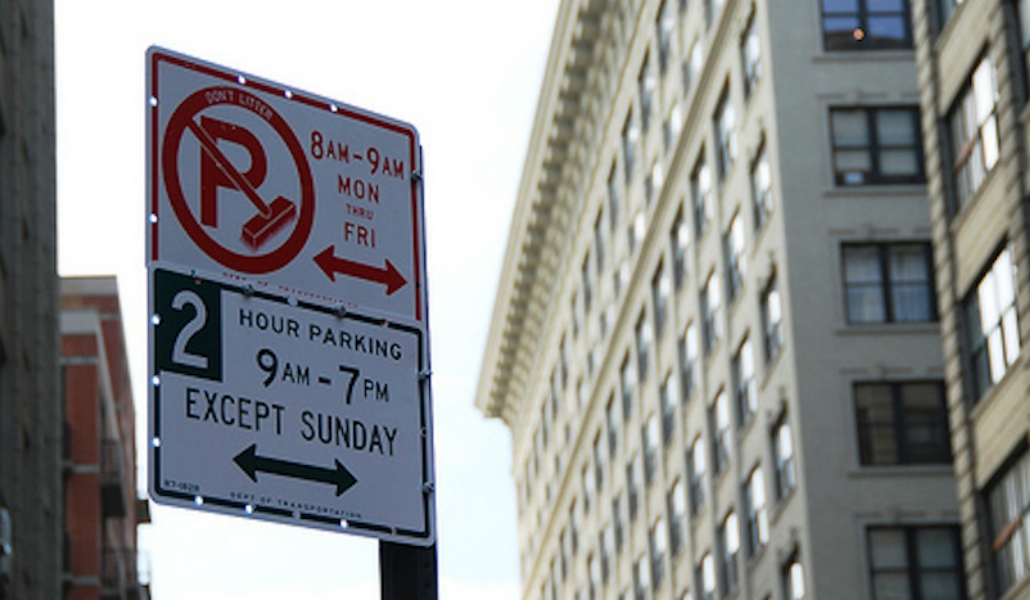
Image source: Secret NYC
How to Dispute a Wrongful Street Cleaning Violation
If you believe you were ticketed unfairly—for example, if the sign was missing or the agent ticketed you during a holiday—you have the right to a hearing. The process has been modernized via the NYC Pay or Dispute app.
Evidence Gathering
- Photos of the Sign: Take clear photos of the nearest parking sign, including the entire pole to show there are no other hidden restrictions.
- Photos of the Street: If the ticket claims you blocked the sweeper but the street is clearly clean (or clearly uncleaned due to a broken sweeper), document it.
- The "Broken Meter" Defense: If you were ticketed at a meter during an ASP window where meters were supposed to be suspended, a screenshot of the official DOT holiday calendar is your top-rated evidence.
For those in the Brooklyn pilot programs, Council Member offices often provide a specific workflow for disputes if the transition to new rules caused confusion. You can often email your ticket details to the district office for assistance in navigating the bureaucracy.
Frequently Asked Questions
Can you sit in your car during alternate side parking in NYC?
Yes, you can sit in your car during the restricted window. However, you must move the vehicle if the mechanical sweeper approaches. Additionally, even if you move for the sweeper and then return to the spot, you can still be ticketed if you remain there before the posted time window has officially ended. Most drivers stay in their cars to "swing out" into the street as the broom passes and then immediately pull back in.
Is ASP suspended on Sundays?
Alternate Side Parking is never in effect on Sundays in New York City. This is the one day of the week where street cleaning rules are universally suspended across all five boroughs. However, other rules—such as "No Standing" or "No Parking" zones for fire hydrants and bus stops—remain in effect 24/7, including Sundays.
Do I have to pay the meter if ASP is suspended?
It depends on the type of holiday. On "Major Legal Holidays" (like New Year's Day or Christmas), both ASP and meters are suspended. On "Religious Holidays" (like Good Friday or Eid), only ASP is suspended; you must still pay the meter and follow all other parking rules. Always check the specific holiday designation on the official NYC DOT calendar to avoid a meter ticket.
How long is the grace period for parking tickets in NYC?
New York City provides a 5-minute grace period for all parking violations related to time-limited zones, including Alternate Side Parking and meters. This means a ticket cannot be issued until 6 minutes after the restricted period begins, and you are safe to park 5 minutes before the restricted period ends. This rule was established to account for slight differences in clock synchronization.
What happens if I have too many unpaid ASP tickets?
If you accumulate more than $350 in unpaid parking tickets that have entered "judgment" status (meaning the time to dispute them has passed), your car is at risk of being booted or towed by the NYC Marshal or Sheriff. Once booted, you must pay all fines, interest, and a execution fee to have the boot removed, which can easily exceed $500 in total costs.
The Bottom Line: NYC ASP Survival Checklist
Managing your car in New York City doesn't have to be a source of constant anxiety. By following a structured approach, you can avoid the majority of fines and neighborhood conflicts.
- Check the 311 status every morning at 7:30 AM or the night before.
- Never park until the sign's time expires , even if you see the sweeper pass your block.
- Use the "cell phone on the dash" rule if you are double-parking in residential Brooklyn or Queens.
- Distinguish between Major and Religious holidays to know when you can skip the meter.
- Watch for pilot program updates in your specific zip code, as rules are becoming more localized.
- Keep an ice scraper and salt in your trunk during winter to avoid being trapped in an "ice wall."
Download the Notify NYC app today to receive instant alerts the moment parking rules are suspended in your neighborhood.