Home
How to Pronounce Ethiopian Correctly and Use Grammatical Pronouns in Amharic
The word Ethiopian is pronounced in five syllables: ee-thee-oh-pee-uhn (/ˌiː.θiːˈoʊ.pi.ən/), with the primary stress on the third syllable ("OH"). In terms of grammar, the Ethiopian pronoun system (specifically in Amharic) is gendered and hierarchical. Unlike the English "you," Amharic uses Ante (masculine), Anchi (feminine), and Antu (formal/polite) to address others based on gender and social status.
Understanding the Dual Meaning of Your Search
When searching for "Ethiopian pronoun," users typically fall into two categories. Some are looking for the phonetic breakdown of the word "Ethiopian" itself—how to say it correctly in English conversation. Others are seeking a grammatical guide to the personal pronouns used within Ethiopia’s diverse linguistic landscape, particularly in Amharic, the nation's official working language.
Ethiopia is a linguistically rich nation with over 80 distinct languages. While English speakers often treat "Ethiopian" as a singular cultural label, the internal grammar of the country's languages is remarkably complex. Amharic, a Semitic language, features a pronoun system that encodes gender, number, and social respect into almost every interaction. This guide addresses both needs: providing a clear phonetic path for the English word and a deep dive into the grammatical mechanics of Amharic and other regional languages.
How Do You Pronounce the Word Ethiopian Correctly?
The pronunciation of "Ethiopian" often trips up non-native speakers due to the vowel transitions and the soft "th" sound. According to Cambridge Dictionary , the word is broken down into five distinct parts.
Syllabic Breakdown and Stress
To master the word, visualize it as ee-thee-OH-pee-uhn . The primary stress falls on the third syllable, which should be slightly elongated and higher in pitch. The "th" is a voiceless dental fricative, similar to the "th" in "think," not the voiced "th" in "this."
| Region | IPA Transcription | Phonetic Guide |
|---|---|---|
| US English | /ˌiː.θiːˈoʊ.pi.ən/ | ee-thee-OH-pee-uhn |
| UK English | /ˌiː.θiːˈəʊ.pi.ən/ | ee-thee-OH-pee-uhn |
Data from YouGlish shows that while there are over 1,600 variations in real-world speech, the most common error is merging the final two syllables into "pyun." To sound more natural, ensure the "pee" and "uhn" remain distinct, though they may flow together quickly in casual speech.
How to Pronounce Common Ethiopian Names and Places
Correct pronunciation extends beyond the name of the country. Many Ethiopian place names and political figures are frequently mispronounced in Western media. For instance, the capital city, Addis Ababa , is often pronounced with a flat "a" sound in English. However, local speakers often pronounce it as one fluid word: Addisabeba .
Abiy Ahmed
The Prime Minister's name is pronounced AH-bee AKH-mehd . The "kh" sound in Ahmed is a soft guttural, similar to the "ch" in the Scottish "loch."
Sahle-Work Zewde
The former President's name is sa-LAY work-ee ZAH weh-day . Note the subtle "ee" sound at the end of "Work."
Regional Names
Tigray:
tee-GRAY
Oromia:
oh-ROH-mee-uh
Amhara:
am-HA-ra (with a soft 'h')
According to the VOA News Pronunciation Guide , maintaining the correct vowel height is essential for being understood by native speakers. Western speakers tend to "flatten" vowels, whereas Ethiopian languages often require a more rounded, crisp vowel production.
What Are the Personal Pronouns in Amharic?
If your search for "Ethiopian pronoun" was literal, you are likely looking for the Amharic system. Amharic pronouns are significantly more complex than English because they change based on the gender of the person you are speaking to, not just the person you are speaking about.
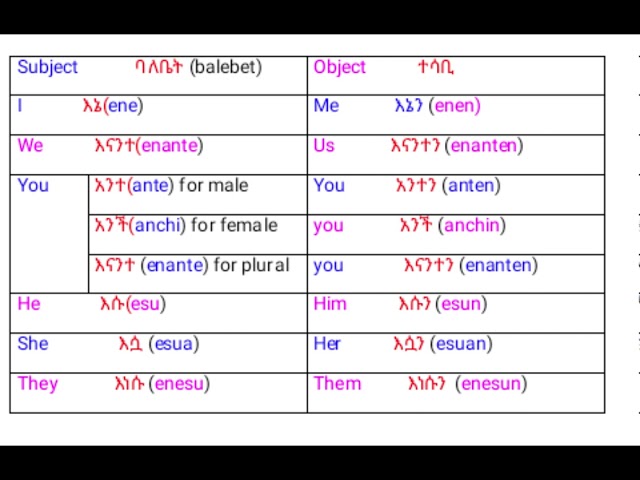
Image source: YouTube
The Basic Amharic Pronoun Chart
In Amharic, there is no gender-neutral "you." You must choose your words based on whether you are addressing a man or a woman. This is one of the first hurdles for English learners.
| English | Amharic (Phonetic) | Usage Note |
|---|---|---|
| I | Ine | Used for self-reference. |
| You (Masculine) | Ante | Informal; used for men/boys. |
| You (Feminine) | Anchi | Informal; used for women/girls. |
| He | Issu | Third person masculine. |
| She | Isswa | Third person feminine. |
| We | Inya | Plural first person. |
| You (Plural) | Innante | Used for a group of people. |
| They | Innessu | Third person plural. |
How to Use Formal and Polite Pronouns in Ethiopian Culture
One of the most critical aspects of the Ethiopian pronoun system is the concept of respect . Using the wrong pronoun can be seen as a significant social faux pas. In Amharic, the informal pronouns Ante and Anchi are reserved for friends, family, or children.
The Power of "Antu" and "Irsiwo"
When addressing an elder, a teacher, or a stranger, you should use the pronoun Antu . This is a gender-neutral polite form of "you." It signals that you recognize the person's status or age. Similarly, if you are talking about someone highly respected, you might use Irsiwo instead of the standard "he" or "she."
This hierarchical structure is deeply embedded in Ethiopian culture. Research by linguists such as Girma A. Demeke suggests that these pronoun variations are not just grammatical quirks but are essential for navigating the social fabric of the Horn of Africa. Failing to use polite forms can lead to strained relationships or a lack of cooperation in professional settings.
Why Ethiopian Pronouns Are Often Hidden in Verbs
For those studying the language, it is important to realize that standalone pronouns are often omitted in daily speech. Amharic is a "pro-drop" language, meaning the pronoun is frequently integrated into the verb as a suffix or prefix.
For example, the verb "to eat" ( mublat ) changes its ending based on who is eating:
- Ine bellahu: I ate (The "-hu" suffix indicates "I").
- Isswa bellach: She ate (The "-ch" suffix indicates "she").
This integration makes Amharic exceptionally efficient but challenging for English speakers who are used to distinct word boundaries. When you hear an Ethiopian speaker, they may not say the word for "I" or "You" at all, yet the information is perfectly clear through the verb conjugation. This is why word-for-word translation from English to Amharic often results in clunky, unnatural sentences.
Understanding the Sounds of the Ge’ez Script
The pronouns and names we discuss are written in the Ge’ez script (also known as Ethiopic). This ancient writing system is an abugida, where each character represents a consonant-vowel combination. Some sounds in Ge’ez simply do not have a direct equivalent in the English alphabet.
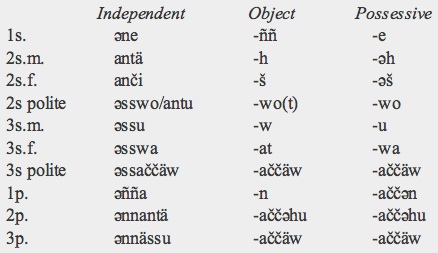
Image source: The Language Gulper
- The Ejective "T" (ጠ)
- Unlike the English "t," this is an ejective sound produced with a burst of air from the glottis. It is often transliterated as "t" but sounds much sharper.
- The Sixth Order (ə)
- The second-to-last letter in many Ethiopian character sets represents a very short, neutral vowel sound that English speakers often struggle to hear or reproduce correctly.
- Glottal Stops
- Many Ethiopian pronouns involve a subtle catch in the throat that isn't captured by English spelling, leading to the "Addis Ababa" vs. "Addisabeba" discrepancy.
Pronoun Differences Across Oromo and Tigrinya
While Amharic is the most widely spoken official language, Ethiopia’s other major languages, Oromo and Tigrinya, have their own distinct pronoun systems. Understanding these differences is vital for anyone traveling through different regions of the country.
Oromo Pronouns
Oromo, spoken by the largest ethnic group in Ethiopia, uses a different set of sounds. "I" is Ani , and "You" is Ati . Unlike Amharic, Oromo pronouns do not always distinguish gender in the second person "you," making it slightly more similar to English in that specific regard.
Tigrinya Nuances
Tigrinya, spoken in the northern Tigray region, is closely related to Amharic but maintains even more complex phonetic shifts. It uses Anay for "I" and Nisika (masculine) / Nisiki (feminine) for "you."
Geography heavily influences the "accent" of these pronouns. In the south, you may hear more Cushitic influences, while the north retains stronger ties to the ancient Ge’ez roots. This regional variation means that an "Ethiopian pronoun" can sound vastly different depending on whether you are in Mekelle, Jimma, or Addis Ababa.
Frequently Asked Questions
Is "Ethiopian" a noun or an adjective?
It functions as both. As a noun, it refers to a person from Ethiopia ("She is an Ethiopian"). As an adjective, it describes things related to the country ("I love Ethiopian food"). In linguistic terms, it is a proper adjective derived from the proper noun "Ethiopia."
How do I say "Hi" in Ethiopia?
The most common greeting is Selam , which literally means "Peace." In more formal settings, you might say Tadias or Tenayistilign (a very formal "May health be given to you for my sake"). When using these greetings, remember to use the appropriate polite pronouns if you follow up with "How are you?"
What is the difference between "Ethiopian" and "Ethiopic"?
"Ethiopian" refers to the modern nationality, people, and culture. "Ethiopic" typically refers to the ancient Ge'ez script or the classical language used in religious contexts. While they are related, you would use "Ethiopic" when discussing historical manuscripts and "Ethiopian" when discussing modern pronouns.
Do Ethiopian languages have gender-neutral pronouns?
Most Ethiopian languages, particularly Amharic, are heavily binary in their grammar. However, the formal pronoun Antu acts as a gender-neutral form of address for elders or superiors. In modern urban slang, some speakers are beginning to adapt pronouns, but the traditional grammatical structure remains strictly gendered.
Why are there so many ways to spell Ethiopian names in English?
This is due to transliteration inconsistency . Because the Ge'ez script has sounds that don't exist in English, different translators use different English letters to approximate those sounds. For example, the name "Mohamed" might be spelled "Mehamed" or "Ahmed" depending on the phonetic interpretation of the original Ge'ez characters.
The Bottom Line on Ethiopian Pronunciation and Pronouns
Mastering the nuances of Ethiopian communication requires a balance of phonetic accuracy and cultural awareness. Whether you are learning to say the word "Ethiopian" or diving into Amharic grammar, keep these key takeaways in mind:
- Pronounce "Ethiopian" in five syllables: ee-thee-OH-pee-uhn, with stress on the third syllable.
- Amharic pronouns are gender-specific; you must use Ante for men and Anchi for women.
- Respect is mandatory in Ethiopian culture; use the formal Antu when speaking to elders or in professional settings.
- Pronouns are often hidden within verb endings, so look at the suffixes to understand who is performing an action.
- Regional differences mean that Oromo and Tigrinya pronouns will differ significantly from Amharic forms.
- Local pronunciations of cities like Addis Ababa often differ from the standard English dictionary versions.
To improve your skills, try practicing the "Antu" formal address with a native speaker to get a feel for the cultural weight it carries.
All trademarks, copyrighted content, and quoted material referenced in this article belong to their respective owners. Brief excerpts are used under fair use (17 U.S.C. § 107) for purposes of commentary, criticism, and informational reporting. This article is not affiliated with or endorsed by any government or linguistic authority.