Home
How to Tell the Difference Between Seals and Sea Lions Every Time
The most reliable way to distinguish these marine mammals is by checking their ears and movement . Sea lions have small, external ear flaps and can "walk" on land by rotating their hind flippers forward. In contrast, true seals have only small ear holes without flaps and must scoot on their bellies like a caterpillar when moving across land.
The Quick Identification Checklist
When you spot a sleek, wet head bobbing in the water or a group of animals lounging on a pier, your first instinct might be to call them all "seals." However, marine biologists categorize these animals into three distinct families within the suborder Pinnipedia (Latin for "fin-footed"). Understanding the difference between seals and sea lions starts with recognizing their place on the evolutionary tree.
The three main families are:
- Phocidae: These are the "true seals," such as harbor seals and elephant seals. They are highly adapted for an aquatic life but are notably awkward on land.
- Otariidae: This family includes sea lions and fur seals. They are often called "eared seals" because of their visible ear flaps.
- Odobenidae: This family contains only one living species: the walrus.
The Fur Seal Paradox
One of the most confusing aspects of pinniped identification is the fur seal. Despite their name, fur seals are not "true seals." They belong to the Otariidae family, making them closer relatives of sea lions. Like sea lions, they have external ear flaps and can walk on their flippers. If you see a "seal" that looks particularly furry and is walking around, it is likely a fur seal, which functions biologically as a sea lion in disguise.
| Feature | True Seals (Phocids) | Sea Lions (Otariids) |
|---|---|---|
| Ears | Internal holes (no flaps) | External ear flaps (pinnae) |
| Flippers | Short, furry, clawed | Long, skin-covered, oar-like |
| Land Movement | Belly scooting (galumphing) | Walking on all four flippers |
| Swimming | Side-to-side hind flipper strokes | Front flipper "underwater flight" |
| Sound | Soft grunts and hisses | Loud, iconic barking |
What Are the Main Physical Differences Between Seals and Sea Lions?
To identify these animals accurately, you must look beyond their general shape. While both have streamlined bodies designed for the ocean, their specific anatomical adaptations reveal their unique survival strategies. According to the National Oceanic and Atmospheric Administration (NOAA) , the differences in ear and flipper structure are the most definitive markers.
Ear Anatomy: Pinnae vs. Holes
The presence or absence of external ear flaps is the "gold standard" for identification. Sea lions possess small, visible flaps called pinnae . These flaps help funnel sound and are easily spotted even from a moderate distance. True seals, however, have evolved to be as streamlined as possible. Their ears are merely small openings on the sides of their heads, which can be difficult to see unless you are very close to the animal. This lack of external structure helps true seals reduce drag while swimming at high speeds.
Front Flipper Structure and Claws
If you look at the front limbs, the differences become even more apparent. Sea lions have long, leathery flippers that resemble oars. These flippers are mostly skin-covered and have very small, reduced claws. They use these powerful limbs to propel themselves through the water. Seals, on the other hand, have shorter, fur-covered flippers with prominent claws. These claws are useful for grooming and, in some species, for gripping ice or rocks as they pull their bodies out of the water.
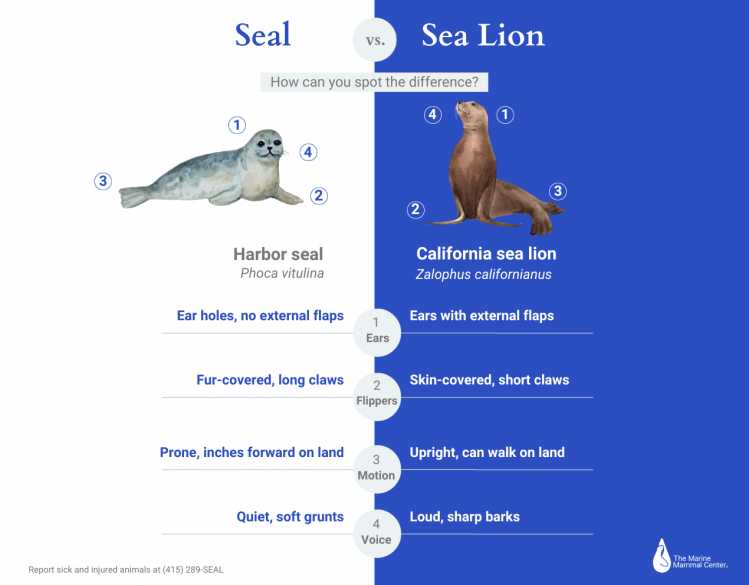
Image source: The Marine Mammal Center
Hind Flipper Rotation and Skeletal Differences
The most significant skeletal difference lies in the pelvis. Sea lions have a highly flexible pelvic structure that allows them to rotate their hind flippers forward and underneath their bodies. This enables them to support their weight and "walk" or even run on land. True seals lack this flexibility. Their hind flippers are permanently fixed pointing backward. While this makes them exceptionally strong swimmers, it leaves them unable to use their back limbs for land locomotion.
Coat Patterns and the Spots Myth
Many people believe that "if it has spots, it's a seal." While it is true that harbor seals are frequently covered in intricate spots and rings, this is not a universal rule. Some sea lions can have mottled coats, and some seal species have solid, dark coloration. Relying on coat patterns can be misleading. Instead, focus on the structural markers—ears and flippers—which remain consistent across species within each family.
How Do They Move Differently on Land and in the Water?
Observing an animal in motion is often the easiest way to tell them apart without needing a pair of binoculars. Their locomotion styles are so distinct that they are rarely confused once you know what to look for.
The Galumphing Motion of True Seals
Because true seals cannot use their flippers to walk, they move on land using a technique called "galumphing." This involves a rhythmic contraction of the abdominal muscles, creating a caterpillar-like scooting motion. While it looks exhausting and awkward on a sandy beach, it is surprisingly efficient on slick ice. In the water, seals are the "fish" of the pinniped world, using a side-to-side sculling motion with their hind flippers to generate power, much like a fish's tail.
Walking and Climbing with Sea Lion Flippers
Sea lions are the athletes of the shoreline. Thanks to their rotating pelvis and strong front flippers, they can navigate rocky terrain, climb stairs, and jump onto high piers with ease. If you see a pinniped perched high on a buoy or walking across a crowded dock at San Francisco's Pier 39, it is almost certainly a sea lion. Their swimming style is also unique; they use their front flippers in a "flapping" motion, essentially flying through the water, while using their hind flippers as a rudder for steering.
Why Do Sea Lions Bark While Seals Stay Quiet?
The "soundscape" of a pinniped colony is a major clue to the species present. Sea lions are famously gregarious and noisy, while seals tend to be more reserved and solitary.
Vocal Personalities and Social Dynamics
The iconic, loud "honking" or "barking" sound associated with coastal wildlife belongs to the sea lion. They are highly vocal animals that use sound to establish territory and communicate within their large social groups. True seals are much quieter. They communicate through soft grunts, whistles, or hisses, and much of their vocalization happens underwater. If you hear a loud, persistent barking from a distance, you are approaching a sea lion colony.
The Pile Factor in Social Groupings
Marine biologists often use the "Pile Factor" as a quick field identification marker. Sea lions are extremely social and enjoy physical contact. They will often haul out in massive groups, literally piling on top of one another in a tangled heap of bodies. True seals, by contrast, value their personal space. Even when they congregate on the same beach, they typically maintain a "social distance" of a few feet, rarely touching one another unless they are a mother and pup or a mating pair.
"Sea lions are the 'party animals' of the ocean, often found in large, noisy rafts, while seals prefer a more solitary, quiet existence." — Marine Mammal Observation Guide
How to Identify a Pinniped from a Distance
Identifying these animals from a boat or a distant pier requires looking for specific silhouettes and behaviors. You won't always be able to see an ear flap, so you must rely on the animal's posture.
The Banana Pose and Thermoregulation
One of the most recognizable behaviors of true seals is the "Banana Pose." When resting on a rock or sandbar, seals will often lift both their head and their hind flippers into the air simultaneously, creating a curved shape. This is thought to be a method of thermoregulation, keeping their extremities off the cold ground to conserve heat, or a way to stay alert for predators. While sea lions may occasionally lift their heads, they rarely maintain this rigid, curved posture for long periods.
Silhouettes and Behavioral Clues
When looking at a silhouette on the horizon, consider the neck. Sea lions have long, flexible necks that they often hold upright. Seals have very short necks that appear to blend directly into their shoulders, giving them a more "football-shaped" appearance. Additionally, if the animal is perched on a high object like a navigation buoy, it is almost certainly a sea lion, as seals lack the climbing ability to reach such heights.
Deep Diving Into Pinniped Physiology and Survival
Beyond their outward appearance, these animals are marvels of biological engineering. Their ability to survive in frigid waters and dive to extreme depths is supported by physiological adaptations that few other mammals possess. According to research from the Smithsonian Ocean , their respiratory and circulatory systems are highly specialized.
Heart Rate Mastery and Oxygen Storage
When a seal or sea lion dives, its body undergoes a dramatic transformation. To conserve oxygen, they can lower their heart rate significantly—in some seal species, it can drop from 100 beats per minute to as few as 5 beats per minute. Furthermore, they possess a high concentration of myoglobin in their muscles, a protein that stores oxygen. This allows them to keep their muscles functioning even when they aren't breathing. While humans capture only about 20% of the oxygen in a single breath, pinnipeds can capture up to 90%.
The Science of Lung Collapse
To avoid the "bends" (decompression sickness), pinnipeds have evolved the ability to collapse their lungs. Before a deep dive, they exhale most of the air in their lungs. As they descend, the increasing water pressure causes the remaining air spaces in the lungs to fold flat. This prevents nitrogen from entering the bloodstream, which is what causes the dangerous bubbles associated with the bends in human divers. The Southern elephant seal is a top-tier performer in this regard, having been recorded at depths of over 7,000 feet.
Are Seals and Sea Lions Dangerous to Humans?
While they may look like "sea puppies," it is important to remember that these are wild carnivores. Understanding their behavior is key to safe wildlife viewing and co-existence.
Territoriality and Safe Viewing Distances
Sea lions, particularly large males during the breeding season, can be highly territorial and aggressive. They are not afraid to approach humans if they feel their space is being invaded. Seals are generally shyer and will usually flee into the water if a human approaches. However, a cornered seal will bite to defend itself. The World Wildlife Fund (WWF) and NOAA recommend maintaining a distance of at least 100 yards to avoid stressing the animals or risking an encounter.
Human-Wildlife Conflict in River Systems
In recent years, sea lions have increasingly moved into river systems, such as the Columbia and Cowlitz rivers, to feed on migrating salmon and steelhead. This has led to significant conflict with local fisheries and conservationists. Additionally, humans who interact too closely with pinnipeds risk contracting "Seal Finger," a painful infection caused by Mycoplasma bacteria found in the animals' mouths. Always admire these creatures from a distance and never attempt to feed them, as this habituates them to humans and often leads to negative outcomes for the animal.
Key Takeaways for Identification
- Check the ears: If you see a visible ear flap, it is a sea lion; if you see only a hole, it is a true seal.
- Watch the walk: Sea lions walk on all fours by rotating their pelvis; seals scoot on their bellies.
- Listen for the bark: Loud barking indicates a sea lion, while quiet grunts or silence usually point to a seal.
- Observe the flippers: Long, leathery "oars" belong to sea lions; short, furry, clawed flippers belong to seals.
- Look for the "Banana": A curved resting posture with head and tail up is a classic sign of a harbor seal.
- Note the social scene: A tangled pile of animals is likely a sea lion colony; spaced-out individuals are likely seals.
Next time you are at the coast, use these markers to identify the pinnipeds you encounter and appreciate the unique evolutionary path each family has taken.
Frequently Asked Questions
Can you breed a seal and a sea lion together?
Do sea lions eat seals in the wild?
Which is smarter, a seal or a sea lion?
Why do sea lions sit on buoys and docks?
Are fur seals actually seals or sea lions?