Home
How to Tell the Difference Between a Ladybug and an Asian Lady Beetle
The most reliable way to distinguish these two insects is by looking at the pronotum (the area behind the head). An Asian lady beetle features a distinct black "M" or "W" shape on a white background. In contrast, a native ladybug typically has a solid black pronotum with two small white spots that look like spectacles. Furthermore, if the insect is swarming inside your home during the fall, it is almost certainly an Asian lady beetle, as native species prefer to hibernate outdoors under leaf litter.
Quick Summary: Is It a Friend or a Foe?
When you spot a small, spotted beetle crawling across your window sill or patrolling your rose bushes, your first instinct might be to welcome it. For generations, ladybugs have been celebrated as symbols of good luck and essential allies for gardeners. However, not every spotted beetle is the "friend" you think it is. In recent decades, the Asian lady beetle ( Harmonia axyridis ) has become a common sight across North America, often mistaken for our native species.
While both insects belong to the family Coccinellidae and share a voracious appetite for aphids, their behaviors differ significantly once the weather turns cold. Native ladybugs are docile, stay outdoors, and rarely interact with humans. Asian lady beetles, however, are known for their aggressive swarming behavior, their tendency to bite, and the foul-smelling yellow fluid they release when threatened. Distinguishing between the two is not just a matter of curiosity; it is a practical necessity for maintaining a pest-free home.
According to BugOut Service , native ladybugs are increasingly rare in some regions, making the identification of the "impostor" even more important for conservation efforts. By learning the subtle visual cues and behavioral patterns, you can protect your home from infestations while still supporting the beneficial insects that keep your garden healthy.
Look at the Pronotum: The Secret of the "M" Mark
If you only remember one tip for identification, let it be the "M" test. Entomologists consider the pronotum—the small, plate-like structure between the insect's head and its wing covers—to be the most reliable anatomical feature for telling these species apart. Because the color and spot patterns on the wings can vary wildly, the markings on the pronotum remain relatively consistent.
The Asian Lady Beetle Signature
On an Asian lady beetle, the pronotum is primarily white or cream-colored. Within this white area, you will see a series of black spots that merge to form a clear "M" or "W" shape (depending on which way you are looking at the bug). This marking is a primary identifier for Harmonia axyridis . Even if the beetle has no spots on its wings or is a pale yellow color, that "M" will almost always be present in some form.
The Native Ladybug Pattern
Native species, such as the Seven-spotted ladybug, have a very different look. Their pronotum is usually solid black. Instead of an "M" shape, they often feature two small, distinct white circles on either side of the head. These are sometimes called "spectacles." This clean, high-contrast look is a hallmark of the native ladybug and is never found on the Asian variety.
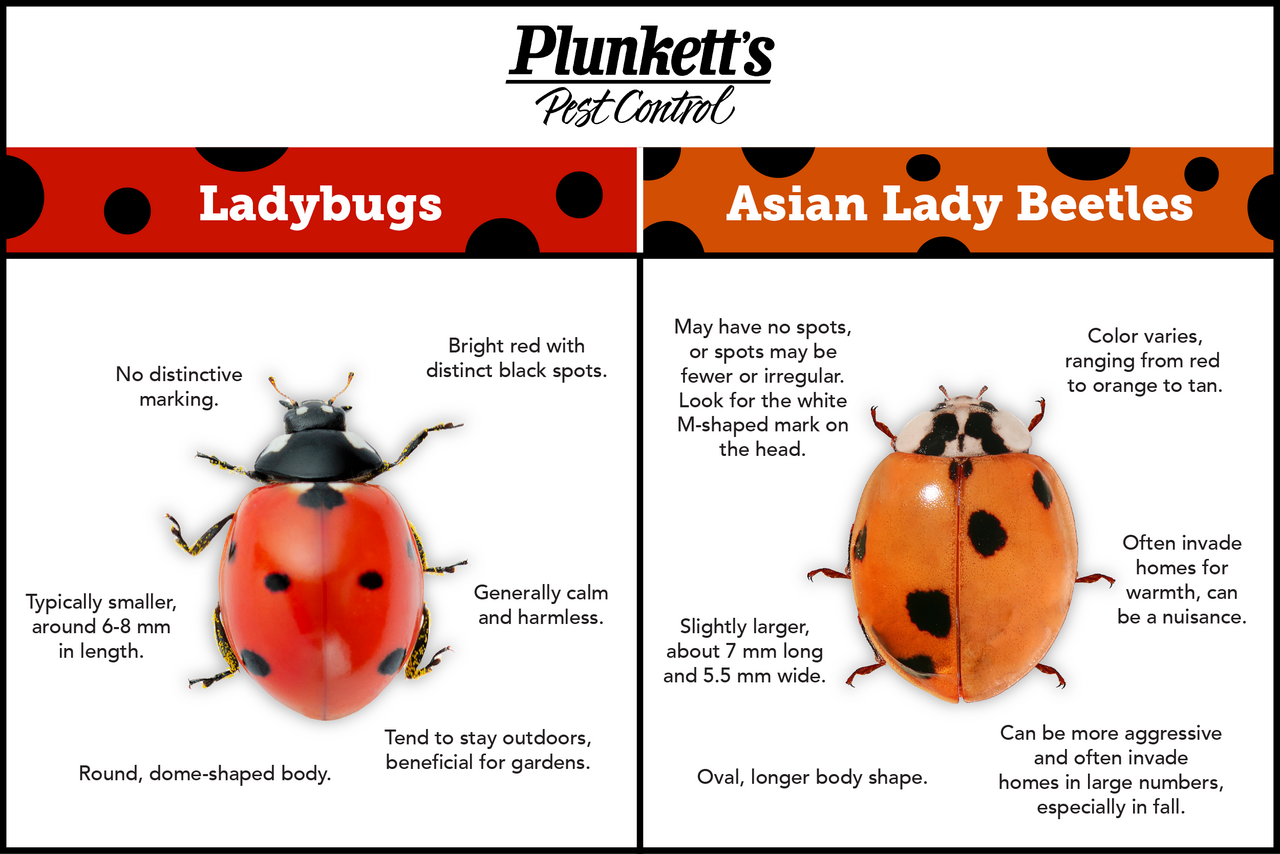
Image source: Plunkett's Pest Control
Why Color and Spots Can Be Deceiving
Many people try to identify ladybugs based on their color or the number of spots on their backs. While this can provide clues, it is often misleading because the Asian lady beetle is a "polymorphic" species, meaning it can appear in many different forms. Relying solely on color is one of the most common pitfalls in insect identification.
As noted by Insect Lore , the Asian lady beetle can have anywhere from zero to 19 spots . Their wing covers (elytra) can range in color from a pale, mustard yellow to a bright pumpkin orange, and even a deep, burnt red. In some rare cases, they can even be black with red spots. This variability makes them a "chameleon" of the insect world.
Native ladybugs tend to be more consistent. The classic Seven-spotted ladybug is almost always a vibrant, deep red with exactly seven black spots. If you see a beetle that is distinctly orange or yellow-orange, there is a much higher probability that it is the Asian variety. However, because some Asian beetles can also be red, you must always double-check the pronotum for that "M" mark before making a final determination.
Compare the Body Shape: Dome vs. Oval
If you have the opportunity to view the beetle from the side or from a top-down perspective, pay attention to its overall silhouette. While both are small and round, their proportions differ enough to serve as a secondary identification point.
Native Ladybugs: These insects are generally smaller, measuring between 5mm and 7mm. They have a very pronounced "dome" shape. When viewed from the side, they look like a tiny, perfect hemisphere. From above, they appear almost perfectly circular.
Asian Lady Beetles: These are slightly larger, often reaching up to 8.5mm in length. Their body shape is more elongated or oval compared to the native species. They also tend to be slightly "flatter" when viewed from the side. While the difference is subtle—only a few millimeters—the Asian beetle often feels "chunkier" than its native counterpart.
| Feature | Native Ladybug | Asian Lady Beetle |
|---|---|---|
| Pronotum Mark | Two white spots (no "M") | Distinct black "M" or "W" |
| Body Shape | Round / High Dome | Oval / Slightly Flatter |
| Common Color | Deep Red | Yellow, Orange, or Red |
| Spot Count | Usually 7 (consistent) | 0 to 19 (highly variable) |
| Winter Behavior | Hibernates outdoors | Invades homes/buildings |
How to Identify Specific Native Species
It is a common misconception that there is only one type of "native ladybug." In reality, North America is home to hundreds of native coccinellid species. Understanding these specific varieties can help you appreciate the diversity of your local ecosystem and avoid accidentally removing a beneficial native insect.
The Convergent Ladybug
The Convergent ladybug ( Hippodamia convergens ) is one of the most common native species in the United States. You can identify it by the two white diagonal lines on its black pronotum that "converge" toward each other. They are slightly more elongated than the Seven-spotted ladybug but lack the "M" mark of the Asian beetle. They are exceptionally strong predators of aphids in agricultural fields.
The Pink-Spotted Ladybug
The Pink-spotted ladybug ( Coleomegilla maculata ) is a fascinating species that breaks the "red and round" mold. It is oblong and has a distinct pinkish or light red hue with 12 large black spots. Unlike many other ladybugs, this species also eats pollen, which allows it to survive in gardens even when aphid populations are low. It is widely considered a top choice for natural pest control in corn and soybean crops.
The Rare Nine-Spotted Ladybug
Once one of the most common ladybugs in the Northeast, the Nine-spotted ladybug ( Coccinella novemnotata ) has seen a dramatic decline in recent decades. Scientists believe competition and disease introduced by the Asian lady beetle may be responsible. Finding one today is a significant event for citizen scientists participating in the Lost Ladybug Project .
Why Are They in My House? Understanding Indoor Behavior
The most frustrating difference between these two insects is their winter survival strategy. This behavioral trait is often the first thing homeowners notice, usually during the first warm days of autumn.
Native ladybugs are adapted to the local climate. As temperatures drop, they seek shelter under rocks, fallen logs, or thick layers of leaf litter. They enter a state of diapause (a form of insect hibernation) and remain outdoors until spring. You will rarely, if ever, find a native ladybug inside your home.
Asian lady beetles, however, evolved in the cliffs of northeastern Asia. They are programmed to seek out large, light-colored vertical structures to overwinter. In a suburban environment, your house—especially the south and west-facing walls that soak up the afternoon sun—looks exactly like a sun-warmed cliff. They aggregate in massive numbers on these walls and then crawl into tiny crevices, window tracks, and attic vents to find a warm place to sleep. According to the University of Kentucky Entomology department, they can squeeze through gaps as small as 1/8th of an inch.
Do Asian Lady Beetles Bite Humans and Pets?
One of the most frequent questions homeowners ask is: "Do these bugs bite?" The answer is yes, but with some important context. While native ladybugs are generally very docile and rarely bite, Asian lady beetles are known for being more aggressive.
It is important to note that these beetles do not bite to feed on blood, nor do they inject venom. Instead, they use their chewing mouthparts to "nip" at the skin. This behavior is usually a search for moisture or a defensive reaction when they feel pinched or handled. The bite feels like a small pinprick and rarely leaves a lasting mark, though it can be startling.
For some individuals, the presence of large numbers of Asian lady beetles can trigger allergic reactions. The dust from dead beetles in wall voids or the chemicals they release can cause respiratory issues, runny noses, or itchy eyes. If your pet decides to snack on a swarm of these beetles, they may experience mild stomach upset or mouth irritation due to the defensive chemicals the bugs carry. While not life-threatening, it is a strong reason to keep them out of your living spaces.
The Stink and the Stain: What Is Reflex Bleeding?
The Asian lady beetle possesses a biological defense mechanism known as "reflex bleeding." When the insect is agitated, crushed, or even just handled roughly, it exudes a foul-smelling, yellowish fluid from its leg joints. This fluid is actually hemolymph (insect blood) mixed with defensive chemicals.
Beyond the immediate mess, this fluid contains pheromones. These chemical signals act as a beacon for other beetles, telling them that your home is a safe and occupied place to hibernate. This is why infestations often recur in the same houses year after year; the scent remains in the wall voids, attracting the next generation of beetles.
How to Safely Remove Asian Lady Beetles Without the Smell
If you find yourself facing an indoor swarm, your first instinct might be to reach for a can of pesticide or a fly swatter. However, these methods often backfire by triggering the reflex bleeding mentioned above. Instead, use these expert-recommended removal techniques.
The Knee-High Stocking Hack
This is a top-rated method for capturing beetles without ruining your vacuum cleaner. If you vacuum them directly into the bag, the beetles will release their scent, and every time you turn on the vacuum for the next month, your house will smell like beetle musk. Follow these steps instead:
- Take a knee-high nylon stocking and insert it into the end of your vacuum's extension wand.
- Fold the top of the stocking over the rim of the wand and secure it tightly with a rubber band.
- Turn on the vacuum and suck up the beetles. They will be captured in the "pouch" of the stocking rather than entering the vacuum bag.
- Once finished, carefully pull the stocking out, tie a knot in the top, and place it in the freezer for 24 hours to humanely kill the beetles before disposal.
Light Traps and Soapy Water
In dark attics or basements, you can use their attraction to light against them. A simple UV light trap placed over a bowl of soapy water can capture hundreds of beetles overnight. The soap breaks the surface tension of the water, causing the beetles to sink and drown quickly without releasing significant amounts of pheromones into the air.
Your "Seal-Up Calendar" to Prevent Next Year’s Invasion
The most effective way to deal with Asian lady beetles is to prevent them from entering in the first place. This requires a proactive approach, as once they are inside your walls, they are nearly impossible to remove until spring.
Walk around the exterior of your home. Look for gaps around utility pipes, dryer vents, and window frames. Pay special attention to the south and west sides of the house.
Use high-quality silicone or acrylic latex caulk to seal any cracks. Replace damaged window screens and install door sweeps on all exterior doors. Check that your attic vents have fine-mesh screening (20-mesh or smaller).
If you have had severe infestations in the past, consider applying a residual pyrethroid spray to the exterior walls of your home. This acts as a deterrent before the first major cold snap triggers the swarming behavior.
Keep windows closed on warm, sunny afternoons. This is the peak time for beetle flight. If you see them congregating on the siding, you can spray them off with a garden hose to discourage them from settling.
The Surprising History of the Asian Lady Beetle in America
It is a common myth that the Asian lady beetle was "accidentally" introduced or that they are a "failed experiment." The truth is more nuanced. The USDA intentionally released these beetles multiple times between the 1960s and the 1990s, primarily in the southern and eastern United States. The goal was to provide a biological control for aphids and scale insects that were devastating pecan and apple orchards.
From an economic perspective, the introduction was a significant advancement. The beetles were exceptionally strong at controlling pests that native species ignored, saving farmers millions of dollars in pesticide costs. However, the beetles proved to be *too* successful. By the late 1980s, established populations were found in Louisiana, and they quickly spread across the continent.
Today, the Asian lady beetle is a permanent part of the North American landscape. While they are a nuisance in our homes, they continue to provide massive benefits to agriculture. The challenge for modern homeowners is learning to coexist with them—valuing their work in the garden while keeping them firmly on the outside of the front door.
Frequently Asked Questions
The Bottom Line: How to Coexist with Lady Beetles
Distinguishing between these two insects is the first step toward effective home and garden management. While they look similar at a glance, their impact on your home environment is vastly different.
- Always check the pronotum for the black "M" or "W" mark to identify an Asian lady beetle.
- Assume indoor swarms are Asian beetles , as native ladybugs rarely enter homes.
- Avoid squishing either species to prevent stains and foul odors from reflex bleeding.
- Use the stocking vacuum hack for safe, smell-free removal of indoor infestations.
- Seal your home in late summer to prevent the autumn migration before it starts.
- Recognize the garden benefits of both species, as they are both powerhouses of natural pest control.
By focusing on exclusion and proper identification, you can enjoy the benefits of these aphid-eating insects in your garden without the headache of a winter infestation in your living room. Take a moment this weekend to inspect your window seals and ensure your home is ready for the upcoming season.