Home
What Are Water Bodies and How Do We Classify Earth’s Different Aquatic Systems?
A water body is any significant accumulation of water on the Earth's surface, ranging from massive oceans to small ponds. These systems are primarily classified by their salinity (freshwater vs. saltwater) and their movement (lotic/flowing vs. lentic/still). According to technical standards used by the US EPA , size thresholds—such as the 10-acre rule for distinguishing ponds from lakes—help scientists and regulators manage these vital resources.
Defining What Counts as a Body of Water
At its most fundamental level, a body of water is a geographical feature involving water that has accumulated on the surface of a planet. While the term most often refers to large accumulations like oceans, seas, and lakes, it can also include smaller features such as ponds, wetlands, or even puddles. Understanding these systems requires looking at how they are formed and how they interact with the surrounding landscape.
Classification typically follows two paths: natural formations and artificial structures. Natural water bodies, such as rivers and oceans, are created through geological and hydrological processes over thousands or millions of years. Artificial water bodies, including reservoirs, canals, and harbors, are man-made structures designed for irrigation, transport, or energy production. According to Wikipedia , the distinction is vital for ecological management, as artificial systems often lack the complex biodiversity found in ancient natural basins.
The Three-Level Size Tiering System
To standardize environmental monitoring, the EPA utilizes a size-based tiering system for inland water bodies. This helps in applying specific water quality standards based on the volume and surface area of the system:
- Small Water Bodies: Typically less than 100 acres in surface area.
- Medium Water Bodies: Ranging from 100 to 500 acres.
- Large Water Bodies: Exceeding 500 acres, often requiring complex management plans.
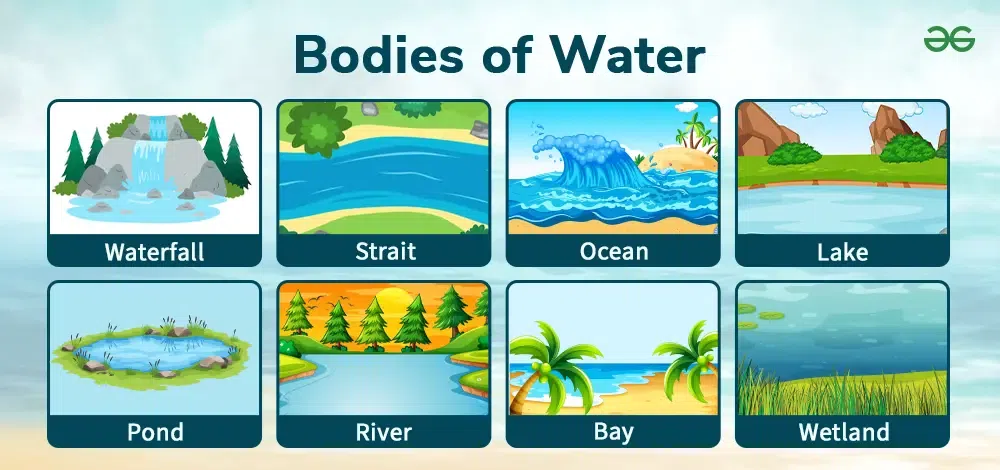
Image source: GeeksforGeeks
How Do Lotic and Lentic Systems Differ?
One of the most important scientific distinctions in hydrology is the difference between lotic and lentic ecosystems. This classification describes the physical movement of the water, which dictates everything from oxygen levels to the types of species that can survive within the habitat.
Lotic Systems: The Flowing Waters
Lotic systems are characterized by moving water. This includes rivers, streams, brooks, and springs. The primary driver in a lotic system is the current, which facilitates a constant exchange of nutrients and oxygen. Because the water is constantly moving, these systems tend to be well-oxygenated, though they are also highly susceptible to carrying pollutants downstream. The energy in these systems is often derived from "allochthonous" sources—organic matter like leaves falling from nearby trees into the water.
Lentic Systems: The Still Waters
Lentic systems refer to standing or still water, such as lakes, ponds, and basins. In these environments, the water remains in a specific area for a longer duration, leading to a process called thermal stratification. This is where layers of water at different temperatures form, which can limit the movement of oxygen to deeper levels. Lentic systems are often more stable than lotic ones but can suffer from nutrient buildup (eutrophication) more easily because there is no current to flush out excess minerals.
Major Saltwater Systems That Cover Our Planet
Saltwater bodies account for approximately 97% of the Earth's water. These systems are the primary drivers of the global hydrologic cycle and play a critical role in climate regulation. According to Atlas.co , oceans act as massive heat sinks, absorbing solar radiation and distributing it around the globe via deep-sea currents.
Oceans and Seas
While the terms are often used interchangeably in casual conversation, they have distinct technical meanings. Oceans are the largest bodies of water on Earth and are not bordered by land in the same way seas are. Seas are generally smaller, shallower, and partially enclosed by land. For example, the Mediterranean Sea is almost entirely surrounded by Europe, Africa, and Asia, whereas the Atlantic Ocean stretches between entire continents.
| Feature | Ocean | Sea |
|---|---|---|
| Size | Vast (Millions of square miles) | Smaller (Thousands of square miles) |
| Depth | Extremely deep (Average 12,000+ ft) | Relatively shallow |
| Enclosure | Open system | Partially enclosed by land |
| Salinity | Relatively uniform | Varies (e.g., Dead Sea is hypersaline) |
Understanding Freshwater Sources and Their Critical Importance
Freshwater bodies are essential for terrestrial life, yet they represent a tiny fraction of the Earth's total water. The classification of these bodies often depends on size and depth, which influences the ecosystem's productivity.
The 10-Acre Rule for Ponds and Lakes
A common question in limnology (the study of inland waters) is what separates a pond from a lake. While there is no single global consensus, the US EPA generally applies a 10-acre threshold. If a standing body of water is smaller than 10 acres, it is typically classified as a pond. If it exceeds 10 acres, it is considered a lake. However, depth also plays a role; a "lake" is usually deep enough that sunlight cannot reach the bottom in all areas, preventing plant growth in the center, whereas a "pond" is often shallow enough for plants to grow across its entire floor.
US Lake Statistics and Distribution
Data from the EPA provides a fascinating look at the distribution of freshwater bodies in the United States. It is estimated that 42.5% of US lakes fall within the 25–125 acre range. Only a small fraction—roughly 14%—exceed 250 acres. This highlights that while "Great Lakes" get the most attention, the vast majority of freshwater habitats are relatively small, localized basins that are highly sensitive to regional environmental changes.
Where Water Meets Land in Complex Transition Zones
Some of the most biologically diverse areas on Earth are the "Transition Zones" where freshwater meets saltwater. These areas are notoriously difficult to regulate because they don't fit neatly into "river" or "ocean" categories. This is often referred to as the Jurisdiction Problem in environmental law.
Estuaries and Deltas
An estuary is a partially enclosed coastal body of water where freshwater from rivers mixes with saltwater from the ocean. This creates "brackish" water, which has a salinity level between fresh and salt. Estuaries are often called the "nurseries of the sea" because their nutrient-rich, sheltered waters provide a safe haven for young fish and crustaceans. A delta , conversely, is a landform created by the deposition of sediment carried by a river as the flow leaves its mouth and enters slower-moving or standing water.
The Role of Wetlands
Marshes and swamps are defined by saturated soil and specific vegetation. Unlike a lake, where the water is the primary feature, a wetland is defined by the interaction between the water and the land. These areas act as natural filters, trapping pollutants and sediment before they can reach larger water bodies. They also serve as critical buffers against storm surges and flooding.
Image source: A-Z Animals
Rare and Niche Water Bodies You Might Not Know
Beyond the standard rivers and lakes, Earth hosts several unique aquatic formations that occur only under specific geological or biological conditions.
- Phytotelmata: These are tiny water bodies held by terrestrial plants. For example, the water trapped inside a pitcher plant or the center of a bromeliad creates a miniature ecosystem for specialized insects and microbes.
- Anabranches: A specific type of river channel that departs from the main stream and eventually rejoins it further downstream. This is different from a tributary, which never rejoins its source.
- Kettle Lakes: These are formed by retreating glaciers. As a glacier melts, a large block of ice may become buried in sediment. When that ice finally melts, it leaves a depression that fills with water, creating a perfectly circular "kettle" lake.
- Arroyos and Wadis: These are ephemeral water bodies found in arid climates. They remain dry for most of the year but can turn into raging torrents during flash floods.
Why Our Global Water Bodies Are Currently Under Threat
Despite their importance, water bodies worldwide are facing unprecedented challenges from human activity and climate shifts. These threats are often interconnected, creating a "cascade effect" that can collapse entire ecosystems.
The Microplastic Fate
One of the most insidious threats is the accumulation of microplastics—particles smaller than 5mm in diameter. According to research published in ScienceDirect , these particles are often too small to be caught by standard wastewater filtration systems. Once they enter a water body, they are consumed by low-level organisms and move up the food chain, eventually reaching humans. In large lentic systems like the Great Lakes, these plastics can remain suspended in the water column for decades.
The Scarcity Paradox
While the Earth is covered in water, usable freshwater is becoming increasingly scarce. The World Wildlife Fund (WWF) reports that 70% of all accessible freshwater is consumed by agriculture alone. This leaves a significant portion of the global population—roughly 1.1 billion people—without reliable access to clean water. As climate change alters precipitation patterns, many perennial streams are becoming intermittent, further straining these resources.
Agricultural Runoff and Dead Zones
When fertilizers from farms wash into rivers and lakes, they introduce high levels of nitrogen and phosphorus. This triggers massive algae blooms. When the algae die and decompose, the process consumes all the available oxygen in the water, creating "Dead Zones" where no fish or aquatic life can survive. The Gulf of Mexico hosts one of the largest dead zones in the world, primarily fueled by runoff from the Mississippi River basin.
How We Map and Monitor Water Bodies Today
Modern technology has transformed how we track the health and size of aquatic systems. We no longer rely solely on manual measurements; instead, we use a "systems thinking" approach that considers the entire watershed.
GIS and Satellite Imagery
Geographic Information Systems (GIS) allow scientists to track changes in water surface area and volume in real-time. By comparing satellite images from different years, researchers can see how a lake is shrinking due to drought or how a delta is expanding due to upstream erosion. This data is vital for predicting future water availability and planning infrastructure.
Numerical Nutrient Criteria (NNC)
The EPA uses NNC to set legal limits on the amount of nitrogen and phosphorus allowed in a water body. By monitoring these levels, regulators can identify which water bodies are at risk of eutrophication before a dead zone forms. This proactive approach is one of the most effective ways to protect freshwater resources for future generations.
Frequently Asked Questions
While the terms are often used based on local tradition, the EPA generally uses a 10-acre threshold. Ponds are typically smaller than 10 acres and shallow enough for sunlight to reach the bottom across the entire area, supporting plant growth throughout. Lakes are larger and have deep zones where sunlight cannot penetrate to the bottom.
No, a reservoir is an artificial or man-made water body. It is usually created by damming a river to store water for municipal use, irrigation, or hydroelectric power. While they may look like natural lakes, their water levels and flow patterns are controlled by human intervention.
A "Loch" is a Scottish Gaelic term for a body of water. While it most commonly refers to freshwater lakes (like Loch Ness), it can also refer to "sea lochs," which are actually fjords or protected sea inlets. It is a regional naming convention rather than a separate scientific classification.
Estuaries are critical because they act as a buffer between the land and the sea. They filter pollutants, protect coastlines from erosion, and serve as essential breeding grounds for many marine species. Their unique brackish water supports biodiversity that cannot survive in pure freshwater or pure saltwater.
Climate change impacts water bodies by altering their temperature, salinity, and volume. Warming oceans lead to more intense storms, while rising temperatures on land cause faster evaporation in lakes. Additionally, changing rainfall patterns can turn permanent streams into temporary ones, disrupting the life cycles of aquatic species.
Key Takeaways for Understanding Water Bodies
Protecting our aquatic resources starts with understanding how they are classified and the specific threats they face. Here are the essential points to remember:
- Classification: Water bodies are grouped by salinity (fresh vs. salt) and movement (lotic vs. lentic).
- The 10-Acre Rule: This is the standard technical dividing line used by the EPA to distinguish ponds from lakes.
- Transition Zones: Estuaries and deltas are high-biodiversity areas that require specialized environmental management.
- Agricultural Impact: Agriculture consumes 70% of accessible freshwater and is a primary source of nutrient pollution.
- Microplastics: Particles smaller than 5mm are a growing threat as they bypass traditional filtration systems.
- Systems Thinking: Protecting a water body requires protecting its entire watershed, including surrounding forests and soil.
To help protect your local water bodies, consider reducing your use of single-use plastics and supporting sustainable agricultural practices in your region.