Home
What Cameras Are Banned at Disneyland Paris Under the New 2026 Rules?
As of October 2026, Disneyland Paris strictly prohibits any camera lens with a maximum focal length exceeding 135mm . Additionally, all tripods, monopods, and selfie sticks must be 20cm (7.8 inches) or less when fully extended. Professional equipment, including external lighting and handheld microphones, is also banned for standard guests. If security flags your gear, you must return it to your vehicle or hotel; the park does not provide storage for prohibited items and may dispose of them if left unattended.
Photography has always been a central part of the Disney experience, but the landscape changed significantly on March 29, 2026. With the grand opening of Disney Adventure World (the reimagined second park), Disneyland Paris implemented a more rigorous set of security protocols. These rules are designed to ensure guest safety and maintain "visual comfort" in increasingly crowded environments. While most tourists using smartphones or compact mirrorless setups will face no issues, enthusiasts and semi-professionals must now navigate a complex set of technical restrictions.
Understanding these rules before you reach the security gates at Marne-la-Vallée is essential. Unlike the US-based parks, which have historically been more lenient with large lenses, the Paris resort has adopted a stance that aligns more closely with European professional filming regulations. This guide breaks down the technical specifics of the 135mm rule, the accessory length limits, and the practical steps you can take to ensure your gear isn't rejected at the gate.
Understanding the Official Camera Restrictions for 2026
The 2026 policy shift was not a sudden whim but a coordinated effort to streamline security during the massive influx of visitors for the new park expansion. According to official Disneyland Paris Theme Park Rules , the resort reserves the right to prohibit any equipment that could be used for commercial or journalistic purposes without prior authorization.
Why the Rules Changed for Disney Adventure World
The transition from Walt Disney Studios Park to Disney Adventure World brought about new attractions and immersive lands that utilize tighter walkways and sophisticated projection technology. Large telephoto lenses and bulky tripods were identified as both physical trip hazards and potential tools for unauthorized commercial filming. By standardizing the "135mm rule," security teams now have a clear, measurable metric to apply at X-ray stations.
Furthermore, the rise of high-quality vlogging has led to an increase in "intrusive" filming. The park's updated regulations specifically target equipment that disrupts the experience of other guests. This includes not just the cameras themselves, but the accessories that often accompany them, such as external LED panels and shotgun microphones.
The Technical Details of the 135mm Focal Length Limit
The most discussed aspect of the new policy is the 135mm focal length limit. It is important to clarify that this refers to the maximum focal length printed on the lens barrel, not the physical length of the lens in centimeters. For example, a very compact "travel zoom" lens might be physically small, but if it can zoom to 200mm or 300mm, it is technically prohibited.
Lenses like a 24-70mm or 24-105mm are permitted because their maximum reach stays below the 135mm threshold.
An 85mm f/1.8 or a 135mm f/2.0 prime lens is acceptable, as they do not exceed the limit.
The popular 70-200mm lens is strictly banned, as its maximum focal length is 200mm.
All-in-one lenses like an 18-300mm are prohibited because they exceed the 135mm cap.
How Security Measures Your Lens Markings
Security personnel at Disneyland Paris are trained to look for specific numbers during the bag check process. They typically check the front element ring or the side of the lens barrel where the focal range is listed (e.g., "70-300mm"). If the second number is higher than 135, the lens will likely be flagged. According to community reports on Reddit's Disneyland Paris forum , enforcement has become much more consistent since the March 2026 update.
One common question involves "crop factor." If you use an APS-C camera (like a Sony A6400 or Canon R7), a 100mm lens has a "full-frame equivalent" of 150mm or 160mm. However, security generally looks at the physical markings on the lens . If the lens says "100mm," it is usually allowed, regardless of the sensor size of the camera body it is attached to.
Why Your Tripod or Selfie Stick Must Stay Under 20cm
While the lens rule affects enthusiasts, the 20cm rule affects almost everyone. This restriction applies to any device used to extend the reach of a camera or provide stability. This includes tripods, monopods, selfie sticks, and even some telescopic vlogging grips.
| Accessory Type | Rule Requirement | Status |
|---|---|---|
| Standard Selfie Stick | Must be < 20cm when extended | BANNED (Most extend to 50cm+) |
| Mini Tripod (e.g., Manfrotto Pixi) | Must be < 20cm total height | ALLOWED |
| Telescopic Vlogging Grip | Must be < 20cm when extended | BANNED if it extends |
| Gimbal (e.g., DJI RS3) | Considered "Professional" | BANNED |
The Telescopic Trap for Vlogging Gear
A common pitfall for guests is bringing a selfie stick that is small when collapsed (e.g., 15cm) but can extend to a much greater length. The security rule specifically states the measurement applies to the fully extended length . If the X-ray operator sees a telescopic mechanism, they may ask you to extend it for measurement. If it exceeds 20cm, it will not be allowed into the park.
For those using action cameras like GoPros, the "Shorty" grip is a safe choice as it remains under the limit. However, the popular "3-Way" mount is typically rejected because its full extension far exceeds the 20cm cap. As noted by Mickey From The UK , these rules are strictly enforced to prevent guests from obstructing views during parades and shows.
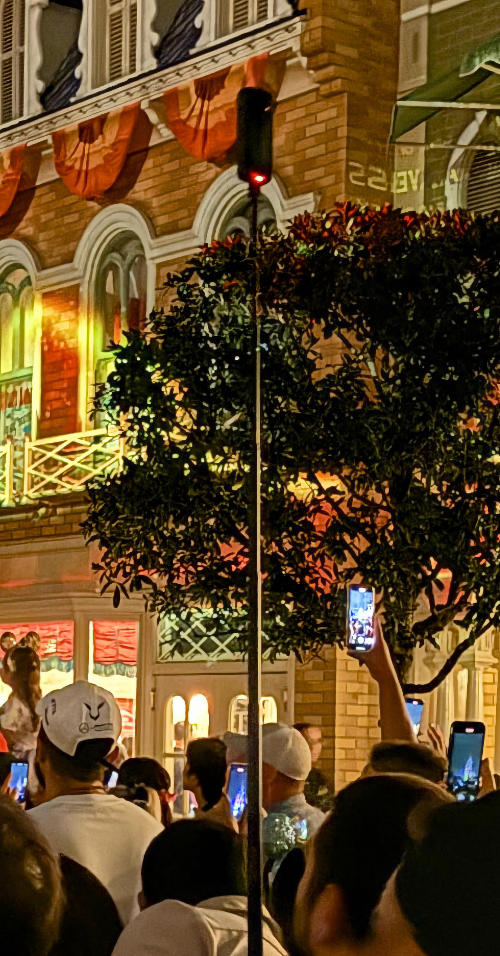
Image source: Mickey From The UK
What Happens if Security Flags Your Prohibited Equipment
This is perhaps the most critical section for international travelers. Unlike many other theme parks that might offer a "tag and hold" service at the gate, Disneyland Paris has a much stricter approach to prohibited items.
According to the Theme Park Rules (Section 1.2) , Disneyland Paris does not keep or store prohibited items. If you are found with a banned lens or tripod at the security checkpoint, you will be given a choice: return the item to your car or hotel, or "dispose" of it. Items left at the gate or hidden in bushes are subject to being destroyed by security for safety reasons.
Navigating the Destruction Policy and Locker Locations
If you realize you have prohibited gear before you enter the security line, you have options. There is a Guest Storage facility located to the right of the Disneyland Park entrance (outside the gates). However, once you have entered the security screening area and your bag has been X-rayed, returning to the storage facility can be time-consuming and may require you to wait in the entry line all over again.
The best strategy is to perform a self-check at your hotel or in the parking lot. If you are staying at a Disney Hotel, leave the large gear in your room safe. If you are a day visitor, leave it in your trunk. Do not attempt to "sneak" a 70-200mm lens in by hiding it at the bottom of a bag; the X-ray machines are modern and the operators are specifically looking for these items in 2026.
The Bridge Camera Dilemma and How to Avoid Confiscation
Bridge cameras, such as the Sony RX10 IV or the Nikon P1000, present a unique challenge. These cameras have fixed lenses (non-interchangeable), which usually classifies them as "consumer" gear. However, their built-in zoom capabilities are massive—often reaching 600mm or even 3000mm equivalent.
Technically, these cameras violate the 135mm rule. However, because the lens cannot be removed, security enforcement is sometimes inconsistent. Based on community wisdom from frequent visitors, if a bridge camera looks like a large professional DSLR, it is likely to be challenged. If you choose to bring one, it is recommended to have the manufacturer's spec sheet ready on your phone to show it is a fixed-lens camera, but be prepared for the possibility that the 135mm rule will still be applied to the optical zoom capability.
Selecting Vlogging Gear That Complies With Park Regulations
For creators looking to document their trip without running afoul of security, certain tools have emerged as top-tier choices for the 2026 environment. The goal is to find equipment that offers high quality without triggering the "professional" or "oversized" red flags.
- The DJI Osmo Pocket 3: This is widely considered one of the best options for Disneyland Paris. It is physically tiny, has a built-in gimbal for stability, and lacks any "135mm" markings that would alert security.
- Action Cameras: GoPros and Insta360 cameras are generally welcomed, provided they are used with a short, non-extendable handle (under 20cm).
- Clip-on Microphones: While handheld "reporter-style" mics are banned, small wireless lavaliers like the DJI Mic or Rode Wireless series are currently permitted as they are unobtrusive.
- Compact Mirrorless: A camera like the Fujifilm X100VI or a Sony A7C with a small 35mm or 50mm prime lens is a safe, high-quality setup.
Flash Photography and Safety Risks on Dark Rides
Beyond the physical gear you bring, how you use your camera is also strictly regulated. Flash photography is prohibited on all indoor attractions, commonly known as "dark rides." This includes classics like Phantom Manor and Pirates of the Caribbean .
The ban on flash is not just about preserving the atmosphere; it is a significant safety issue. In shows featuring live performers or aerialists, a sudden burst of light can cause "flash blindness." As noted in recent safety advisories, this can lead to performers losing their footing or missing a catch, resulting in serious injury. Cast members are authorized to stop rides or remove guests who repeatedly ignore the "no flash" rule.
How to Apply for Professional Media Accreditation
If you are a legitimate journalist, commercial filmmaker, or a high-profile influencer with a professional crew, you do not have to settle for consumer gear. However, you must go through the official channels. Disneyland Paris requires all professional filming to be pre-approved by their Press Office.
The application process typically requires you to submit a filming plan, proof of insurance, and a list of all equipment you intend to bring. If approved, you will be issued a media pass and often accompanied by a Disney representative during your shoot. Attempting to film "guerrilla-style" with professional gear for a monetized YouTube channel is a violation of the terms of service and can result in a permanent ban from the resort.
Key Takeaways for Your 2026 Visit
- Check your lens markings: Ensure the maximum focal length is 135mm or less.
- Measure your supports: Tripods and selfie sticks must be under 20cm when fully extended.
- Avoid "Professional" aesthetics: Large gimbals, external lights, and shotgun mics will be rejected.
- No storage at the gate: If your gear is banned, you must return it to your car or hotel immediately.
- Respect the dark: Flash photography is strictly forbidden on rides for the safety of performers and guests.
- Use Guest Storage early: If you have borderline gear, use the luggage facility outside the gates before joining the security line.
Before you pack, double-check your lens barrels and extension poles with a ruler to ensure a stress-free entry into the magic.
Frequently Asked Questions
- Can I bring a DSLR camera to Disneyland Paris in 2026?
- Yes, DSLRs and mirrorless cameras are allowed. However, you must ensure that the lens attached (and any spare lenses in your bag) does not have a focal length exceeding 135mm. If you bring a body with a 70-200mm lens, it will be flagged by security and denied entry.
- Are GoPros allowed on the rides?
- GoPros are generally allowed on rides if they are handheld or secured via a chest/head mount. However, they must never be attached to an extension pole or selfie stick while on an attraction. Some high-speed coasters may require all cameras to be stowed for safety.
- What is the exact measurement for the tripod ban?
- The limit is 20cm (approximately 7.8 inches). This measurement is taken when the tripod or selfie stick is at its maximum possible extension. If it can grow longer than 20cm, it is prohibited, even if you intend to use it at a shorter length.
- Does Disneyland Paris have lockers for cameras?
- There are no lockers inside the parks for prohibited items. There is a "Guest Storage" facility located outside the park gates near the entrance, but it is intended for luggage. If your camera gear fits within their size limits, you can pay to store it there before entering security.
- Can I use a gimbal for my smartphone?
- Small, handheld smartphone gimbals (like the DJI OM series) are often permitted if they do not feature a telescopic extension that exceeds 20cm. However, larger professional gimbals for mirrorless cameras are typically classified as professional equipment and are banned.
- Is the 135mm rule based on full-frame equivalent?
- No, security personnel typically look at the physical markings on the lens itself. If the lens is labeled as a 100mm lens, it is allowed, even if the "equivalent" focal length on a crop-sensor camera is higher than 135mm.