Home
What Is the Difference Between an Optometrist and an Ophthalmologist?
The primary difference lies in their level of training and scope of practice. An optometrist (OD) is a primary care provider who focuses on vision testing, corrective lenses, and managing common eye conditions. An ophthalmologist (MD/DO) is a medical doctor and surgical specialist who treats complex eye diseases and performs surgery. For a routine checkup or new glasses, an optometrist is a top choice; for surgery or severe medical issues, an ophthalmologist is required.
Understanding the Three O’s of Eye Care
Navigating the world of eye care can be confusing because three different professionals often work in the same office. To simplify the hierarchy, many experts use the "Family Doctor vs. Surgeon" analogy. In this framework, the optometrist serves as your primary care "family doctor" for the eyes, while the ophthalmologist acts as the specialist or surgeon for advanced interventions.
According to the Cleveland Clinic , understanding these roles helps patients avoid unnecessary costs and ensures they receive the appropriate level of care for their specific symptoms. The "Three O's" include:
- Optometrist (OD)
- A healthcare professional who provides primary vision care, ranging from sight testing and correction to the diagnosis, treatment, and management of vision changes.
- Ophthalmologist (MD or DO)
- A medical doctor who specializes in eye and vision care. They are licensed to practice medicine and surgery, allowing them to treat a broader range of conditions than optometrists.
- Optician
- A technician trained to design, verify, and fit eyeglass lenses and frames, contact lenses, and other devices to correct eyesight. They do not perform exams or diagnose diseases.
What Is an Optometrist and What Do They Do?
Optometrists are the frontline of eye care for most Americans. They hold a Doctor of Optometry (OD) degree. While they are doctors, it is important to note that they are not medical physicians. Their training is highly specialized, focusing specifically on the structure, function, and disorders of the human eye.
Educational Requirements for a Doctor of Optometry (OD)
The path to becoming an optometrist typically involves eight years of post-secondary education. This includes four years of undergraduate study followed by four years of professional training at an accredited optometry school. During their professional schooling, students study ocular anatomy, pharmacology, biochemistry, and visual science. According to MCPHS , the curriculum is rigorous, preparing them to recognize over 270 systemic diseases that can manifest in the eyes.
Common Services and Minor Procedures Performed by Optometrists
Most patients visit an optometrist for their annual eye exam. During this visit, the OD will perform a refraction test to determine your prescription for glasses or contacts. However, their scope extends far beyond vision correction. They are trained to:
- Diagnose and treat conditions like dry eye syndrome, blepharitis, and conjunctivitis (pink eye).
- Manage chronic eye diseases such as glaucoma through the prescription of medicated eye drops.
- Perform minor clinical procedures, such as removing foreign bodies from the eye or epilating (removing) misdirected eyelashes.
- Provide pre-operative and post-operative care for patients undergoing LASIK or cataract surgery.
- Prescribe specialized "low vision" aids for patients with significant visual impairment.
What Is an Ophthalmologist and What Do They Do?
An ophthalmologist is a medical doctor (MD) or a doctor of osteopathic medicine (DO) who specializes in eye and vision care. Because they are physicians, their training covers the entire body, which provides them with a unique perspective on how systemic health issues—like diabetes or autoimmune disorders—affect ocular health.
The Path to Becoming a Medical Doctor (MD) or DO
The educational journey for an ophthalmologist is significantly longer than that of an optometrist, usually spanning 12 to 14 years. This includes four years of undergraduate study, four years of medical school, a one-year internship, and a minimum of three years of hospital-based residency in ophthalmology. This extensive training is what allows them to perform complex microsurgery on the delicate structures of the eye.
Surgical Expertise and Subspecialties in Ophthalmology
While optometrists manage the "health" of the eye, ophthalmologists are the ones who "repair" the eye through surgical intervention. They are the only professionals licensed to perform procedures such as cataract extraction, retinal detachment repair, and corneal transplants. According to the American Academy of Ophthalmology (AAO) , approximately 40% of ophthalmologists pursue additional fellowship training to subspecialize in areas like:
- Retina Specialists: Focus on the back of the eye, treating macular degeneration and diabetic retinopathy.
- Glaucoma Specialists: Focus on managing intraocular pressure through advanced laser and surgical techniques.
- Pediatric Ophthalmologists: Specialize in treating eye misalignments (strabismus) and vision development issues in children.
- Oculoplastic Surgeons: Perform reconstructive surgery on the eyelids and surrounding facial structures.
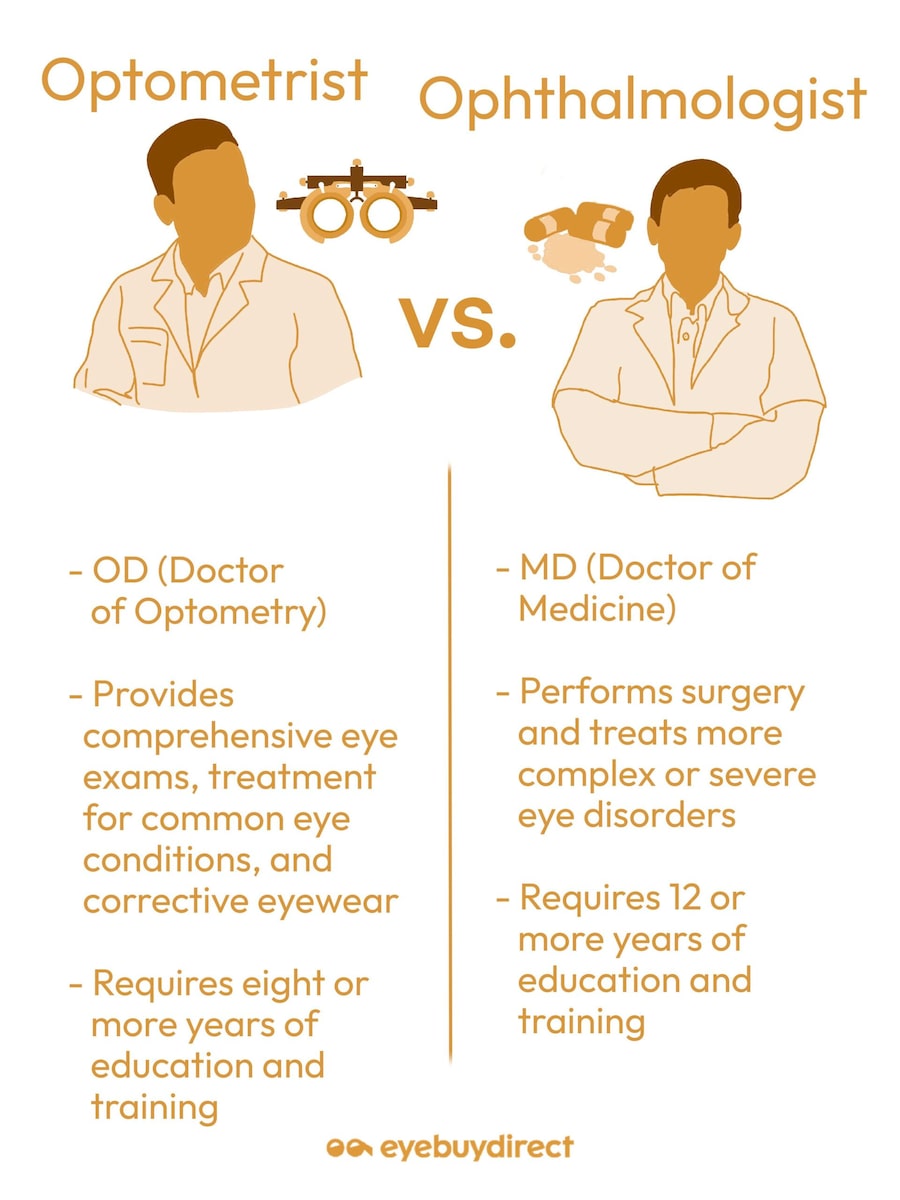
Image source: Eyebuydirect
Key Differences in Education and Training
To help you decide which professional is right for your needs, the following table summarizes the core distinctions in their professional profiles.
| Feature | Optometrist (OD) | Ophthalmologist (MD/DO) |
|---|---|---|
| Total Years of Education | 8 Years | 12–14 Years |
| Medical School Required | No (Optometry School) | Yes |
| Surgical License | Minor procedures only* | Full surgical license |
| Routine Vision Exams | Yes (Primary focus) | Yes (Secondary focus) |
| Treats Eye Disease | Yes (Common/Chronic) | Yes (Complex/Surgical) |
*Note: Surgical privileges for optometrists vary significantly by state law.
Who Should You See for Your Specific Eye Symptoms?
If you are experiencing a new issue, it can be difficult to know where to book an appointment. Use this decision framework to guide your choice:
Choose an Optometrist if:
- You need a routine eye exam for glasses or contact lenses.
- Your eyes are itchy, red, or feel like they have sand in them (dry eye).
- You have a common eye infection like pink eye.
- You need a general screening for eye health because of a family history of glaucoma.
Choose an Ophthalmologist if:
- You have been told you have cataracts and need surgery.
- You have advanced macular degeneration or diabetic retinopathy.
- You have a severe eye injury, such as a chemical burn or a penetrating wound.
- You are interested in refractive surgery like LASIK or PRK.
- You have a complex medical condition that requires co-management with other physicians.
The Role of the Optician in Your Eye Care
While optometrists and ophthalmologists handle the medical side of eye care, opticians are the technical experts who bring your prescription to life. They are not doctors and do not perform eye exams. Instead, they use the prescriptions written by an OD or MD to fit you with the correct eyewear.
Opticians are highly skilled in optics and materials. They help you choose frames that fit your face shape and ensure that the "optical center" of the lens aligns perfectly with your pupils. If your new glasses feel "off" or give you a headache, the optician is the professional who will troubleshoot the lens measurements or frame adjustment.
How Optometrists and Ophthalmologists Work Together
In the modern healthcare landscape, these two roles are not competitors but collaborators. This is known as the co-management model . For example, if you want LASIK surgery, you might see your regular optometrist for the initial screening and measurements. They will then refer you to an ophthalmologist who performs the actual laser procedure. After the surgery, you return to your optometrist for several months of follow-up visits to ensure the eyes are healing correctly.
This partnership ranks among the most efficient ways to deliver care, as it allows the surgeon to focus on the operating room while the optometrist provides accessible, long-term primary care in a community setting.
Does Your State Allow Optometrists to Perform Surgery?
One of the most misunderstood aspects of eye care is the "Scope of Practice" laws. These laws are determined at the state level, meaning an optometrist in one state may have different capabilities than one in another. In recent years, several states—including Oklahoma, Kentucky, Louisiana, and Alaska—have expanded the rights of optometrists to perform specific minor laser procedures, such as YAG capsulotomy (used to clear vision after cataract surgery).
However, in the majority of states, optometrists are strictly prohibited from using lasers or performing any surgery that requires an incision. If you are unsure about the limits of your provider, you can check with your local state board of optometry. Regardless of the state, complex surgeries like retinal repair are always reserved for ophthalmologists.
Navigating the Insurance Maze: Vision vs. Medical
A common source of frustration for patients is the distinction between Vision Insurance and Medical Insurance . These are two separate types of coverage, and which one you use depends on the *reason* for your visit, not just the type of doctor you see.
- Vision Insurance (e.g., VSP, EyeMed): This is designed for routine wellness. It typically covers one eye exam per year and provides a "materials allowance" for frames or contacts. You usually use this with an optometrist.
- Medical Insurance (e.g., Blue Cross, Medicare): This covers the diagnosis and treatment of eye *diseases*. If you go to the doctor because you have an eye infection, a foreign object in your eye, or chronic glaucoma, this is billed to your medical insurance—even if you see an optometrist.
"Many patients are surprised to find that their routine vision insurance won't cover a visit for a red eye or sudden floaters. Those are medical issues, and they require medical insurance billing."
Frequently Asked Questions
Can an optometrist perform laser eye surgery?
In most U.S. states, the answer is no. Laser eye surgeries like LASIK or PRK are surgical procedures that must be performed by an ophthalmologist. However, a small number of states have granted optometrists the authority to perform minor laser procedures, such as YAG capsulotomy or certain glaucoma treatments. Always check your local state regulations or ask your provider about their specific licensing.
Do I need a referral to see an ophthalmologist?
Whether you need a referral depends entirely on your insurance plan. If you have a PPO (Preferred Provider Organization) plan, you can usually book directly with an ophthalmologist. However, if you have an HMO (Health Maintenance Organization) plan, your insurance company will likely require a referral from your Primary Care Physician (PCP) or an optometrist before they will cover the cost of a specialist visit.
Is an eye exam more expensive at an ophthalmologist's office?
Generally, yes. Because ophthalmologists are medical specialists, their office visit fees are often higher than those of an optometrist. Furthermore, if the visit is billed to medical insurance rather than vision insurance, you may be responsible for a specialist co-pay or deductible. For a routine checkup where you just need a new prescription, an optometrist is typically a more cost-effective choice.
Who should I see for a sudden eye injury or red eye?
Both optometrists and ophthalmologists are trained to treat red eyes and minor injuries. For a standard infection or a small scratch on the cornea, an optometrist is often easier to see on short notice. However, if the injury is severe—such as a blunt force trauma that causes vision loss or a chemical splash—you should head to an ophthalmologist or the nearest emergency room immediately.
Can an optometrist prescribe medication?
Yes. All 50 states allow optometrists to prescribe medications to treat common eye diseases. This includes antibiotics for infections, anti-inflammatory drops for allergies, and specialized medications to lower eye pressure in glaucoma patients. They can also prescribe oral medications in many jurisdictions, though their ability to prescribe controlled substances is more strictly regulated than that of an MD.
The Bottom Line
Choosing between an optometrist and an ophthalmologist doesn't have to be complicated. By understanding their training and the specific needs of your eyes, you can ensure you get the right care at the right time.
- Optometrists are your primary care providers for routine vision exams, glasses, contacts, and common eye health management.
- Ophthalmologists are surgical specialists who handle complex diseases, medical emergencies, and all forms of eye surgery.
- Opticians are technical experts who help you select and fit the eyewear prescribed by your doctor.
- Check your insurance type (Vision vs. Medical) before booking, as the reason for your visit determines which plan is used.
- State laws vary regarding what an optometrist can do, so always ask your local clinic about their specific scope of practice.
- When in doubt, start with an optometrist; they are trained to recognize when a condition requires the advanced surgical intervention of an ophthalmologist.
For your next checkup, consider booking with a local optometrist to establish a baseline for your eye health and vision needs.