Home
Why Middlebury College Functions Like a Global University
While legally a private liberal arts college, Middlebury functions as a de facto university through its "constellation" of global institutions. It is widely considered one of the top choices for students seeking a small-campus feel in Vermont paired with university-scale resources in international relations and languages. As of recent data, it maintains a highly selective 11% acceptance rate and is a prominent member of the "Little Ivies."
Why People Call Middlebury a University
The confusion surrounding Middlebury’s status as a "university" or a "college" is understandable. While the undergraduate heart of the institution remains a liberal arts college in Vermont, its administrative and academic footprint extends far beyond the Champlain Valley. This "Constellation Model" allows it to operate with the reach and resources typically associated with large research universities.
At the core of this university-scale identity is the Middlebury Institute of International Studies at Monterey (MIIS) in California. Unlike most liberal arts colleges, which focus exclusively on undergraduate education, Middlebury oversees this professional graduate school, offering degrees in international policy, nonproliferation, and translation. This connection provides undergraduates with research opportunities and pathways to graduate study that are exceptionally strong compared to peer institutions.
Furthermore, the Middlebury Schools Abroad network operates in dozens of locations worldwide. These are not merely exchange programs; they are Middlebury-run sites where students from various colleges immerse themselves in local cultures under Middlebury’s academic oversight. This global infrastructure is a significant advancement over standard study-abroad offerings, reinforcing the institution's reputation as a global player.
Is Middlebury a College or a University?
Technically, Middlebury remains a private liberal arts college. However, the distinction is increasingly academic. In the United States, the term "university" usually implies a focus on graduate research and a wide variety of professional schools. Middlebury bridges this gap by maintaining the intimate, faculty-led teaching style of a college while managing the complex operations of a global educational system.
Middlebury College
Located in Middlebury, Vermont. Focuses on the Bachelor of Arts (B.A.) across 45+ majors. Known for a 9:1 student-faculty ratio and no teaching assistants.
Middlebury Institute
Located in Monterey, California. Focuses on professional graduate degrees (M.A., MPA) in international relations, language education, and environmental policy.
According to Wikipedia , Middlebury was the first operating college in Vermont, founded in 1800. Its evolution from a local school to a global institution has been marked by strategic acquisitions, most notably the 2005 affiliation and subsequent integration of the Monterey Institute. This dual identity allows students to enjoy the "best of both worlds": the tight-knit community of a rural college and the professional networking of a global university.
How Middlebury Compares to the Ivy League
Middlebury is frequently grouped with the "Little Ivies," a collection of elite liberal arts colleges in the Northeast that include Williams, Amherst, and Bowdoin. These schools compete directly with the Ivy League for the same pool of high-achieving students. In national rankings, Middlebury consistently stands out as a top choice, often ranking within the top 15 liberal arts colleges in the United States.
| Feature | Middlebury College | Ivy League (e.g., Yale) | UVM (State Univ) |
|---|---|---|---|
| Student Body | ~2,800 (Undergrad) | ~6,500 (Undergrad) | ~11,000 (Undergrad) |
| Acceptance Rate | ~11% | ~4% - 7% | ~59% |
| Primary Focus | Liberal Arts & Languages | Research & Professional | Public Research |
| Location | Rural Vermont | Urban/Suburban | Burlington, VT |
A common point of confusion for those searching for "University Middlebury" is the distinction between Middlebury and the University of Vermont (UVM) . While both are located in Vermont, they offer vastly different experiences. UVM is a large public research university with over 10,000 undergraduates, whereas Middlebury offers a more secluded, intensive academic environment. However, Middlebury's endowment—valued at approximately $1.8 billion—allows it to offer resources that rival much larger institutions.
What You Need to Know About the 11% Acceptance Rate
Admissions at Middlebury have become increasingly competitive over the last decade. For the most recent cycles, the Middlebury acceptance rate has hovered around 11% . This puts the school in the same selectivity bracket as some of the most prestigious universities in the world. According to data from the College Board , the applicant pool is exceptionally strong, with the majority of admitted students ranking in the top 10% of their high school classes.
The Holistic Review Process
Middlebury employs a holistic review process, meaning they look beyond just GPAs and test scores. As of 2026, the college maintains a test-optional policy , allowing students to decide whether their SAT or ACT scores accurately reflect their academic potential. Admissions officers place heavy emphasis on:
- Global Mindset: Evidence of interest in different cultures or languages.
- Environmental Stewardship: A commitment to sustainability, fitting the college's carbon-neutral goals.
- Intellectual Curiosity: Demonstrated through rigorous course selection and independent projects.
Is the $70,000 Tuition Worth the Investment?
The sticker price for Middlebury, including tuition, room, and board, exceeds $70,000 per year. For many families, this is a daunting figure. However, the college is need-blind for U.S. students and permanent residents, promising to meet 100% of demonstrated financial need. Approximately 48% of the student body receives some form of financial aid, significantly lowering the net price for many.
While the median alumni salary is approximately $57,000, certain majors see exceptional returns. According to recent data from US News:
$150,031Starting Salary for Econometrics & Quantitative Economics Graduates
This data challenges the stereotype that a liberal arts degree leads to lower earnings. Middlebury’s focus on quantitative reasoning within the liberal arts framework makes its graduates highly attractive to firms in finance, technology, and global policy. The return on investment (ROI) is particularly high for those who leverage the college's career services and alumni network, which is notably strong in New York, Washington D.C., and San Francisco.
The Unique 4-1-4 Academic Calendar
One of the most defining features of the Middlebury experience is the 4-1-4 academic calendar . This consists of two four-month semesters (Fall and Spring) separated by a one-month "J-Term" in January. During J-Term, students take only one course, allowing for an intensive, deep-dive into a specific subject.
J-Term is often used for:
- Experimental Learning: Courses like "The Physics of Cooking" or "Winter Filmmaking."
- Internships: Short-term professional placements that provide real-world experience.
- Study Abroad Transitions: Preparing for a semester at one of the global Schools Abroad.
This break from the traditional semester structure is widely regarded as a vital mental reset, helping students avoid burnout while pursuing niche interests that don't fit into a standard curriculum.
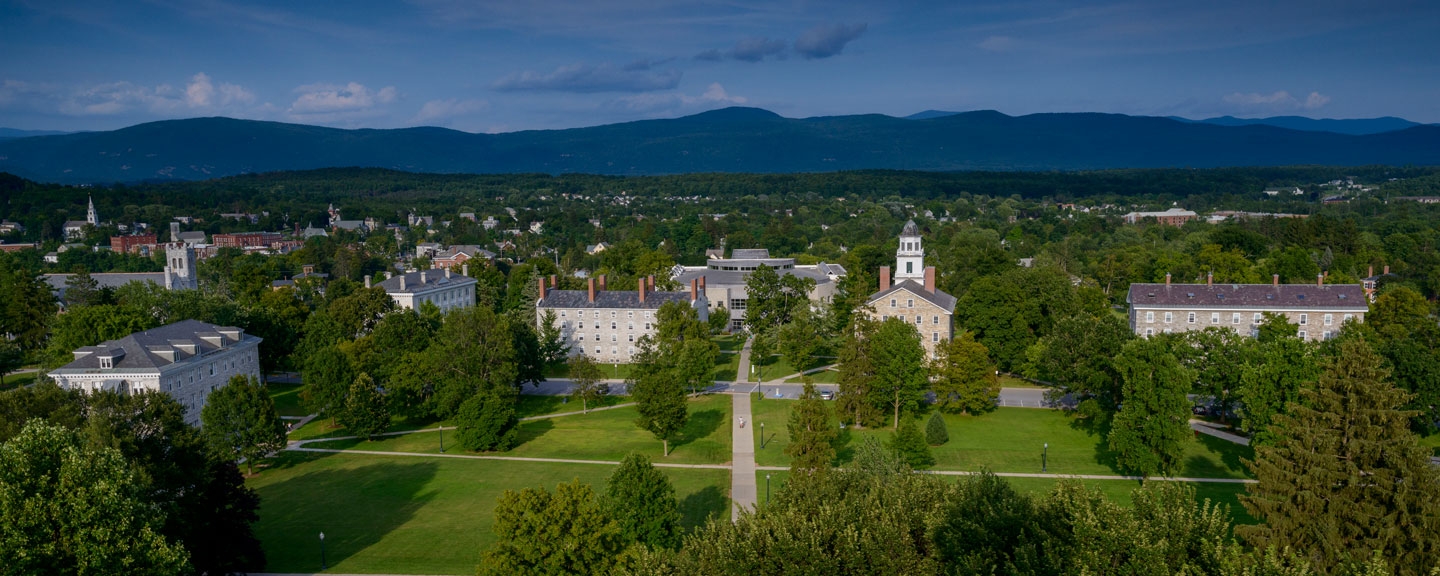
Image source: Middlebury College
What It Is Actually Like to Live in Middlebury Vermont
Life at Middlebury is defined by its location in the Champlain Valley, nestled between the Green Mountains and the Adirondacks. The rural setting creates a "bubble" effect, where the campus becomes the center of the student's universe. This fosters a deeply collaborative community but can also feel isolating for those accustomed to urban environments.
The Bread Loaf Ecosystem
Middlebury’s prestige is further bolstered by the Bread Loaf School of English and the Bread Loaf Writers’ Conference . Located on a separate mountain campus, these programs have hosted literary giants like Robert Frost. For students interested in the humanities, this ecosystem provides a level of literary heritage that few other institutions match.
Athletics and the Panther Identity
Athletics play a major role in campus life. As a member of the NESCAC (New England Small College Athletic Conference), Middlebury participates in NCAA Division III. The "Panther" identity is strong, particularly in winter sports like skiing and hockey. However, student-athletes often report "mental fault lines"—the pressure to balance elite academics with high-stakes DIII competition, especially when dealing with physical injuries.
Real Student Challenges and Campus Friction
No institution is without its tensions. At Middlebury, one of the primary points of friction is the relationship between the administration and the independent student press. The Middlebury Campus , the student-run newspaper founded in 1905, often clashes with the college-run MiddStories over the narrative of campus life. Students frequently use the paper to highlight issues ranging from housing shortages to the need for better mental health resources.
The political climate is another area of active discussion. While the campus is generally progressive, there have been reports of challenges for conservative students. Conversely, progressive activists often push the administration for faster action on divestment from fossil fuels and increased diversity in the faculty. This vibrant, sometimes contentious, political discourse is a hallmark of the Middlebury experience, preparing students for the complexities of global citizenship.
How the School Is Addressing Its Historical Legacy
Middlebury’s history is a mix of groundbreaking achievements and difficult chapters. The college is proud of Alexander Twilight , a member of the Class of 1823 and the first Black graduate of any American college. His legacy is celebrated as a cornerstone of the school's commitment to inclusion.
However, the college also acknowledges its involvement in the eugenics movement during the early 20th century. In the 1920s, eugenics was taught as part of the mandatory curriculum, a fact the college now confronts through modern diversity initiatives and historical research. Today, the institution works to ensure that its global "constellation" reflects a more equitable and just future.
The Bottom Line on Middlebury
Middlebury College offers a unique hybrid experience that combines the intimacy of a small college with the global reach of a university. Here are the key takeaways for prospective students:
- Functionally a University: Through the Monterey Institute and Schools Abroad, Middlebury provides global resources that few colleges can match.
- Elite Selectivity: With an 11% acceptance rate, it ranks among the top-tier institutions in the U.S.
- Exceptional ROI: Quantitative majors like Econometrics can see starting salaries exceeding $150,000.
- Global Leader: The Language Schools and "Language Pledge" set a high standard for linguistic immersion.
- Financial Commitment: The school meets 100% of demonstrated need for U.S. students, making it accessible despite the high sticker price.
- Rural but Active: The Vermont campus offers a scenic, tight-knit community with a strong emphasis on environmental sustainability.
If you are looking for a high-intensity academic environment with a global perspective, Middlebury stands out as a top choice for your undergraduate years.
Frequently Asked Questions
- Is Middlebury a "Little Ivy"?
- Yes, Middlebury is a member of the New England Small College Athletic Conference (NESCAC), a group of elite liberal arts colleges often referred to as the "Little Ivies" due to their academic prestige and selective admissions.
- What is the difference between Middlebury College and the University of Vermont?
- Middlebury is a private liberal arts college with approximately 2,800 students, focusing on undergraduate education and specialized graduate programs. The University of Vermont (UVM) is a public research university with over 10,000 students and a broader range of professional schools.
- Is Middlebury test-optional for 2026?
- Yes, Middlebury currently maintains a test-optional policy. Applicants can choose whether to submit SAT or ACT scores as part of their holistic review process.
- Why is Middlebury famous for languages?
- Middlebury is renowned for its Summer Language Schools and the "Language Pledge," a formal commitment students make to speak only their target language for the duration of the program. This immersion method is widely considered one of the most effective ways to achieve fluency.
- What is the most popular major at Middlebury?
- Economics is consistently the most popular major, followed by Environmental Studies and International Politics. The Econometrics program is particularly noted for its high alumni starting salaries.
- Does Middlebury offer graduate degrees?
- Yes. While the main Vermont campus is undergraduate-focused, Middlebury offers graduate degrees through the Middlebury Institute of International Studies at Monterey and the Bread Loaf School of English.