Home
How to Choose the Best Tea Strainer for a Perfect Loose Leaf Brew
Choosing between a tea strainer and a tea infuser depends on your brewing method. A strainer is a passive tool used to catch leaves as you pour tea from a pot into a cup, allowing leaves maximum room to expand in the pot. An infuser is a submersible vessel (like a mesh basket or ball) that holds the leaves inside your cup or pot during the steeping process. For the highest flavor extraction, a large stainless steel basket infuser ranks among the top choices for single cups, while a traditional rim-resting strainer is preferred for multi-cup teapot service.
What Is the Difference Between a Tea Strainer and a Tea Infuser?
In the world of specialty tea, terminology often overlaps, but the functional differences between a strainer and an infuser are significant. Understanding these distinctions is the first step toward mastering the art of loose leaf preparation. As of 2026, the market has evolved to offer highly specialized versions of both, but the core mechanics remain the same.
A tea strainer is essentially a filter. It does not sit in the water with the tea leaves. Instead, the tea leaves are placed directly into a teapot, where they swim freely in hot water. When the steeping time is complete, you pour the liquid through the strainer into your teacup. This method is widely regarded as one of the strongest for flavor development because the leaves have the entire volume of the teapot to unfurl and release their complex oils.
Conversely, a tea infuser is a container. You place the dry leaves inside the infuser, then submerge the entire unit into a cup or pot of hot water. The water circulates through the mesh or perforations, steeping the tea while keeping the leaves contained. This is a popular choice for office environments or solo drinkers who want a quick cleanup without the need for a secondary vessel. According to Tea Trolley , the primary advantage of the infuser is convenience, though it requires careful selection to ensure the leaves aren't "cramped" during the process.
| Feature | Tea Strainer (Passive) | Tea Infuser (Active) |
|---|---|---|
| Primary Use | Teapot service; catching leaves while pouring. | Single cups or pots; holding leaves while steeping. |
| Leaf Expansion | Maximum; leaves move freely in the pot. | Variable; depends on the size of the vessel. |
| Cleanup | Requires cleaning both pot and strainer. | Easy; just empty the infuser basket. |
| Best For | Large whole-leaf Oolongs and Pu-erhs. | Daily black tea, herbals, and office brewing. |
When Should You Use a Passive Tea Strainer?
The passive strainer is the tool of choice for the traditionalist. When you use a teapot, the leaves are not restricted by a cage. This "free-swimming" environment allows for a process called agony of the leaf , where the leaves fully hydrate and expand to their original shape. This is particularly vital for high-quality Oolongs, which are often rolled into tight pearls that expand to five or six times their dry size.
Using a strainer also allows for better temperature control. By brewing in a dedicated ceramic or glass pot, you can maintain a consistent heat profile that is often lost in an open-top mug. When the tea reaches its peak flavor, the strainer ensures that no stray particles—often referred to as "fannings" or "dust"—end up in your final cup, providing a clean, clear liquor.
Why a Submersible Tea Infuser Is Better for Single Cups
For the modern tea drinker, the submersible infuser offers a streamlined experience. If you are brewing a single 8-ounce cup, using a full teapot can be cumbersome. A high-quality basket infuser sits directly on the rim of your mug, providing enough space for most medium-grade leaves to expand while allowing for an immediate stop to the steeping process by simply lifting the basket out.
Experts often suggest avoiding small "tea balls" in favor of deep baskets. A deep basket allows for better water circulation, ensuring that the water in the center of the leaf mass is just as saturated as the water on the edges. This prevents the "weak tea" phenomenon often associated with poorly designed filtration tools.
Comparing the Most Popular Types of Tea Filtration Tools
The variety of filtration tools available today can be overwhelming. From traditional bamboo to notably innovative silicone designs, each form factor serves a specific purpose. Selecting the right one requires balancing aesthetic preference with the specific morphology of the tea you enjoy most.
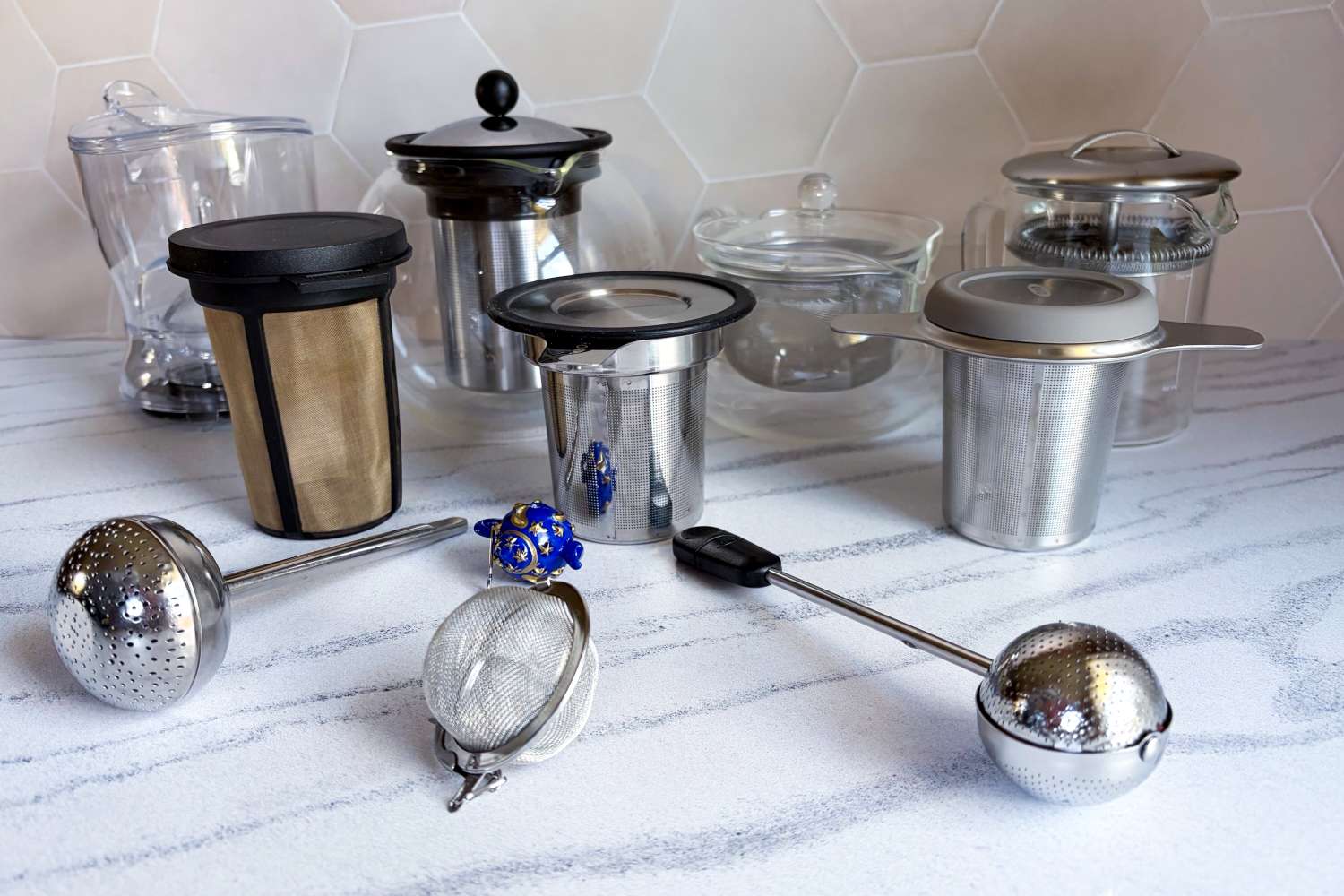
Image source: Serious Eats
Fine Mesh Baskets for Maximum Leaf Expansion
Fine mesh baskets are widely considered one of the best options for all-around brewing. These baskets, often made from laser-cut stainless steel, feature thousands of microscopic holes that are small enough to catch even the finest Rooibos needles while allowing water to flow freely. Brands like OXO and Whittard of Chelsea have popularized this design because it typically includes a lid. This lid serves a dual purpose: it traps heat during the steep and acts as a drip tray once the brewing is finished.
Traditional Tea Balls and Why They Might Limit Flavor
The classic tea ball—a hinged mesh sphere on a chain—is perhaps the most recognizable tea tool. While they are affordable and widely available, they often present a "cramping" problem. Because the sphere is relatively small, whole-leaf teas cannot fully unfurl, leading to an uneven extraction. However, for broken-leaf black teas or CTC (Crush, Tear, Curl) varieties, a tea ball is a perfectly functional and highly portable choice.
Novelty Silicone Infusers for Style and Gifting
Silicone infusers, such as those from Genuine Fred , have become a significant advancement in the gifting market. These products often take the shape of animals (like the famous "Manatea") or whimsical objects. While they add a sense of fun to the ritual, they often feature larger holes than mesh baskets, which may allow small leaf particles to escape into the cup. They are a top-tier choice for gifting but may not satisfy the "purist" looking for a perfectly sediment-free brew.
Which Materials Are Safest and Most Durable for Your Tea?
The material of your strainer does more than just hold the leaves; it interacts with the chemistry of the water and the tea itself. Durability, heat retention, and flavor neutrality are the three pillars of material selection.
Why 304 Food-Grade Stainless Steel Is the Gold Standard
When it comes to longevity and hygiene, 304 food-grade stainless steel stands out as a top choice. This material is non-reactive, meaning it won't leach a metallic taste into your delicate White or Green teas. It is also exceptionally strong, resisting the rust and corrosion that can occur with frequent exposure to boiling water and acidic tannins. Most "apothecary-grade" strainers utilize this steel because it can be cleaned aggressively without losing its finish.
Are Silicone Tea Infusers Safe to Use in Boiling Water?
High-quality silicone infusers are made from BPA-free, food-grade silicone that is rated for temperatures well above the boiling point of water (212°F). They are flexible, dishwasher safe, and won't break if dropped. However, users should ensure they are buying from reputable brands to avoid "filler" plastics that might off-gas or leach chemicals at high temperatures. If a silicone tool turns white when twisted, it likely contains fillers and should be avoided.
The Aesthetic Appeal of Sterling Silver and Porcelain
For those who enjoy the "High Tea" aesthetic, sterling silver and porcelain strainers offer a classic experience. Silver is naturally antimicrobial, though it requires regular polishing to prevent tarnish from tea oils. Porcelain strainers, often built into the spouts of traditional teapots, provide a completely inert surface but are fragile and can be difficult to clean if the holes become clogged with fine particles.
How to Clean a Clogged Tea Strainer When Baking Soda Fails
One of the most common pitfalls for long-term tea drinkers is the "permanent clog." Over time, tea polyphenols and essential oils create a sticky film that traps fine particles in the mesh, eventually restricting water flow entirely. While a simple rinse is enough for daily use, a deep clean is necessary once a month.
Place your metal strainer in a heat-proof bowl. Add one tablespoon of sodium percarbonate (like Oxyclean Free) and cover with boiling water. The resulting fizzing action physically lifts organic oils from the mesh weave.
After soaking for 15 minutes, use a soft toothbrush to gently scrub both sides of the mesh. This removes the softened tannins that the chemical soak loosened.
If light still doesn't pass through the holes, use a water flosser on its highest setting. The concentrated stream of water can blast out microscopic particles that brushes cannot reach. This is a highly impactful tip for ultra-fine mesh.
Using Oxygen-Based Bleach to Lift Stubborn Tannins
Sodium percarbonate is a significant step forward in teaware maintenance. Unlike chlorine bleach, which can pit stainless steel and leave a lingering odor, oxygen bleach breaks down into water, oxygen, and soda ash. It is highly effective at breaking the molecular bonds of tea stains without damaging the integrity of the metal. Many enthusiasts on forums like TeaForum.org swear by this method for restoring vintage silver strainers as well.
Why Barkeeper’s Friend Ranks Among the Top Polishes for Metal Strainers
If your stainless steel strainer has developed a "rainbow" sheen or a dull, cloudy appearance, Barkeeper’s Friend (which contains oxalic acid) is a top-performing solution. It removes mineral scale from hard water and restores the original luster of the steel. Simply apply a small amount of the powder, rub with a damp cloth, and rinse thoroughly. This ensures your equipment looks as good as the tea tastes.
Does Using a Metal Strainer Actually Change the Taste of Your Tea?
There is a long-standing debate in the tea community regarding "metal-on-tea" contact. Some purists argue that metal can "bruise" the flavor of delicate teas, while others maintain that high-quality steel is completely inert.
Some believe that pouring hot tea through a metal mesh causes unwanted aeration, which can flatten the subtle top notes of a high-grade Gyokuro or Silver Needle white tea. They prefer glass or ceramic filtration to keep the flavor profile "pure."
For teas like Shou Pu-erh or finely broken breakfast blends, a metal strainer is essential. It prevents "tactile issues" caused by sediment and ensures the liquor is smooth. Without a fine filter, the last few sips of the cup can become overly bitter and gritty.
How to Match Your Strainer to Your Favorite Tea Variety
Not all strainers are created equal, and matching the tool to the leaf is the secret to a perfect steep. The size of the holes (measured in microns) and the volume of the basket should be chosen based on the tea's morphology.
The Best Filters for Fine Rooibos and Herbal Blends
Rooibos is notorious for its needle-like leaves that can slip through standard tea balls. For these varieties, you need an "ultra-fine" mesh basket. These baskets have a weave so tight that they resemble a solid sheet of metal with pinpricks. This ensures a clean cup without the "muddy" bottom often found with coarser filters.
Why Large Oolong Leaves Need Room to Unfurl
As mentioned previously, Oolongs are the "space hogs" of the tea world. If you use a small infuser for a high-quality Tie Guan Yin, the leaves will expand into a solid mass, preventing water from reaching the center. For these teas, a large rim-resting strainer used with a wide-mouthed teapot is a much better choice. This allows the leaves to dance and release their full spectrum of floral and creamy notes.
Frequently Asked Questions
Key Takeaways for a Perfect Steep
- Choose 304 Stainless Steel for a durable, rust-resistant, and flavor-neutral experience.
- Prioritize Basket Infusers over tea balls to give your leaves the space they need to fully unfurl.
- Match Mesh Fineness to your tea; use ultra-fine mesh for Rooibos and wider mesh for whole-leaf Oolongs.
- Use a Lid during the steeping process to maintain the correct temperature and trap aromatic oils.
- Deep Clean Monthly using oxygen-based bleach to remove stubborn tannin build-up and restore flow.
- Consider a Passive Strainer for traditional teapot service to achieve the highest possible flavor extraction.
To start improving your daily ritual, try the oxygen soak method on your current strainer to see how much flavor you've been missing due to clogged mesh.