Home
What Is the Difference Between Champagne and Prosecco and Which Should You Buy?
The primary difference between Champagne and Prosecco lies in their origin and production method. Champagne hails from the Champagne region of France and is made using the "Traditional Method," where a second fermentation occurs inside each individual bottle. This creates complex, toasty notes and fine, persistent bubbles. Prosecco comes from Northern Italy and typically uses the "Tank Method" (Charmat), where fermentation happens in large stainless steel vats. This preserves the fresh, floral, and fruity characteristics of the Glera grape, resulting in a lighter, frothier sparkling wine that is generally more affordable.
A Quick Comparison of Champagne and Prosecco
When standing in the wine aisle, the visual differences between these two sparkling giants are subtle, but the technical specifications reveal two distinct worlds of viticulture. According to data from WSJ Wine , the atmospheric pressure alone sets them apart, influencing everything from the sound of the cork pop to the way the bubbles feel on your tongue.
| Feature | Champagne | Prosecco |
|---|---|---|
| Origin | Champagne, France | Veneto & Friuli, Italy |
| Primary Grapes | Chardonnay, Pinot Noir, Pinot Meunier | Glera (minimum 85%) |
| Production Method | Traditional Method (Bottle) | Tank Method (Charmat/Martinotti) |
| Pressure (Bars) | 5–7 Bars | 2–4 Bars |
| Typical ABV | 12% – 12.5% | 10.5% – 11% |
| Aging Requirement | Minimum 15 Months | None (usually bottled fresh) |
| Price Range | $40 – $500+ | $12 – $40 |
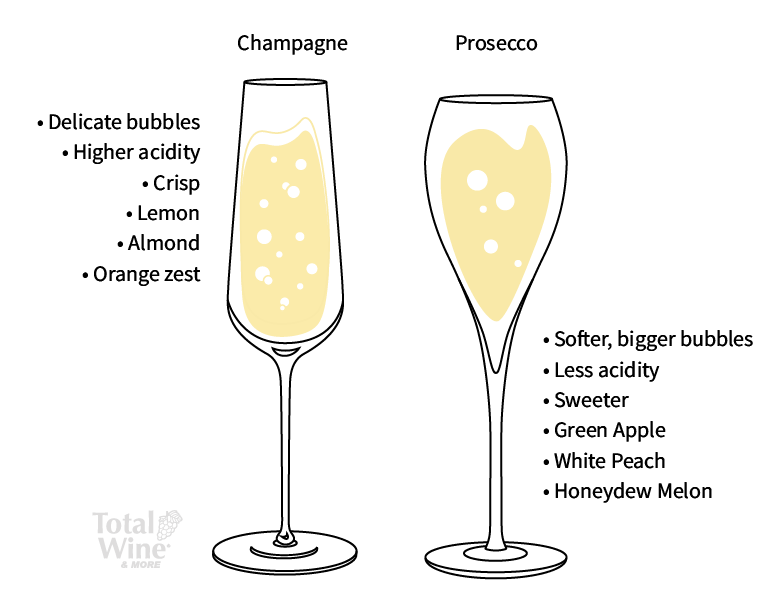
Image source: Total Wine
How Geography and Terroir Define the Character of the Wine
The concept of terroir —the environmental factors that affect a crop's phenotype—is central to understanding why these wines cannot be replicated elsewhere. Both regions enjoy protected status, meaning a sparkling wine made in California or Australia cannot legally be labeled as "Champagne" or "Prosecco" in most international markets.
The Chalky Soils and Cool Climate of Champagne France
Champagne is one of the northernmost wine-producing regions in the world. The climate is cool and often harsh, which forces the grapes to retain high levels of acidity—a crucial component for high-quality sparkling wine. The defining feature of this region, however, is the soil. Millions of years ago, this area was an inland sea, leaving behind thick deposits of limestone and chalk. These porous soils provide excellent drainage while reflecting sunlight back up to the vines, helping the grapes ripen in a marginal climate. This mineral-rich environment contributes to the "flinty" or "stony" notes often found in premium bottles.
The Sun-Drenched Hills of Prosecco in Northern Italy
Prosecco is produced in the lush, rolling hills of the Veneto and Friuli-Venezia Giulia regions. The climate here is warmer and more temperate than in Champagne, though the best vineyards are located on steep, high-altitude slopes that benefit from cooling breezes. The soil varies from clay and marl to sandstone, which encourages the Glera grape to develop its signature aromatic profile. The sub-region of Conegliano Valdobbiadene is widely regarded as a top-tier area, producing wines with greater structure and elegance due to the dramatic elevation and ancient soils of the UNESCO World Heritage hills.
Understanding the Science of the Bubbles and Production Methods
The way the bubbles are created is the most significant technical difference between the two styles. This process, known as secondary fermentation, is where the carbon dioxide is trapped within the liquid.
Why the Traditional Method Makes Champagne More Complex
In the Méthode Traditionnelle , the wine undergoes its second fermentation inside the very bottle that will eventually be sold to the consumer. A mixture of sugar and yeast (liqueur de tirage) is added to the base wine, and the bottle is sealed. As the yeast consumes the sugar, it releases CO2, which dissolves into the wine.
Crucially, the wine then sits on the "lees" (dead yeast cells) for a minimum of 15 months. During a process called autolysis , these yeast cells break down, releasing compounds that impart flavors of brioche, toast, and roasted nuts. This method is labor-intensive, requiring "riddling" (turning the bottles to move sediment to the neck) and "disgorgement" (removing the sediment), which explains the higher price point.
How the Tank Method Preserves the Freshness of Prosecco
Most Prosecco is made using the Charmat-Martinotti method . Instead of individual bottles, the secondary fermentation takes place in large, pressurized stainless steel tanks (autoclaves). This process is significantly faster, often taking only 30 to 80 days. Because the wine has less contact with yeast, the primary fruit and floral aromas of the Glera grape are preserved. This method is highly efficient and allows producers to maintain a consistent, fresh style that highlights notes of green apple, pear, and honeysuckle. According to We Drink Bubbles , this method is what gives Prosecco its characteristic "frothy" mouthfeel.
The Rare Exception of Metodo Classico Prosecco
While the tank method is the standard, a small number of artisanal producers in Italy are blurring the lines by producing Prosecco Superiore DOCG Metodo Classico . These rare bottles undergo secondary fermentation in the bottle, just like Champagne. This results in a wine that combines the aromatic, floral nature of the Glera grape with the creamy, yeasty complexity typically associated with French sparklers. While these bottles represent a tiny fraction of the market, they are a significant advancement for enthusiasts seeking the "best of both worlds."
Comparing the Technical Specs and Mouthfeel
The sensory experience of drinking sparkling wine is heavily influenced by physics and chemistry. The size of the bubbles and the alcohol content change how the wine interacts with your palate.
Atmospheric Pressure and the Persistence of Bubbles
Champagne is a high-pressure environment. It typically sits at 5 to 7 atmospheres (roughly 75 to 90 psi). This high pressure creates tiny, needle-like bubbles that are incredibly persistent, continuing to rise in the glass long after the wine is poured. This contributes to a "creamy" texture. Prosecco, by contrast, is often bottled at lower pressures of 2 to 4 atmospheres . The bubbles are larger, softer, and tend to dissipate more quickly, creating a refreshing, spritzy sensation rather than a dense mousse.
Alcohol Content and Calorie Differences
Champagne generally has a higher alcohol by volume (ABV), typically ranging from 12% to 12.5% . Prosecco is lighter, usually hovering between 10.5% and 11% . In terms of calories, a standard 5-ounce pour of Brut Champagne contains about 95 calories, while a Dry Prosecco may contain slightly more due to the "dosage" (added sugar). However, because Prosecco is often naturally fruitier, it can taste sweeter even if the sugar content is identical to a bottle of Champagne.
What Does Each Wine Actually Taste Like?
If you were to taste these side-by-side in a blind tasting, the flavor profiles would be remarkably distinct.
Champagne Profile
- Primary Notes: Citrus, white peach, cherry.
- Secondary Notes: Brioche, almond, toast, cream.
- Mouthfeel: Fine, persistent bubbles; high acidity; mineral finish.
Prosecco Profile
- Primary Notes: Green apple, honeydew melon, pear.
- Secondary Notes: Honeysuckle, lily, white flowers.
- Mouthfeel: Larger, frothy bubbles; light and airy; soft finish.
Recent Regulatory Changes and New Grape Varieties
The world of sparkling wine is not static. Climate change and shifting consumer tastes have led to major updates in how these wines are produced as of 2026.
The Introduction of the Voltis Grape in Champagne
In 2021, the Champagne region took a notably innovative step by approving a new grape variety called Voltis . This is a fungus-resistant hybrid (PiWi) designed to help growers reduce the use of pesticides and adapt to a warming climate. While traditionalists were initially skeptical, Voltis is now permitted to make up to 10% of a final blend. While you won't see "Voltis" on a label, its inclusion marks a significant step forward in the region's sustainability efforts.
The New Rules for Prosecco Rosé
Until 2020, "Prosecco Rosé" did not officially exist under Italian law. Any pink sparkling wine from the region had to be labeled simply as "Spumante Rosato." New regulations now allow for the Prosecco Rosé DOC designation, provided the wine is made from at least 85% Glera and 10–15% Pinot Noir . The Pinot Noir must be vinified as a red wine to give the sparkler its characteristic pale pink hue and subtle notes of strawberry and raspberry. This change has been a major improvement for the region's global exports.
When Should You Choose Champagne vs Prosecco?
Choosing between the two often comes down to the occasion, your budget, and what you plan to eat.
Which Sparkling Wine Is Better for Mimosas?
For a brunch cocktail, Prosecco is widely considered a top choice . There are two reasons for this:
- Flavor Harmony: Prosecco’s fruity, floral profile complements orange juice seamlessly. The yeasty, bready notes of Champagne can sometimes clash with the acidity of the citrus.
- Value: Since the nuances of a high-end wine are lost when mixed with juice, it is more practical to use a $15 bottle of Prosecco than a $50 bottle of Champagne.
A Top Choice for Weddings and Major Celebrations
Champagne remains the gold standard for prestige. If you are celebrating a milestone anniversary, a promotion, or a formal wedding toast, the complexity and history of Champagne offer a sense of occasion that few other wines can match. However, if you are hosting a large party where the wine will be flowing freely, Prosecco offers a crowd-pleasing style that is easier on the wallet without sacrificing quality.
Longevity and How to Store Your Bottles
Storage needs differ significantly between the two. Prosecco is designed to be consumed young—ideally within one to two years of its vintage. It does not improve with age and will eventually lose its fresh fruit flavors. Champagne, thanks to its high acidity and time spent on the lees, can be cellared for much longer. Non-vintage Champagne can last 3–5 years, while vintage bottles can age gracefully for decades, developing deep flavors of honey, dried fruits, and toasted hazelnuts.
Frequently Asked Questions
Is Prosecco just a cheaper version of Champagne?
No, they are fundamentally different products. While Prosecco is generally less expensive due to the efficient tank method of production, high-end Prosecco Superiore can be more complex and expensive than entry-level Champagne. They should be viewed as two different styles of wine rather than one being a "knock-off" of the other.
Why does Champagne sometimes cause a worse headache?
This is often attributed to two factors: alcohol content and sugar. Champagne typically has a higher ABV (12%+) compared to Prosecco (10.5%). Additionally, the carbonation in sparkling wine causes alcohol to be absorbed into the bloodstream faster. If you are sensitive, look for "Brut Nature" or "Extra Brut" labels, which have the lowest sugar content.
What is the best glass for serving these wines?
For Champagne, a Tulip glass is highly recommended. The wider bowl allows the complex aromas to develop, while the tapered top traps them for the nose. For Prosecco, a standard Flute or a diamond-shaped glass works well to showcase the lively bubbles and fresh floral scents.
Can American sparkling wine be called Champagne?
Generally, no. Under international trade agreements, the name "Champagne" is reserved exclusively for wines produced in the Champagne region of France. However, a few older American brands (like Korbel or Cook's) are "grandfathered" in and can use the term "California Champagne" on their labels, though they cannot export these bottles to Europe.
Is Cava the same as Prosecco?
No. Cava is a Spanish sparkling wine that is actually more similar to Champagne in its production. It is made using the Traditional Method (bottle fermentation) but uses indigenous Spanish grapes like Macabeo, Xarel-lo, and Parellada. It offers a middle ground: the complexity of Champagne at a price point closer to Prosecco.
The Bottom Line on Choosing the Right Sparkler
Understanding the difference between Champagne and Prosecco allows you to tailor your wine choice to the specific needs of your event and palate. Whether you prefer the yeasty complexity of a French classic or the bright, floral charm of an Italian favorite, both offer exceptional quality in their respective categories.
- Choose Champagne for milestones, formal toasts, and those who enjoy flavors of toast, brioche, and minerals.
- Choose Prosecco for casual brunches, mimosas, and those who prefer light, fruity, and floral palates.
- Check the pressure: Champagne offers fine, persistent beads (6 bars), while Prosecco provides a frothier, softer bubble (2-4 bars).
- Mind the grapes: Champagne relies on Chardonnay and Pinot varieties; Prosecco is defined by the aromatic Glera grape.
- Watch the age: Drink Prosecco fresh (within 2 years); feel free to cellar high-quality Champagne for several years.
- Consider the "Metodo Classico": Look for this label on Prosecco if you want a hybrid style with bottle-fermented complexity.
Next time you shop, try a bottle of each to experience how the soil of France and the hills of Italy create two entirely different sparkling sensations.